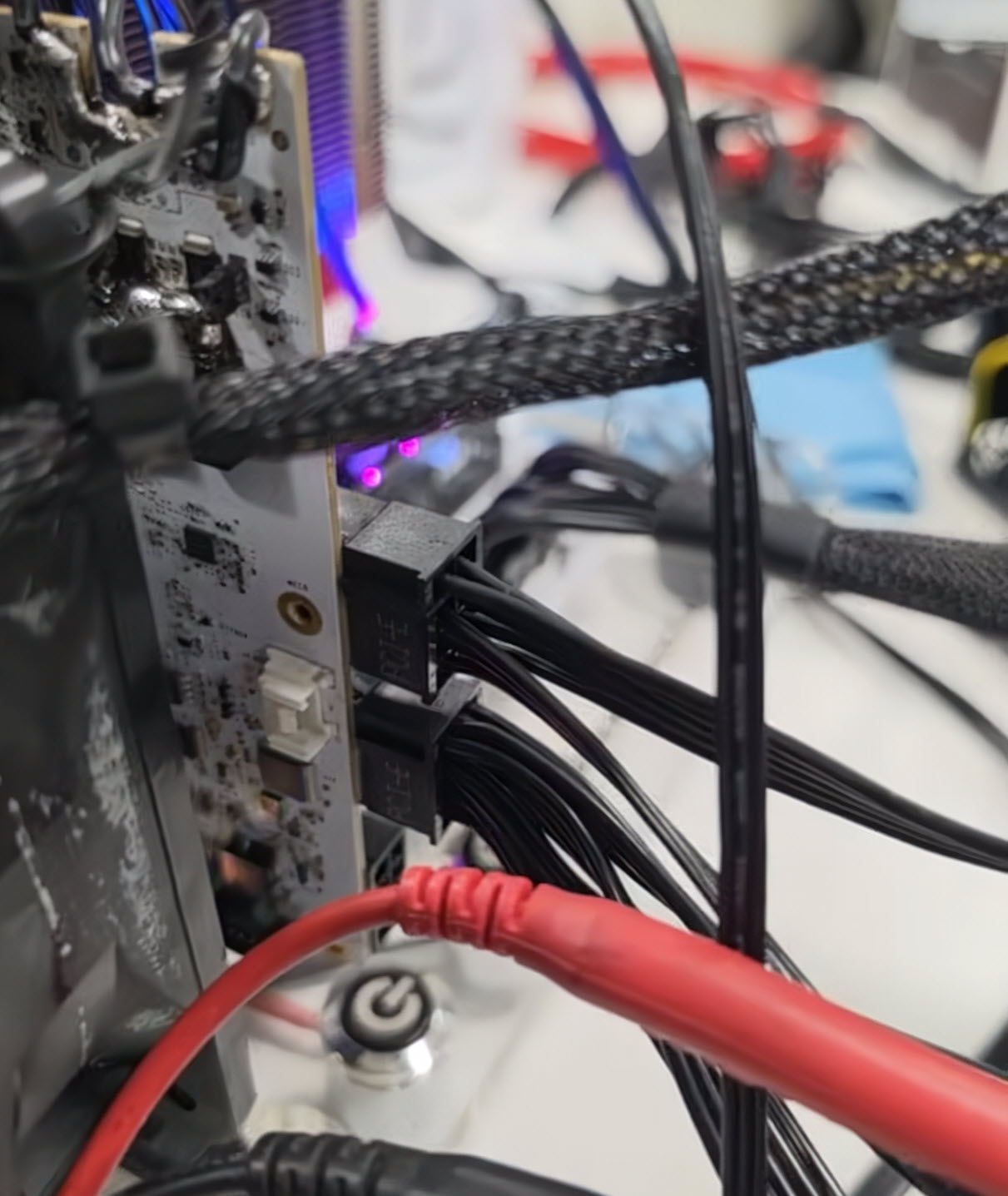
In a remarkable feat of hardware modification, the YouTube channel Teclab has successfully created the world’s first RTX 5090 graphics card to utilize a 3×8-pin power configuration. This groundbreaking mod addresses the high power demands of flagship GPUs by rethinking the standard power delivery system.
From 16-Pin to 3×8-Pin Power
The original GALAX HOF OC LAB custom RTX 5090 card featured two 16-pin power connectors. The Teclab team meticulously removed the stock connectors and their associated power delivery design, replacing them with three standard 8-pin PCIe power inputs. To manage the increased complexity and ensure robust power delivery, they reinforced the back of the graphics card’s PCB with a copper plate. This modification involved routing 24 heavy-gauge wires, which were then connected to the front-side power delivery area of the PCB.
The resulting setup provides nine individual +12V power lines, with each line rated to handle 8 to 8.5 amps of current. A crucial aspect of the modification was the adjustment of the Sense 0 and Sense 1 pins. By reconfiguring these pins, Teclab ensured the graphics card correctly recognized the new power configuration, allowing it to operate at its maximum available power capacity without needing any BIOS or software alterations. All adjustments were performed purely at the hardware level.
Performance and Thermal Testing
Teclab subjected the modified RTX 5090 to a series of rigorous tests, progressively increasing the input power from 400W up to 900W. During these tests, they closely monitored the card’s temperature and voltage levels. Under the 3×8-pin configuration, the RTX 5090 reached peak currents exceeding 60A and a core frequency of 3400MHz.
Even when pushed to extreme levels, with currents surpassing 120A and a core clock of approximately 3400MHz, the card maintained stable operation for over an hour. Remarkably, the temperature of the cables during these demanding conditions remained just slightly above 35°C. This indicates a significant improvement in thermal management compared to what might be expected from such high power draw through a modified setup.
Further Stress Tests
In further experiments, the team removed the third 8-pin connector, leaving only two. Even with this reduced power input, the graphics card continued to operate at over 66A with a core frequency exceeding 3200MHz. In this scenario, the thermal readings from an infrared thermometer showed cable temperatures below 25°C.
When the card was further stressed by using only a single 8-pin connector, it managed to sustain a current of 65A, with frequencies hovering between 3.1GHz and 3.2GHz. Under this ultimate stress test, the temperature of the single connector reached approximately 45°C, and the cable’s highest temperature was recorded at around 65°C. These results demonstrate the effectiveness of the custom power delivery solution and the thermal efficiency achieved through the extensive modifications.
This modification by Teclab not only showcases technical ingenuity but also provides valuable insights into the power delivery capabilities and thermal characteristics of next-generation GPUs like the RTX 5090. The ability to achieve such low cable temperatures under significant load highlights the potential for optimized power solutions in high-performance computing.