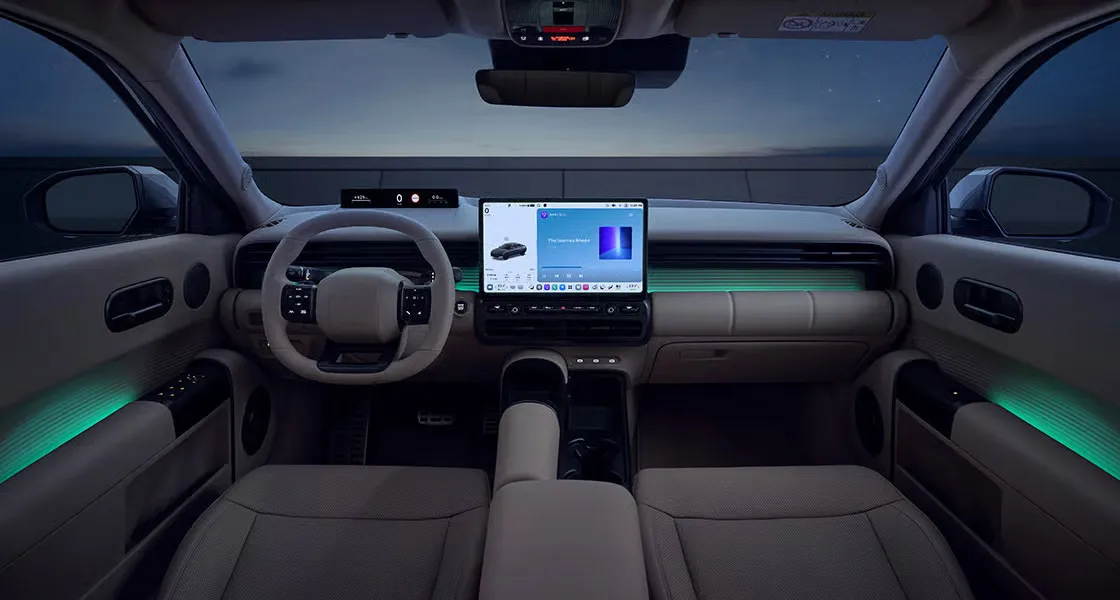
Hyundai is ushering in a new era of interior design, prioritizing large central displays and streamlining the driver’s immediate surroundings. This shift, already seen in models like the Grandeur in the Korean market, is now extending to upcoming vehicles such as the IONIQ 3, the new Elantra, and the Tucson.
The Rise of the Central Display
At the heart of these revamped cabins is the ‘ccNC’ (connected car Navigation Cockpit) infotainment system, featuring a prominent central screen. The user interface and operational logic draw inspiration from Tesla’s approach, offering a minimalist and screen-centric experience. However, Hyundai is making a cost-saving move by omitting the traditional driver’s instrument cluster on lower trim levels of these new models.
Elantra and IONIQ 3 Lead the Charge
The recently launched 2027 model year Elantra in Korea and the globally anticipated IONIQ 3 will be among the first to debut without a digital dashboard directly in front of the driver. Previously, this digital display was a standard feature in most of Hyundai’s current vehicle lineup.
For the Elantra, Korean consumers have the option to add a slim, 9.9-inch digital instrument panel for an additional 350,000 Korean Won (approximately $250 USD). The situation for the IONIQ 3’s entry-level variants appears more restrictive, with no apparent option for a digital dashboard. Drivers of these base models will need to rely solely on the central touchscreen for all driving information. Notably, this configuration also lacks a head-up display, mirroring the approach taken by Tesla in its Model 3 and Model Y vehicles.
Cost Savings and Consumer Demand Drive the Change
Automakers have long sought ways to reduce costs, and replacing physical instrument clusters with large screens is a well-established strategy. A single glass panel and the associated software are significantly cheaper to produce than a traditional dashboard with its gauges, bezels, wiring harnesses, and physical controls. This cost advantage helps explain the relatively smooth industry-wide transition to this new design philosophy.
However, cost isn’t the sole driver. Consumer preferences have also played a crucial role. The demand for tablet-like interfaces, intuitive app menus, and over-the-air (OTA) update capabilities has grown significantly. Hyundai’s new ccNC system is designed to meet these evolving expectations, offering a more connected and technologically advanced user experience that aligns with modern digital lifestyles.
This strategic shift by Hyundai signals a broader trend in the automotive industry, where the focus is increasingly on integrated digital ecosystems within vehicles, potentially redefining the driver’s relationship with their car.