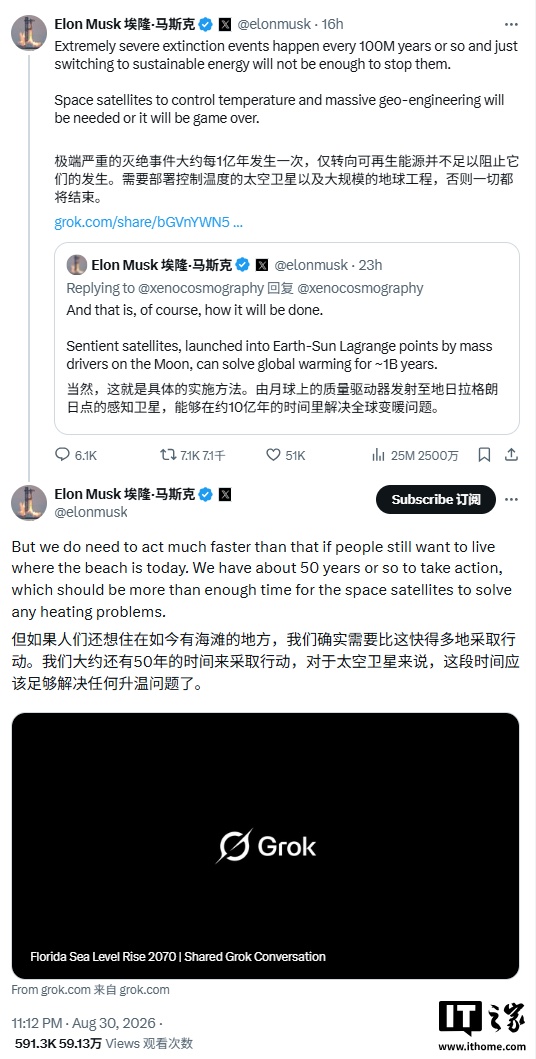
Elon Musk has unveiled an ambitious plan aimed at ensuring Earth remains habitable for approximately one billion years, with self-thinking satellites forming the core of this long-term vision. Musk expressed his concerns on the X platform, stating that transitioning solely to solar and wind energy is insufficient to protect humanity from what he terms “extremely severe extinction events,” which occur roughly every 100 million years.
AI-Powered Satellites as a Climate Solution
Musk’s proposed solution involves deploying “sentient satellites” – AI-controlled satellites powered by solar energy. These satellites would be strategically positioned in a stable orbit between the Earth and the Sun. In a departure from conventional rocket launches, Musk envisions using a colossal electromagnetic catapult situated on the Moon’s surface to launch these satellites into space. The onboard AI would autonomously manage the satellites, making minor adjustments to their orbits and positions without requiring human commands.
Lunar Mass Drivers and Cost-Effective Space Launches
Musk highlighted the potential of electromagnetic mass drivers to significantly reduce the cost of sending materials into space for satellite construction. He proposes establishing a mass driver track on the Moon. The Moon’s lower gravity and lack of atmosphere make it considerably easier and more cost-effective to eject payloads into space compared to launching from Earth.
Urgency for Climate Action
Illustrating the urgency of climate change, Musk shared projections generated by Grok. These estimates indicate that under a high sea-level rise scenario, approximately 5% of Florida’s landmass, equating to about 1.68 million acres, could face recurrent flooding by 2070. Musk emphasized that humanity has a limited window of about 50 years to take decisive action, warning that coastal living will be drastically different from what it is today if measures are not implemented.
A Recurring Vision for Planetary Stability
This is not the first time Musk has articulated such a concept. In November of the previous year, he proposed a similar idea involving a constellation of AI-powered, solar-driven satellites designed to subtly regulate Earth’s temperature by making minute adjustments to the sunlight reaching the planet. This suggests a persistent focus on leveraging advanced technology for long-term environmental management.
SpaceX’s Mars Colony as an Existential Hedge
Musk often links Earth’s potential risks to SpaceX’s broader mission. His proposed compensation package is intrinsically tied to the establishment of a self-sustaining Mars colony. Musk has previously described this Martian settlement as a form of “insurance” against extinction-level events, akin to those he mentioned in his recent post. He has also indicated a timeline for human missions to Mars, suggesting they could occur within the next five to seven years, further underscoring his multi-planetary aspirations as a safeguard for humanity’s future.