Researchers at Xiamen University have made a significant stride in the development of lead-free perovskite light-emitting diodes (LEDs), achieving an impressive operational lifespan exceeding 900 hours for tin-based devices. This breakthrough, a collaboration with Fudan University, addresses a key mechanism behind LED degradation and paves the way for wider applications of this promising technology.
Unraveling the Degradation Mystery
Published on August 27th in the prestigious international journal Science, the research pinpoints electrochemical oxidation of tin-based perovskite CsSnI₃ under electrical stress as the primary culprit for LED performance decay. The team, led by Professor Rongjun Xie from Xiamen University’s School of Materials and Professor Lixin Wang from Fudan University, meticulously analyzed structural changes, tin ion valence states, and the light-emitting decay process within the perovskite films.
Their findings reveal that an imbalance of carrier injection, coupled with the material’s inherent conductivity, leads to irreversible oxidation of divalent tin ions. This oxidation process alters the crystal structure and degrades the luminescent properties, causing a sharp decline in the device’s light-emitting efficiency.
A Synergistic Strategy for Stability and Performance
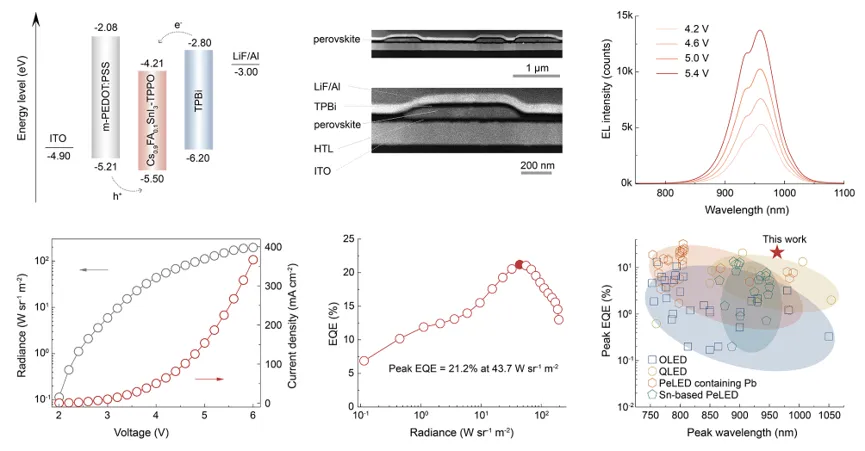
To overcome this critical challenge, the research team implemented a novel synergistic strategy combining lattice doping and surface passivation. This dual approach effectively stabilizes the perovskite crystal structure, enhances charge carrier transport, and suppresses non-radiative recombination – a common pathway for energy loss in LEDs.
The result is the successful fabrication of near-infrared tin-based perovskite LEDs that not only boast high efficiency but also remarkable stability. The devices achieved a peak external quantum efficiency (EQE) exceeding 20%, with the specific figure reported as 21.2%. Crucially, under an initial radiance of 7.1 W·sr⁻¹·m⁻², the LEDs maintained their performance for over 900 hours (T50 > 900 hours), marking a substantial leap in operational lifespan.
The Promise of Tin-Based Perovskites
Tin-based perovskite LEDs offer several compelling advantages over their lead-based counterparts and traditional quantum dot LEDs. Their low toxicity, solution processability, and potential for low-cost manufacturing make them highly attractive for a range of cutting-edge applications. These include:
- Optical communications
- Night vision imaging
- Data storage
- Biomedical sensing
However, historical challenges such as the susceptibility of divalent tin ions to oxidation and difficulties in controlling the crystallization process have hampered their widespread adoption. This latest research directly tackles these limitations, bringing tin-based perovskites closer to commercial viability.
Future Outlook
The achievement by the Xiamen University and Fudan University teams represents a significant milestone in the quest for efficient and stable perovskite optoelectronic devices. By elucidating the fundamental degradation mechanisms and developing an effective counter-strategy, they have unlocked new potential for tin-based perovskites. This advancement is expected to accelerate research and development in fields requiring high-performance, low-toxicity light-emitting technologies.