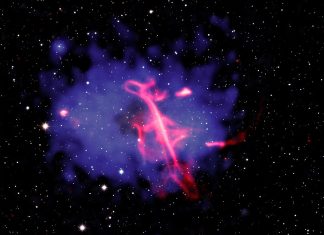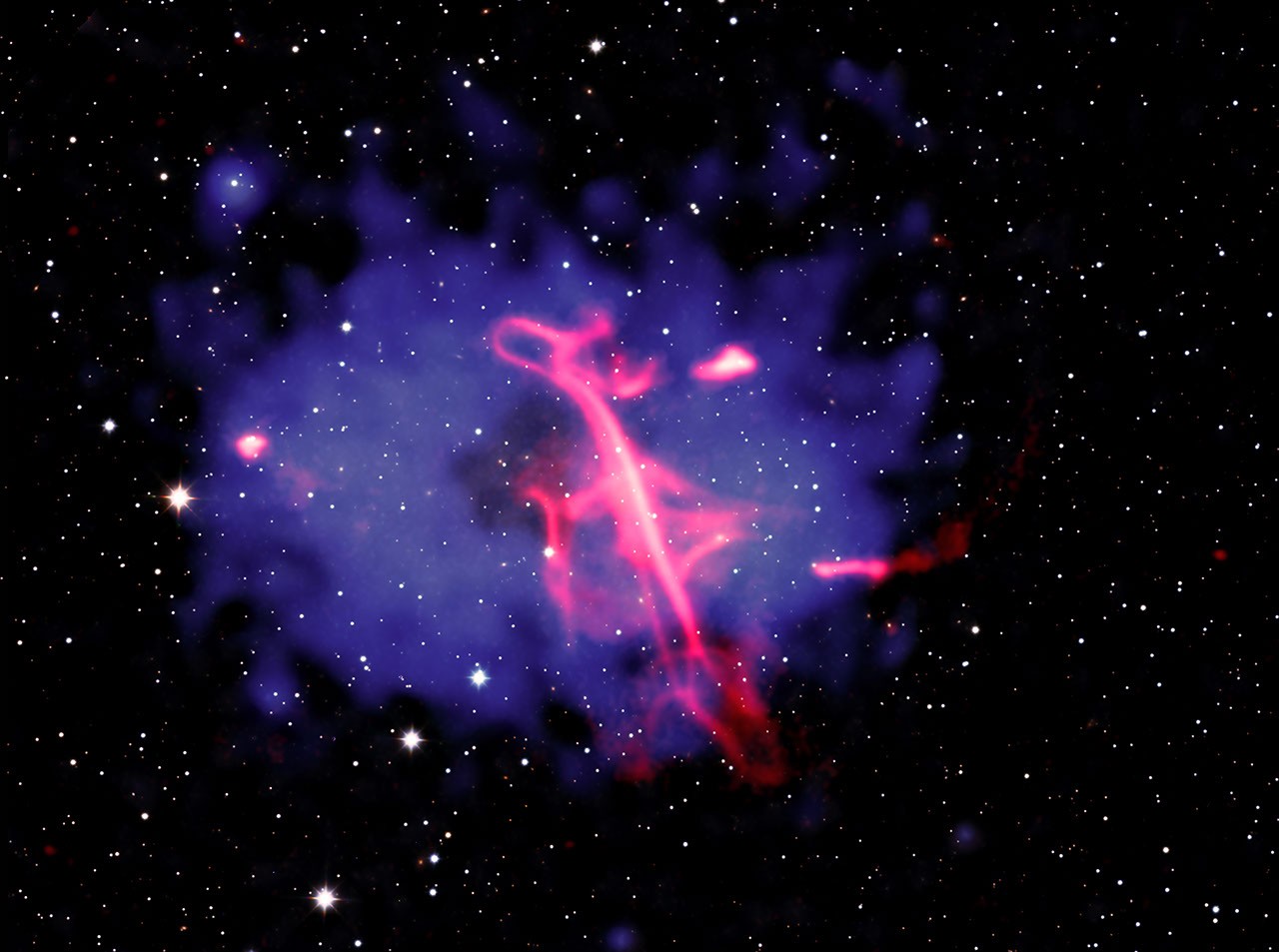
Astronomers have used NASA’s Chandra X-ray Observatory to decipher the origins of a striking radio wave structure, playfully dubbed the ‘Treble Clef’ due to its resemblance to the musical symbol. This cosmic phenomenon, hidden behind our own Milky Way galaxy, is the result of a powerful outburst from a supermassive black hole interacting with the immense collision of two vast galaxy clusters.
A Symphony of Cosmic Forces
The ‘Treble Clef’ formation, nestled within a galaxy cluster, presented a significant challenge to scientists. Its location, directly behind the dense plane of our Milky Way, obscured direct observation. However, by employing instruments capable of piercing through this cosmic veil, researchers have pieced together its dramatic story. NASA’s Chandra X-ray Observatory, alongside the German eROSITA X-ray telescope, detected hot, diffuse gas indicative of a galaxy cluster. Further analysis revealed that this wasn’t just one cluster, but two, in the midst of a colossal merger. These behemoths of the universe, teeming with hundreds of galaxies and scorching gas, provided the perfect stage for this celestial performance.
The stunning composite image captures the interplay of different cosmic phenomena: the million-degree gas seen in X-rays (blue) by Chandra and eROSITA, the vibrant radio waves (red) from the LOFAR radio telescope network forming the ‘Treble Clef,’ and infrared data (white) from the United Kingdom Infrared Telescope. This multi-wavelength approach was crucial in understanding the two-stage process behind the ‘Treble Clef.’
From Black Hole’s Roar to Collision’s Echo
Scientists believe the ‘Treble Clef’ was sculpted by a two-part cosmic event. Initially, a supermassive black hole at the heart of a galaxy within the cluster unleashed a powerful outburst, expelling clouds of charged particles and magnetic fields at near light speed. This event, a kind of cosmic crescendo, generated bright radio waves that gradually faded as the particles lost energy. The subsequent collision between the two massive galaxy clusters acted as a cosmic conductor, compressing and re-energizing these lingering particle clouds. Shock waves, akin to sonic booms from supersonic aircraft, likely played a key role in this re-energization, causing the ‘Treble Clef’ to glow brightly once more in radio waves.
To further evidence the cluster collision, researchers analyzed the X-ray data for asymmetries in the hot gas. By digitally removing the symmetrical oval shape of the gas, they revealed brighter X-ray emissions on the left and right sides of the cluster’s center. This residual emission points to a collision that likely occurred along the left-right axis depicted in the image, with the two clusters now moving apart after their monumental encounter.
Source: NASA