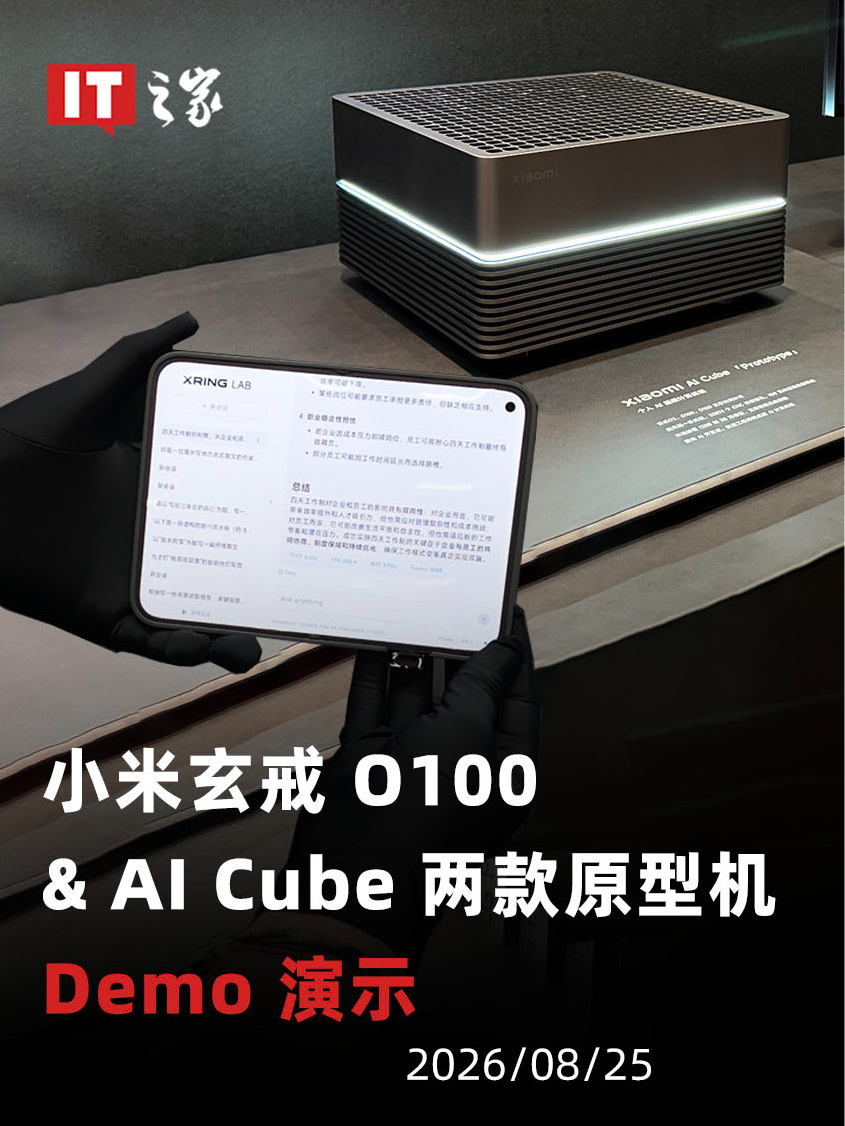
Xiaomi recently held a chip technology communication conference, showcasing not only its new Xuanjie chips but also two innovative prototype devices: the Xuanjie O100 and the AI Cube Prototype mini-host. These devices highlight Xiaomi’s advancements in self-developed chips and on-device AI processing.
Xuanjie O100 Prototype: Powering On-Device AI
The Xuanjie O100, presented as a high-speed AI demonstration terminal designed for large on-device models, represents a significant leap in mobile AI capabilities. According to Lu Weibing, a Xiaomi Group Partner and President of the Mobile Phone Department, this prototype utilizes a dual-chip synergy of Xuanjie O3 and O100 for accelerated computation. To accommodate this advanced processing, traditional smartphone camera modules were removed, and the motherboard was completely redesigned.
A key feature of the Xuanjie O100 is its active air-cooling system, capable of dissipating up to 10 watts of power. This advanced cooling is essential for sustained high performance during intensive AI tasks. Furthermore, the prototype is equipped with the built-in Xiaomi MiMo on-device model, achieving an impressive inference speed of 295 Tokens per second, demonstrating remarkable efficiency for local AI processing.
Xiaomi AI Cube Prototype: A Personal AI Supercomputing Terminal
Alongside the Xuanjie O100, Xiaomi also revealed the Xiaomi AI Cube “Prototype” mini-host. This compact device boasts an integrated aircraft-grade aluminum body, meticulously crafted with 33,874 precision CNC hollowed-out cooling holes to ensure optimal thermal management. The AI Cube is designed to sustain a high-performance output of 150 watts.
Internally, the AI Cube Prototype integrates the Xuanjie O3, O100, and D100 chips, creating a powerful, unified computing architecture. It features a substantial 80GB of unified memory, capable of running both large parameter models (120 billion) and smaller on-device models (3 billion). The system supports quick and slow mode switching, making it versatile for a wide range of applications, from front-end development to complex programming tasks. This makes the AI Cube a personal AI supercomputing terminal, capable of handling demanding computational workloads locally.
Demonstrations and Future Implications
Xiaomi showcased several demonstration cases running on these two on-device AI prototypes, illustrating their potential capabilities. While specific details of these demos were shared via video, their performance suggests a future where complex AI tasks can be executed directly on personal devices without constant reliance on cloud computing.
The unveiling of these prototypes signifies Xiaomi’s commitment to advancing its in-house chip technology and exploring the potential of on-device AI. The Xuanjie O100 and AI Cube Prototype are not just technological marvels; they represent a vision for more powerful, efficient, and private AI experiences in the future. Further details and images of these prototypes were captured at the event, offering a closer look at Xiaomi’s next-generation hardware for artificial intelligence.