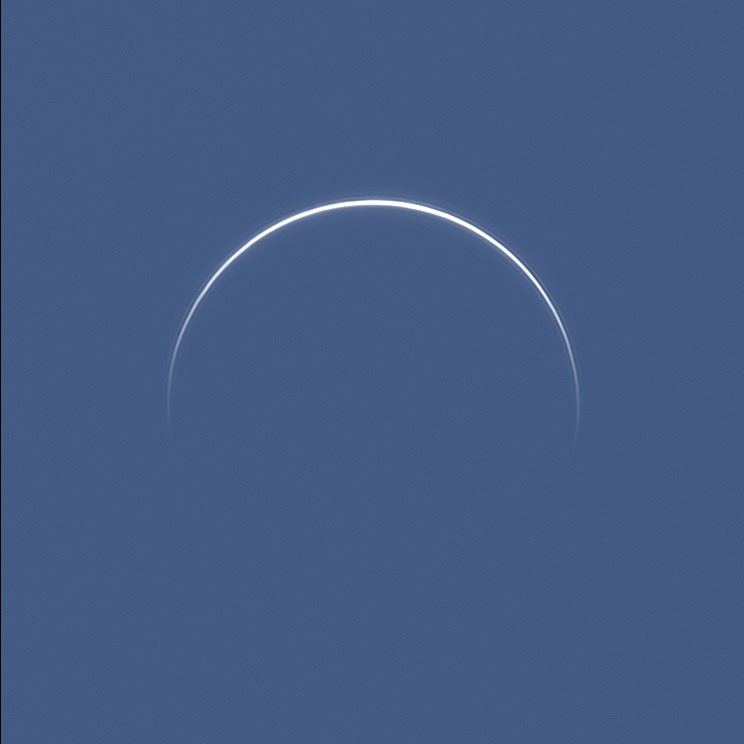
On October 29, 2026, stargazers will have the chance to witness a unique phenomenon: the ‘horns’ of Venus. This rare sight, where Venus appears as a glowing crescent arc extending beyond 180 degrees, occurs when the planet is positioned almost directly between the Sun and Earth, similar to a new moon phase. Unlike our dark new moon, Venus’s atmosphere refracts and scatters sunlight, creating this ethereal glow that can be observed with simple optical aid.
Understanding the Phenomenon
The ‘horns’ of Venus are actually the tips of a bright crescent formed by sunlight illuminating the planet’s atmosphere. This spectacular display happens approximately every 18 months. While a small telescope or binoculars can reveal this celestial marvel during twilight, ancient civilizations and individuals with exceptionally keen eyesight might have observed it even with the naked eye. The ancient Babylonians were among the first to document Venus’s brightness changes, which are intrinsically linked to its phases, with other cultures, including the Maya, also keeping detailed astronomical records.
Venus’s Phases: A Celestial Dance
The phases of Venus are a direct consequence of its orbit around the Sun, as viewed from Earth. When Venus is between Earth and the Sun (inferior conjunction), we see a crescent. As it moves in its orbit, the illuminated portion visible from Earth changes, much like the phases of our own Moon. This variation in appearance has been a subject of fascination and study for centuries, offering profound insights into planetary motion and our place in the solar system. The observation of these phases by early astronomers was a crucial step in understanding heliocentric models of the solar system.
Source: NASA