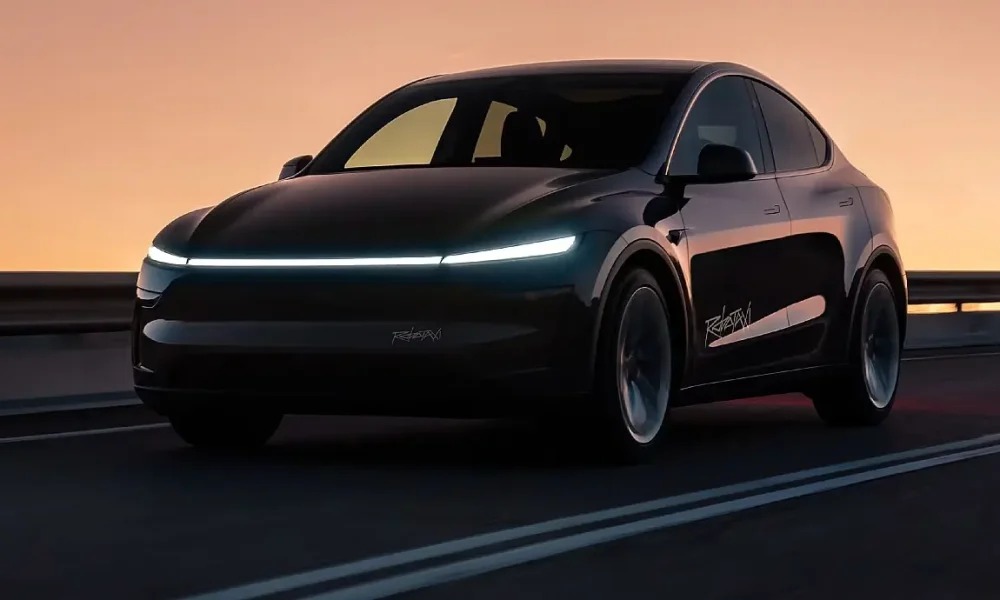
Tesla is reportedly slowing down the integration of its popular Model Y into its Robotaxi fleet, signaling a strategic shift towards its dedicated autonomous vehicle, the Cybercab. This move, revealed by JPMorgan analysts following a factory visit and discussions with Tesla’s investor relations team, underscores the company’s confidence in the Cybercab’s potential for rapid scaling.
Strategic Pivot to Cybercab
According to a recent investor report from JPMorgan, Tesla has indicated a deliberate slowdown in adding Model Y vehicles to its Robotaxi operations. The underlying reason for this decision stems from Tesla’s belief that the Cybercab is poised for swift and large-scale deployment in the near future. This assessment is closely tied to the advancements in Tesla’s Full Self-Driving (FSD) software, particularly the upcoming FSD V15.
Tesla views FSD V15 as a significant leap in performance, comparable to the jump from V13 to V14. This latest iteration incorporates seven core technological advancements, with approximately 40% of these features currently undergoing testing within the existing Robotaxi fleet, yielding encouraging initial feedback. The company is carefully managing software development, aiming to integrate new capabilities without compromising existing core driving functions. Management considers FSD V15 a crucial gateway to the widespread adoption of unsupervised FSD.
Cybercab: The Dedicated Robotaxi Solution
While Tesla’s Robotaxi service, launched in Austin and expanding to other markets, has predominantly utilized modified Model Y vehicles, the company is now strategically pausing further conversions. The Cybercab is engineered specifically for the demands of Robotaxi services. Its design features a dual-seat configuration and notably lacks a steering wheel and pedals, making it more suitable for high-frequency operational requirements. Tesla anticipates that Cybercab production and deployment efficiencies will surpass those of retrofitting Model Y vehicles in the coming months.
This specialized vehicle is also expected to offer superior per-vehicle operational economics for typical ride-sharing trips, which often involve only one or two passengers. Furthermore, by reducing the conversion of Model Ys for taxi duty, Tesla can ensure a greater supply of these vehicles remains available for sale to the general consumer market.
Enabling Technologies and Future Vision
The development of FSD V15 is a critical enabler of this strategic adjustment. Tesla’s current AI computing platform and Hardware 4 system are already capable of running FSD V15 and supporting unsupervised autonomous driving. The Cybercab is just the first vehicle built on Tesla’s autonomous driving platform. The company has reiterated its plans to introduce more vehicle forms in the future, citing concepts like the ‘Robovan’ as examples of how the platform can extend to various types of driverless vehicles.
Optimus Project Progress
In parallel, Tesla’s humanoid robot, Optimus, continues its development. Production is slated to begin in the coming months, with potential commercial sales starting as early as the second half of 2027. Details regarding Optimus Gen 3 will be disclosed closer to its production phase to safeguard competitive advantages, while Gen 4’s design and features will be informed by real-world operational data from Gen 3.
JPMorgan’s insights from the factory visit reinforced their positive outlook on Tesla’s manufacturing automation capabilities, leading them to maintain a price target of $475 for the company’s stock. Therefore, the decision to slow down the Model Y conversion is not indicative of a setback in Tesla’s Robotaxi strategy, but rather a calculated maneuver to concentrate resources on the more efficient and purpose-built Cybercab, which Tesla believes is ready for significant future expansion.