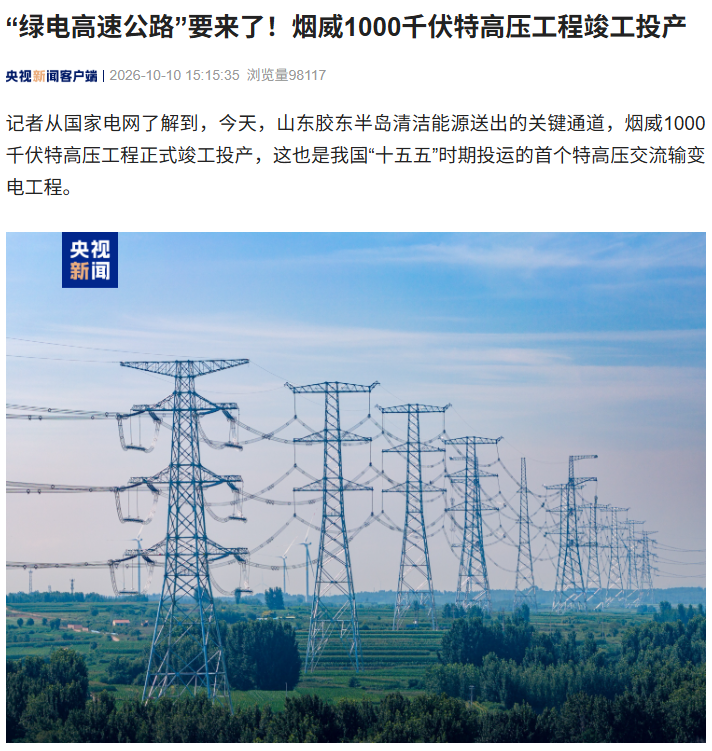
Shandong’s Yantai-Weihai 1000 kV UHV Project has officially commenced operations, marking a significant milestone as the first ultra-high voltage alternating current (UHV AC) power transmission and transformation project commissioned during China’s “14th Five-Year Plan” period. This vital artery is designed to channel clean energy from the Shandong Peninsula, particularly nuclear power, to the entire province.
A New Era for Clean Energy Transmission
The newly completed Yantai-Weihai UHV project spans an impressive 1,197 kilometers and traverses five major cities: Yantai, Qingdao, Rizhao, Weifang, and Linyi. Its primary function is to facilitate the transmission of electricity generated from newly established clean energy sources. Notably, this is China’s first UHV project specifically built to transmit electricity from nuclear power plants. Following its activation, nuclear power from facilities in Yantai’s Haiyang and Laiyang regions will be efficiently delivered across the province via this new UHV corridor.
Beyond nuclear power, the project will also play a crucial role in optimizing the allocation of other renewable energy sources in the Yantai-Weihai region, including wind and solar power, throughout Shandong Province. Cheng Jian, Director of the UHV Management Office of the State Grid Shandong Electric Power Construction Department, highlighted the rapid growth of clean energy, such as nuclear and offshore wind power, on the Shandong Peninsula, transforming it into a major hub for electricity export.
Boosting Grid Stability and Capacity
Projections indicate that by the end of the “14th Five-Year Plan” period, the Yantai-Weihai region is expected to export over 30 million kilowatts of surplus electricity. The Yantai-Weihai UHV project, described as a “green electricity highway”, ensures that this abundant clean energy can be smoothly transported to meet the province’s growing demands.
Upon its integration with Shandong’s existing UHV network, the project will form a double-ring structure, creating China’s first provincial-level UHV double-ring grid. This advanced grid configuration is set to not only streamline the transmission of clean energy from renewable sources in eastern and northern Shandong but also significantly enhance the overall safety, stability, and reliability of the Shandong power grid.
Understanding Ultra-High Voltage (UHV) Technology
Ultra-high voltage (UHV) refers to power transmission technologies operating at alternating current (AC) voltage levels of 1000 kV and above, and direct current (DC) voltage levels of ±800 kV and above. AC UHV projects are generally characterized by their flexibility, allowing for interconnections and intermediate access points, often utilized within provincial main grid frameworks. DC UHV projects, on the other hand, are typically designed for long-distance, point-to-point power transmission.
The successful commissioning of the Yantai-Weihai UHV project represents a substantial leap forward in China’s energy infrastructure, underscoring the nation’s commitment to developing and deploying clean energy technologies on a massive scale.