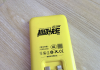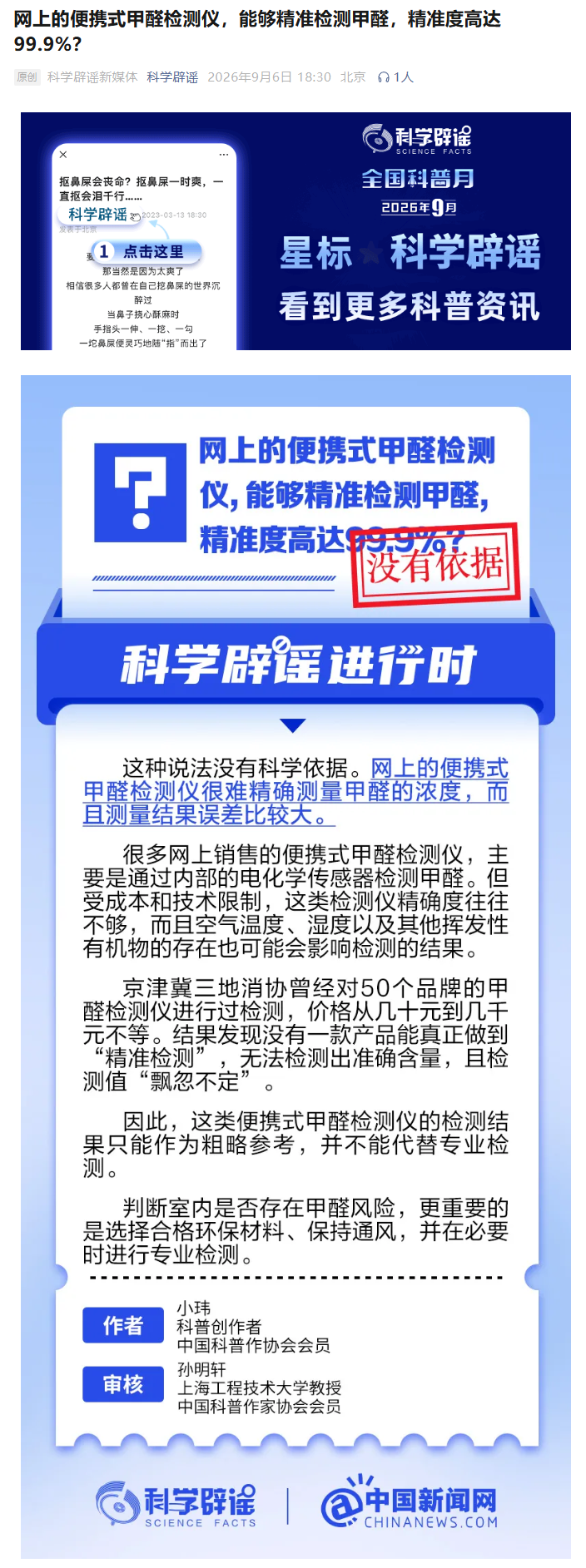
In the wake of new home renovations, many families worry about excessive formaldehyde levels indoors. Portable formaldehyde detectors have become popular on e-commerce platforms due to their compact size and ease of use. Some vendors make bold claims of “up to 99.9% accuracy,” promising precise indoor formaldehyde concentration measurements. However, a recent exposé by the “Scientific Rumor Refutation” official account has shed light on the unreliability of many such devices.
Questionable Accuracy of Portable Detectors
The article from IT Home points out that these claims of high accuracy lack scientific basis. Portable formaldehyde detectors sold online often struggle to accurately measure formaldehyde concentration, and their results can have significant errors. The primary detection method for many of these devices involves electrochemical sensors. Unfortunately, due to cost and technological limitations, the precision of these detectors is frequently insufficient. Furthermore, environmental factors such as air temperature, humidity, and the presence of other volatile organic compounds (VOCs) can easily influence the readings.
To investigate this issue, the consumer associations of Beijing, Tianjin, and Hebei conducted tests on 50 different brands of formaldehyde detectors, with prices ranging from tens to thousands of yuan. The results were telling: none of the tested products could achieve “accurate detection.” They were unable to provide precise formaldehyde content, and their readings were described as “unstable and fluctuating.”
Consequently, the article emphasizes that the results from these portable detectors should only be considered a rough reference and cannot replace professional testing. When assessing formaldehyde risks in a home, the most crucial steps are to choose qualified and eco-friendly materials, ensure adequate ventilation, and opt for professional testing if necessary.
Misleading Marketing Tactics in the Air Purification Market
This isn’t an isolated issue. In February of this year, the consumer associations of Beijing, Tianjin, and Hebei jointly issued a public advisory to regulate the market for air purifiers and formaldehyde-removing gels. The aim was to promote rational competition and protect consumer rights through industry standards and consumer tips.
The market for air purifiers is rife with exaggerated and false advertising:
- Some brands boast “a single unit covers 180㎡” or “99%+ formaldehyde removal in 2 hours.” In reality, these figures often originate from small, sealed test chambers, bearing little resemblance to complex home environments. This “high-efficiency purification” is, in fact, misleading.
- Certain companies deliberately confuse consumers by rebranding strong irritants like ozone as “active oxygen” or “superoxide.” They intentionally obscure the associated health hazards and fail to include warnings in their product instructions.
- Alarmingly, some vendors propagate the idea that “window ventilation is useless,” aiming to push consumers towards expensive, unnecessary purchases and openly defying scientific common sense.
Similarly, formaldehyde-removing gels face similar criticisms:
- Claims like “move into your new home in 24 hours” or “99% formaldehyde removal rate” often omit crucial details about the experimental space’s volume and specific temperature/humidity conditions, making their effectiveness in typical home environments questionable.
- Some products use the gimmick of “gel color change indicating purification progress,” which is actually a visual illusion designed to deceive consumers.
- Others use vague terms like “herbal essence” to mask core ingredients, failing to disclose the risks associated with strong oxidizing properties, such as respiratory irritation or material corrosion.
Regulatory Action and Consumer Protection
In response to these widespread issues of false advertising and exaggerated claims in the air purifier and formaldehyde-removing gel markets, the Beijing-Tianjin-Hebei Consumer Associations have engaged with key manufacturers, e-commerce platforms, and MCN agencies. Brands such as Hope Tree, Honeywell, Shanshan, Chuanglvjia, Olans, Bafair, Best, and Kaiwen have been specifically targeted for discussions. The associations have clearly demanded that these entities take responsibility for their products and strictly control false advertising and misleading promotions.
The “Scientific Rumor Refutation” platform is a collaborative initiative supported by various Chinese government bodies, including the China Association for Science and Technology, the National Health Commission, the Ministry of Emergency Management, and the State Administration for Market Regulation, under the guidance of the Cyberspace Administration of China. It involves national societies, authoritative media, social institutions, and scientific professionals.