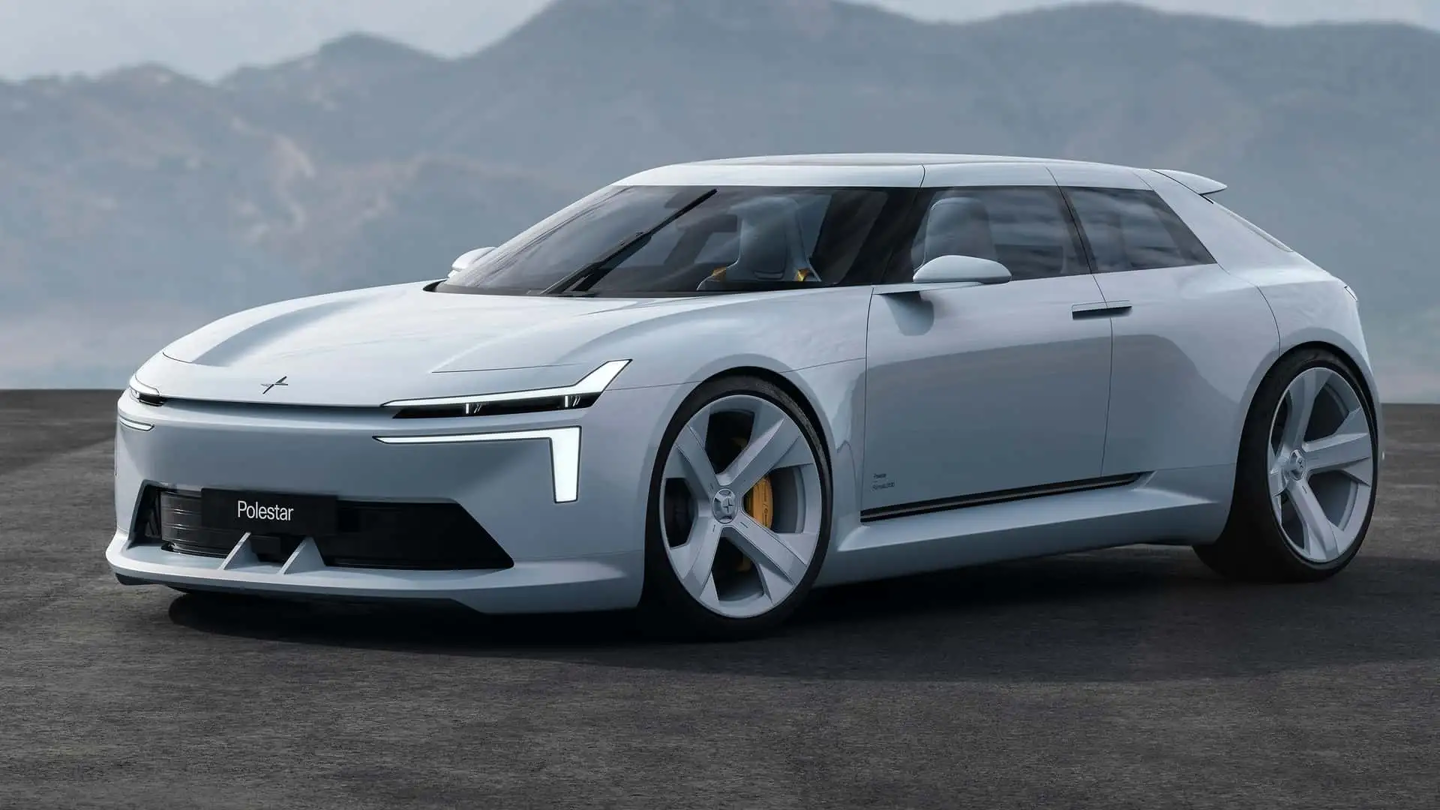
Polestar has officially pulled the wraps off its striking new concept car, the Formula 2030, showcasing a bold vision for the future of electric performance vehicles. Revealed today, the concept boasts a futuristic sports hatchback design, characterized by a wide body, a low-sloping stance, and aggressive 22-inch center-lock wheels.
Radical Design and Practicality
One of the most eye-catching features of the Formula 2030 is its complete absence of B-pillars. This design choice, combined with rear-hinged coach doors, creates a wide, unobstructed opening, significantly enhancing passenger accessibility. From the front, the car adopts the pure aesthetics of a sports car, yet it surprisingly accommodates four seats along with both front and rear storage compartments.
The rear of the concept features a distinctive “flying saucer”-like shape and incorporates a newly designed taillight signature. Dimensionally, the Formula 2030 measures 4680mm in length, 2021mm in width, and a mere 1350mm in height. Thanks to its dedicated electric vehicle platform, it achieves a wheelbase of 2780mm.
Innovative Features
Further design highlights include a unique, “racing-style” vertical front windshield wiper, a panoramic glass roof that extends into a large rear wing, and a retractable lidar sensor that only emerges when the autonomous driving system is engaged.
The design philosophy extends to the glasswork, with the rear glass echoing the wraparound nature of the front windshield. Despite the car’s low profile, the cabin benefits from ample glass surfaces, providing a sense of openness.
Futuristic Interior and Adaptable Cockpit
The interior of the Formula 2030 introduces several innovative elements. All four individual seats are equipped with inflatable bolsters and cushions, allowing for personalized adjustments to fit each occupant. The driver’s area is clearly prioritized, featuring a 20-inch curved instrument display mounted directly onto the steering column. A 12.2-inch central touchscreen is integrated into the center console.
Interestingly, below the main infotainment screen, eight customizable physical controls remain, offering flexibility for configuring switches and knobs according to user preference. The cockpit layout dynamically adapts to different driving modes. In autonomous mode, the central screen rises from the dashboard, increasing the space between the steering wheel and seats. When switching to performance mode, the screen retracts into the center console, while the steering wheel and instrument display move closer to the driver.
Powertrain Details Still Under Wraps
Polestar has not yet disclosed specific performance figures for the Formula 2030. While it is confirmed to be fully electric, details regarding its output power, battery capacity, and overall performance remain unknown.
Influence on Future Production Models
Looking ahead, Polestar has confirmed that elements of the Formula 2030’s design will be incorporated into upcoming production vehicles. The next-generation Polestar 2, slated for launch in 2027, and the Polestar 7, a compact all-electric SUV planned for release in 2028, are expected to feature some of these concept-derived design cues.