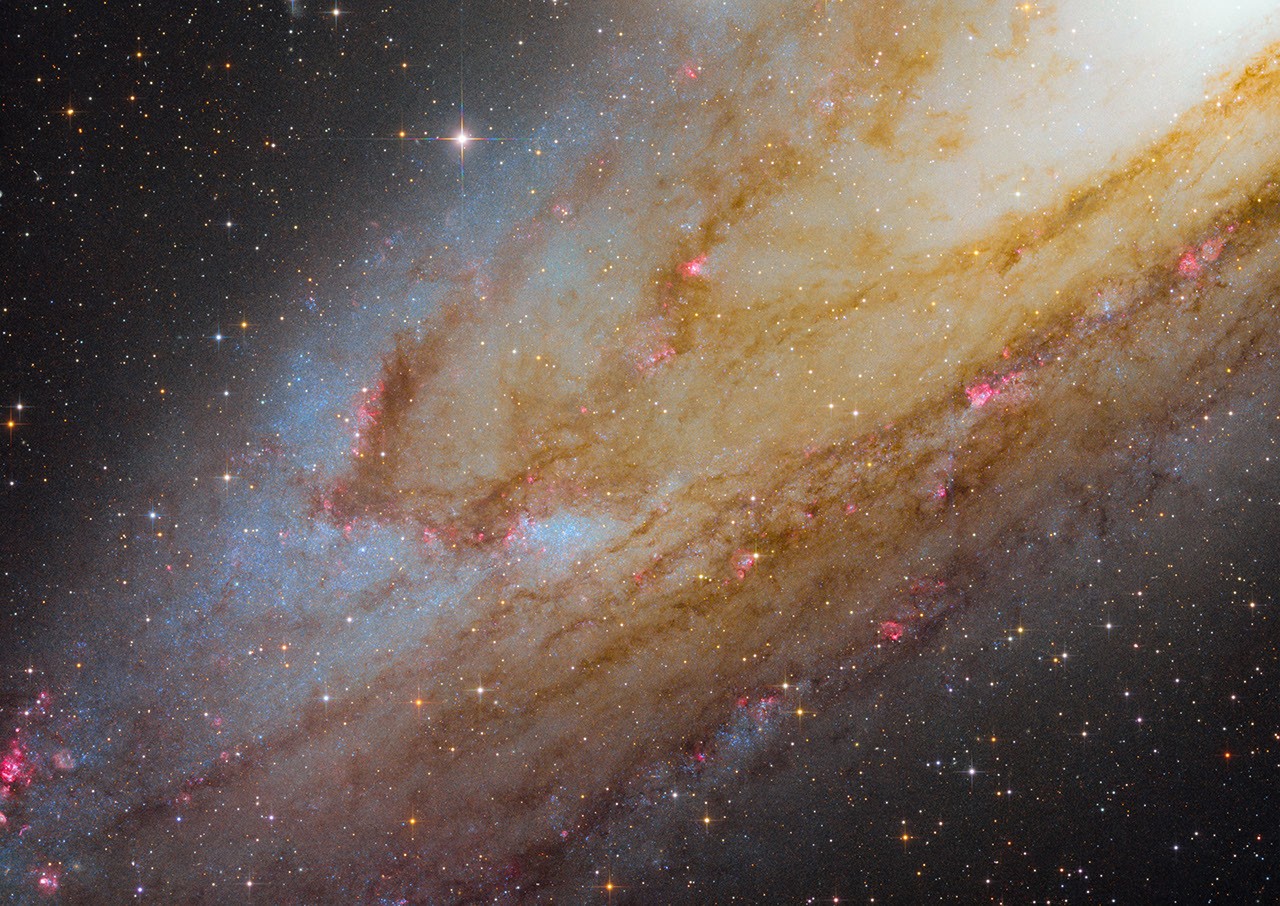
NASA’s Hubble Space Telescope has captured a stunning close-up of NGC 206, a colossal stellar association nestled within the spiral arms of the Andromeda galaxy. This vibrant star-forming region, located a mere 2.5 million light-years away, offers astronomers a unique glimpse into the dynamic processes of star birth on an immense scale, comparable to some of the most active stellar nurseries in our own galactic neighborhood.
A Galaxy Within a Galaxy
NGC 206 is a spectacular sight, appearing as a collection of bright, blue stars that signal its youth. Astronomers estimate that the youngest massive stars within this association are less than 10 million years old. Spanning approximately 4,000 light-years, NGC 206 is significantly larger than typical star clusters found in our Milky Way’s disk. Its sheer size makes it a crucial laboratory for studying the evolution of massive stars and the conditions required for their formation.
Andromeda’s Dusty Canvas
This detailed image showcases NGC 206 against the backdrop of Andromeda’s (also known as M31) southwestern disk. The galaxy’s characteristic pinkish star-forming regions are visible, interwoven with dark, dusty lanes that are the raw material for future generations of stars. The juxtaposition of the young, bright stars of NGC 206 with the surrounding dusty environment highlights the ongoing cycle of star birth and death within this nearby spiral galaxy.
Source: NASA