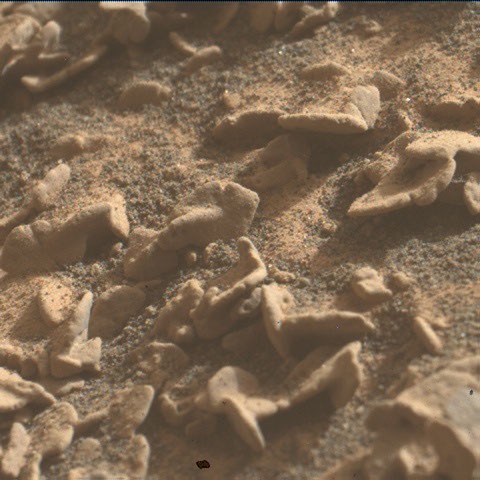
NASA’s Curiosity rover has been busy exploring intriguing rock formations on Mars, resembling “potato chips,” as part of its ongoing drilling campaign. The rover also took time to capture a rare celestial event – an eclipse of the Sun by Mars’ moon, Phobos. These investigations are crucial for understanding the geological history and dynamic environment of the Red Planet.
Unearthing Martian Geology
During Sols 5063-5069, Curiosity focused its efforts on the “Nazca” drill hole, an area characterized by bedrock featuring unique disk-shaped crystal formations. Scientists are particularly interested in characterizing these “chip-shaped” features, which hint at specific geological processes that occurred on Mars. Samples from these formations have been delivered to the Sample Analysis for Mars (SAM) instrument for detailed analysis. While SAM conducted its research, Curiosity also employed its ChemCam instrument to study other crystal formations like “Ahi Veremos” and “Colca,” and analyzed a dark float rock. To provide a broader context, the rover captured extensive Mastcam imagery to create a mosaic of the Nazca area and its surroundings, alongside environmental observations such as dust devil surveys and atmospheric monitoring.
Celestial Observations and Future Journeys
Beyond its geological investigations, Curiosity also documented a significant astronomical event: an eclipse of the Sun by Mars’ moon, Phobos. This observation was a priority for the mission team, offering valuable data about the orbital mechanics and the Martian atmosphere. The rover also used its Mars Hand Lens Imager (MAHLI) for detailed nighttime imaging of the crystal formations using both white-light and ultraviolet LEDs, revealing intricate details not visible in daylight. Following these intensive studies, Curiosity prepared for a drive away from the Nazca drill site, resuming its exploration along its southerly trending route, continuing its trek of discovery across the Red Planet.
Source: NASA