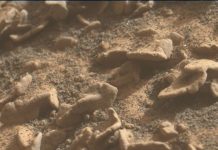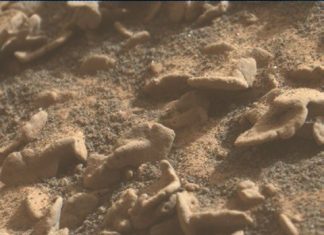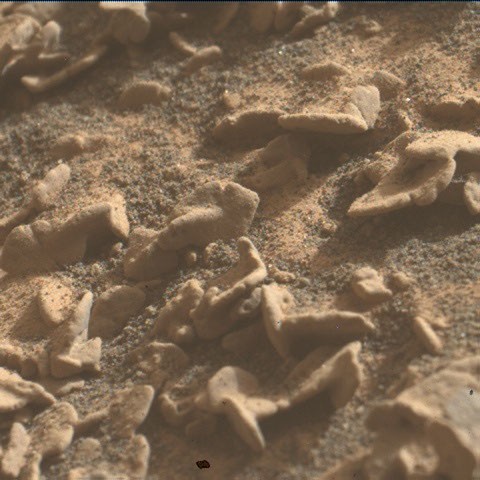
NASA’s Mars rover Curiosity continues its exploration of the Red Planet, with mission teams recently focusing on detailed study of unique rock formations in the “Nazca” region. These formations feature disk-shaped crystalline structures that NASA playfully refers to as “chips.” The primary objective is to gain a deeper understanding of the nature of these intriguing geological features.
Investigating ‘Chips’ and Atmospheric Observations
Over the past sols (5063-5069), the rover completed a drilling campaign in the “Nazca” area, delivering samples for analysis to the Sample Analysis for Mars (SAM) instrument. Concurrently, Curiosity conducted spectral analysis using the ChemCam LIBS instrument on another crystalline formation, “Ahi Veremos.” Detailed images of the “Nazca” surroundings were also captured by Mastcam to create a terrain mosaic. Beyond geological investigations, Curiosity has been monitoring Martian weather, observing dust devils, studying the horizon, and recording atmospheric “movies.”
In-Depth Crystal Study and Departure Preparations
Subsequent sols were dedicated to more targeted study of the crystalline formations. The team planned detailed spectral profiles of “Colca” and “Bermejo” using ChemCam LIBS. Images of rock clusters beneath the “Cordillera” ridge were also acquired using the Remote Micro-Imager (RMI). Mastcam continued its “Nazca” mosaic imaging. Friday was packed with plans, including three sols with three science blocks. These involved detailed imaging of crystalline forms using the Mars Hand Lens Imager (MAHLI) in both daytime and nighttime modes, as well as under UV illumination. An evening observation of the Sun being eclipsed by the Martian moon Phobos was also scheduled. Additionally, spectral studies were performed on crystal clusters, resistant rock layers, and dark fragments. Imaging of dark lenses beneath the planar surface of the “Mishe Mokwa” ridge was also planned with the RMI. By the end of the week, the rover was expected to begin its traverse, returning to a southerly route to continue its mission exploring the Red Planet.
Source: NASA