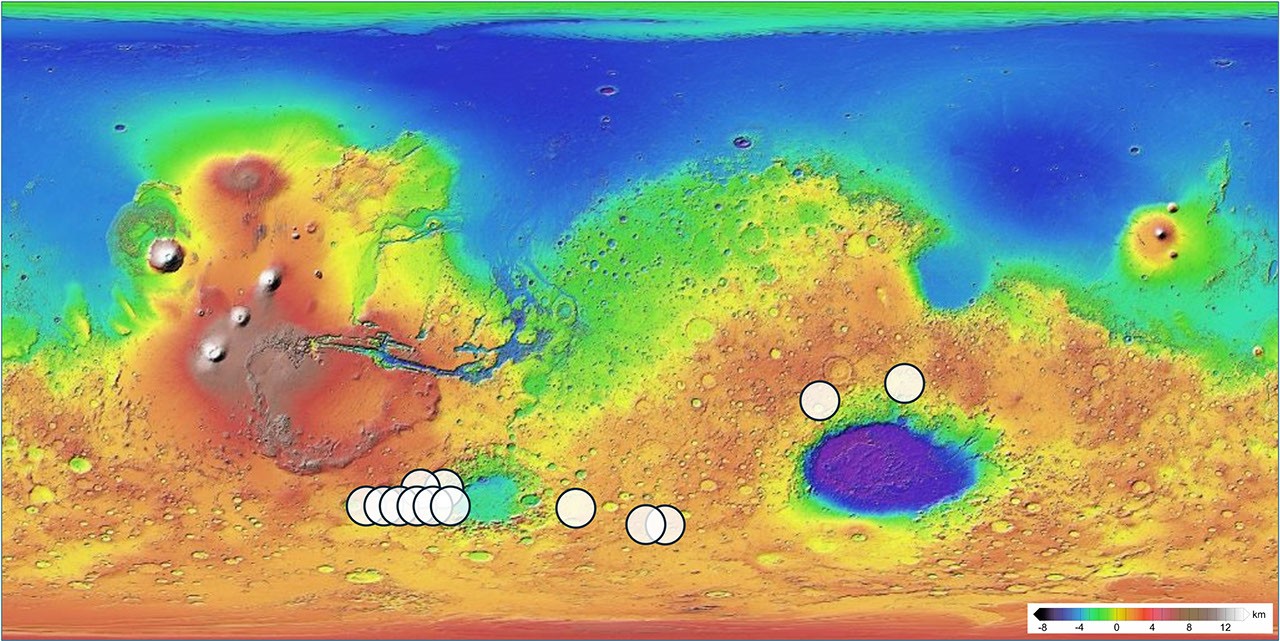
Scientists have pinpointed 13 potential landing sites on Mars where the ancient meteorite Teghaza 001 might have originated. Discovered on Earth, this rocky visitor from the Red Planet offers invaluable clues about Mars’ early history, and new analysis by NASA suggests its cosmic roots lie in the planet’s southern hemisphere highlands. While the exact origin will likely remain a mystery, this research brings us closer to understanding the geological evolution of Mars.
Unlocking the Secrets of Teghaza 001
Teghaza 001 is considered one of the oldest Martian meteorites ever found, making its chemical and mineral composition a treasure trove of information about the early Red Planet. By meticulously comparing the known properties of Teghaza 001 with data gathered from Mars’ surface, researchers have identified specific regions that share striking similarities. These areas, marked by white circles on the provided map, exhibit comparable mineralogy and chemistry, significantly narrowing down the possibilities for the meteorite’s birthplace.
Mapping Mars with Advanced Technology
This groundbreaking analysis was made possible by combining data from two of NASA’s highly successful missions. The base map utilized in this research was generated using data from the Mars Orbiter Laser Altimeter (MOLA) instrument aboard the Mars Global Surveyor spacecraft. This instrument provided a detailed topographic map of the Martian surface. Complementing this, data from NASA’s Mars Reconnaissance Orbiter (MRO) was crucial for identifying areas with the specific mineral signatures matching Teghaza 001. This collaborative approach showcases the power of orbital observations in unraveling planetary mysteries.
Source: NASA