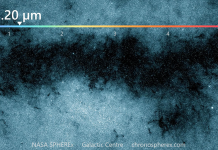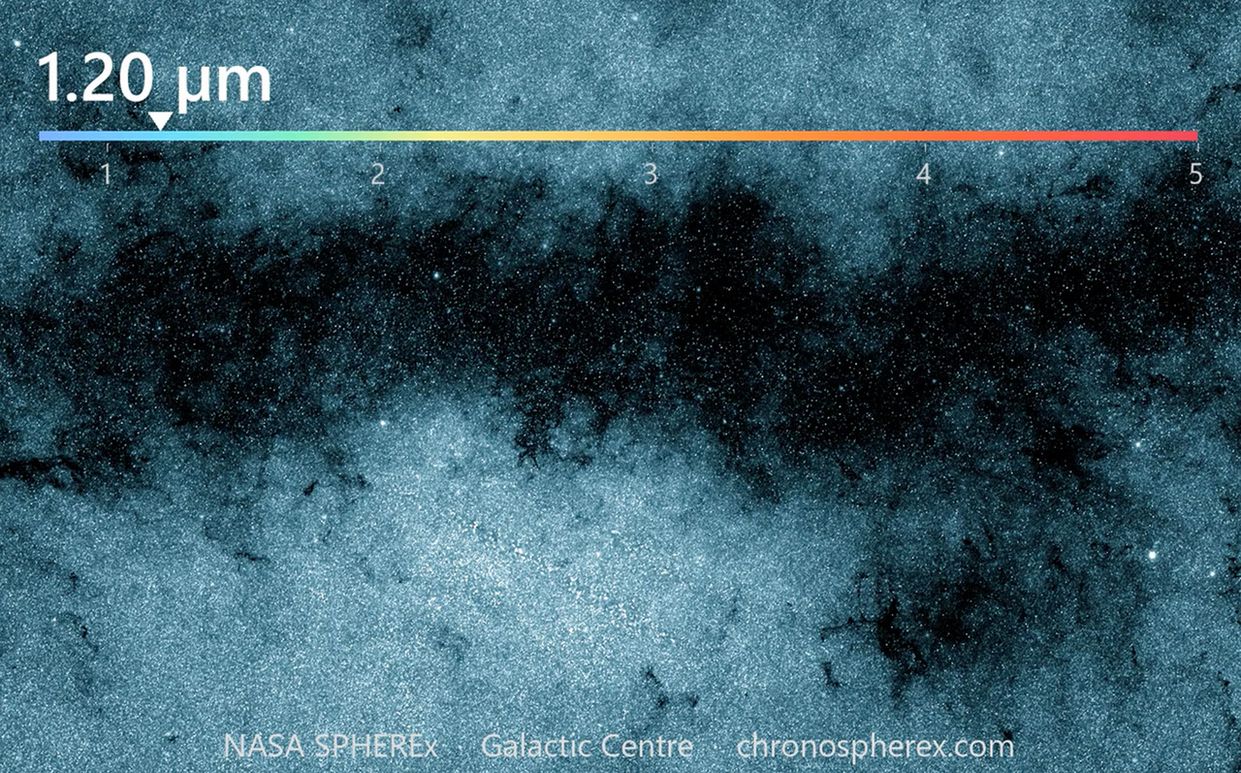
NASA’s SPHEREx space telescope has captured a remarkable infrared image of our galaxy’s center, offering an unprecedented view through the cosmic dust that has accumulated over billions of years. This breakthrough is crucial for astronomical research, as this dense dust obscures the galactic core from optical telescopes.
Cosmic Dust: An Obstacle to Observation
Over its 13-billion-year history, the Milky Way has amassed a vast quantity of dust. These microscopic particles, forged from elements like oxygen and carbon expelled by dying stars, are far smaller than everyday dust. However, they are highly effective at absorbing and scattering visible light, rendering the galaxy’s center largely invisible to traditional optical instruments.
SPHEREx’s Infrared Advantage
SPHEREx operates in the infrared spectrum, where light has longer wavelengths and can penetrate these obscuring dust clouds. By measuring light across various infrared wavelengths, the telescope can reconstruct images hidden from optical devices. Specifically:
- In the near-infrared range (around 1.2 micrometers), dust significantly absorbs and scatters light, effectively blocking the view of the galactic center.
- In the mid-infrared range, however, light can pass through the dust and reach SPHEREx’s detectors, enabling detailed study of the central regions.
This infrared transparency effect is akin to why sunsets often appear red, but in space, it offers a clear window into the deepest parts of the Milky Way.