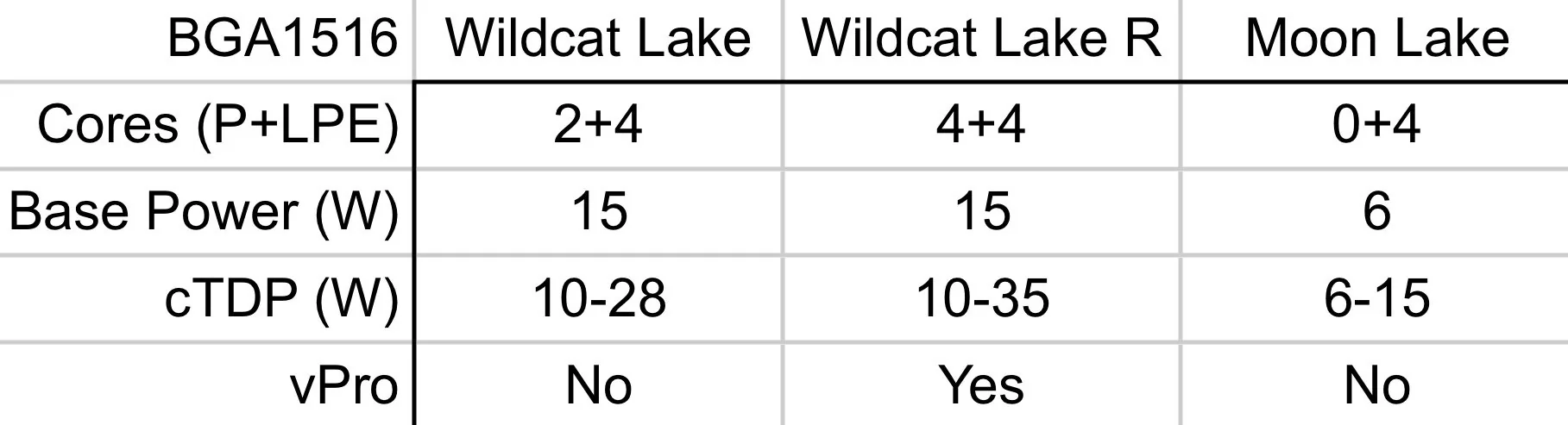
New details have emerged regarding Intel’s upcoming “Moon Lake” processor, shedding light on its specifications and design philosophy. Codenamed “Moon Lake,” this new chip appears to be a distinct offering, focusing solely on power efficiency.
Moon Lake: A Focus on Efficiency
According to information shared by source @jaykihn0, the “Moon Lake” processor will utilize the BGA1516 package, similar to the existing “Wildcat Lake” series. A key differentiator for “Moon” Lake is its complete absence of performance cores. Instead, it will feature up to four “Darkmont” microarchitecture low-power efficiency cores. The processor is expected to have a default Thermal Design Power (TDP) of 6W, emphasizing its low-power nature.
Design and Architecture
The “Moon Lake” processor is set to adopt a disaggregated design, much like “Wildcat Lake.” The main chip will be built on Intel’s cutting-edge Intel 18A process technology. In terms of its place in Intel’s lineup, “Moon Lake” can be viewed as a scaled-down version of “Wildcat Lake.” However, its specifications also position it as a significant upgrade over previous low-power offerings such as “Alder Lake N.” This suggests Intel is refining its strategy for energy-efficient computing platforms.
Comparison with Wildcat Lake Refresh
In related news, the “Wildcat Lake Refresh” is also making waves with its own set of improvements. This refreshed series will see an increase in performance cores, boasting up to four of them. Furthermore, the cTDP (Configurable TDP) ceiling for “Wildcat Lake Refresh” will be extended to 35W. A significant addition for enterprise users is the introduction of vPro platform support in the “Wildcat Lake Refresh” models. This indicates a bifurcated approach, with “Moon Lake” targeting efficiency-centric markets and “Wildcat Lake Refresh” catering to higher performance and business needs.
Implications for the Market
The emergence of “Moon Lake” suggests Intel is doubling down on the low-power segment, likely targeting ultra-portable devices, fanless systems, and other applications where power consumption is paramount. By separating performance and efficiency cores into different product lines, Intel can potentially optimize each design for its intended use case more effectively. This strategy could lead to devices with longer battery life and reduced thermal output without compromising on core functionality for everyday tasks.
The reliance on the Intel 18A process for the main chip in both “Moon Lake” and “Wildcat Lake” signals Intel’s commitment to advancing its manufacturing capabilities. This advanced node is expected to offer further improvements in power efficiency and performance density.
While specific launch dates and target devices for “Moon Lake” remain under wraps, these leaked specifications provide a compelling glimpse into Intel’s future product roadmap. The company appears poised to offer a diverse range of solutions, from highly efficient processors for thin-and-light computing to more robust options for demanding workloads.