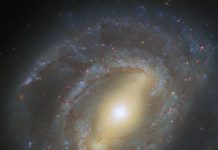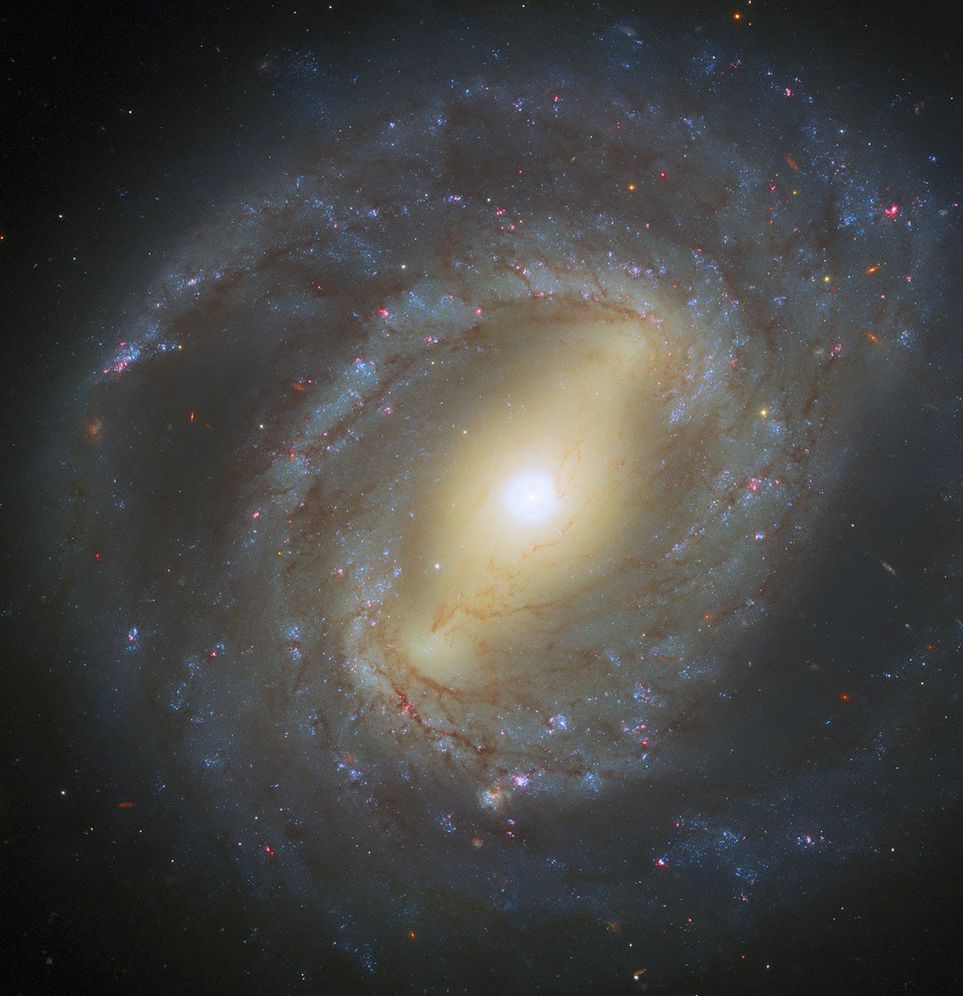
NASA and ESA’s Hubble Space Telescope has captured a breathtaking new image of the spiral galaxy NGC 4394, located 55 million light-years away in the constellation Coma Berenices. This galaxy, a member of the Virgo Cluster which comprises over a thousand galaxies, offers astronomers a closer look at the characteristic stellar bar structure that is key to understanding the dynamics of spiral galaxies, including our own Milky Way.
NGC 4394’s Unique Structure
NGC 4394 is distinguished by a prominent central stellar bar – a straight structure of stars that bisects its disc. Stellar bars are common features in spiral galaxies, found in approximately 65% of them, and are considered crucial to galactic evolution. They are believed to form due to instabilities within the galactic disc, driven by gravitational interactions with neighboring galaxies or internal processes.
The new Hubble image allows for a direct comparison of NGC 4394 with our own Milky Way, providing a compelling visualization of how our galaxy might appear if viewed from above.
Hubble’s Role in Studying Galactic Bars and Star Formation
This is not the first time Hubble has observed NGC 4394. Previous images, acquired under a different program, have been combined with recent observations utilizing a broad spectral range to determine the ages of star clusters within the galaxy.
Such data aids scientists in investigating how star formation processes decline in galaxies, particularly within dense clusters, and how these differ from isolated systems.
Furthermore, similar to the Milky Way, NGC 4394 may possess a LINER region – a Low-Ionization Nuclear Emission-line Region located near its core. The exact causes of these regions remain uncertain, but hypotheses include the activity of a supermassive black hole or intense star formation in the galaxy’s central area.