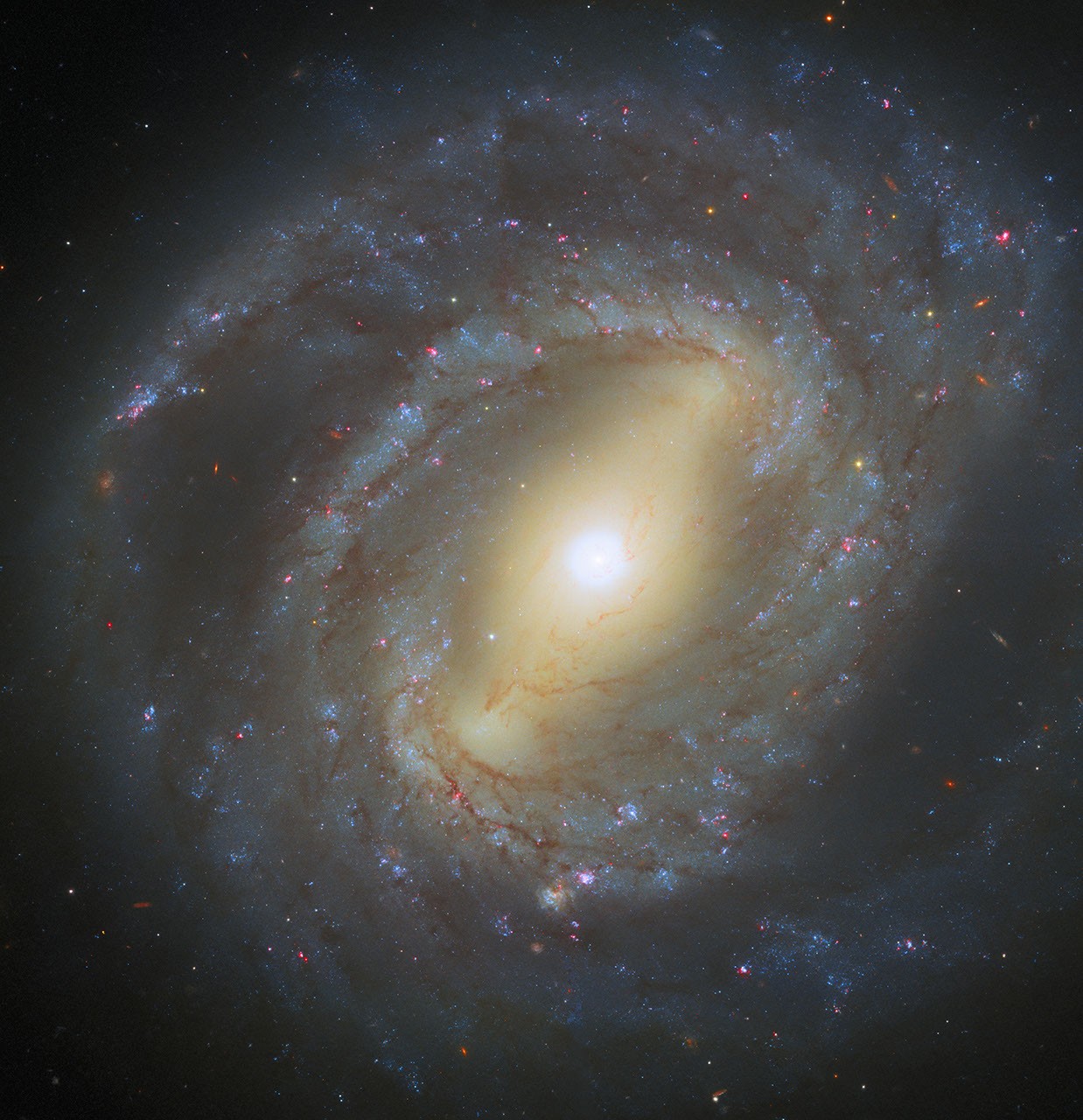
The NASA/ESA Hubble Space Telescope has unveiled a breathtaking new image of the spiral galaxy NGC 4394, showcasing its prominent central bar and graceful arms. Located in the constellation Coma Berenices, approximately 55 million light-years away, NGC 4394 is a member of the Virgo Cluster, our nearest galactic neighbor. Its striking resemblance to our own Milky Way, when viewed face-on, offers astronomers a valuable perspective on galactic structure and evolution.
The Fascinating Galactic Bar
Galactic bars, elongated structures of stars at the centers of many spiral galaxies, are a common cosmic phenomenon, estimated to be present in about 65% of nearby spiral galaxies. While NGC 4394’s bar is a striking feature, its formation is still a subject of scientific inquiry. Current theories suggest that these bars emerge when a galaxy’s stellar disk becomes gravitationally unstable, potentially due to interactions with neighboring galaxies or internal stellar dynamics. This instability causes stars to shift from circular orbits to more elongated paths, creating the characteristic bar shape. Intriguingly, observations indicate that galactic bars are becoming more prevalent in the universe over time, though this phase is believed to be temporary as bars grow and can become unstable themselves.
Unveiling Galactic Secrets with Hubble
NGC 4394 shares another intriguing characteristic with our Milky Way: the potential presence of a LINER (low-ionization nuclear emission-line region) near its core. LINERs are identified by specific spectral emissions of ionized or neutral elements. The exact mechanisms behind LINER formation remain unclear, but they are thought to be linked to either actively feeding supermassive black holes or intense bursts of star formation. This latest Hubble image builds upon previous observations, incorporating data from a recent program aimed at understanding how star formation ceases in galaxies within dense clusters compared to those in isolation. By studying the ages of individual star clusters in galaxies like NGC 4394, researchers gain deeper insights into the diverse environments that shape galactic evolution.
Source: NASA