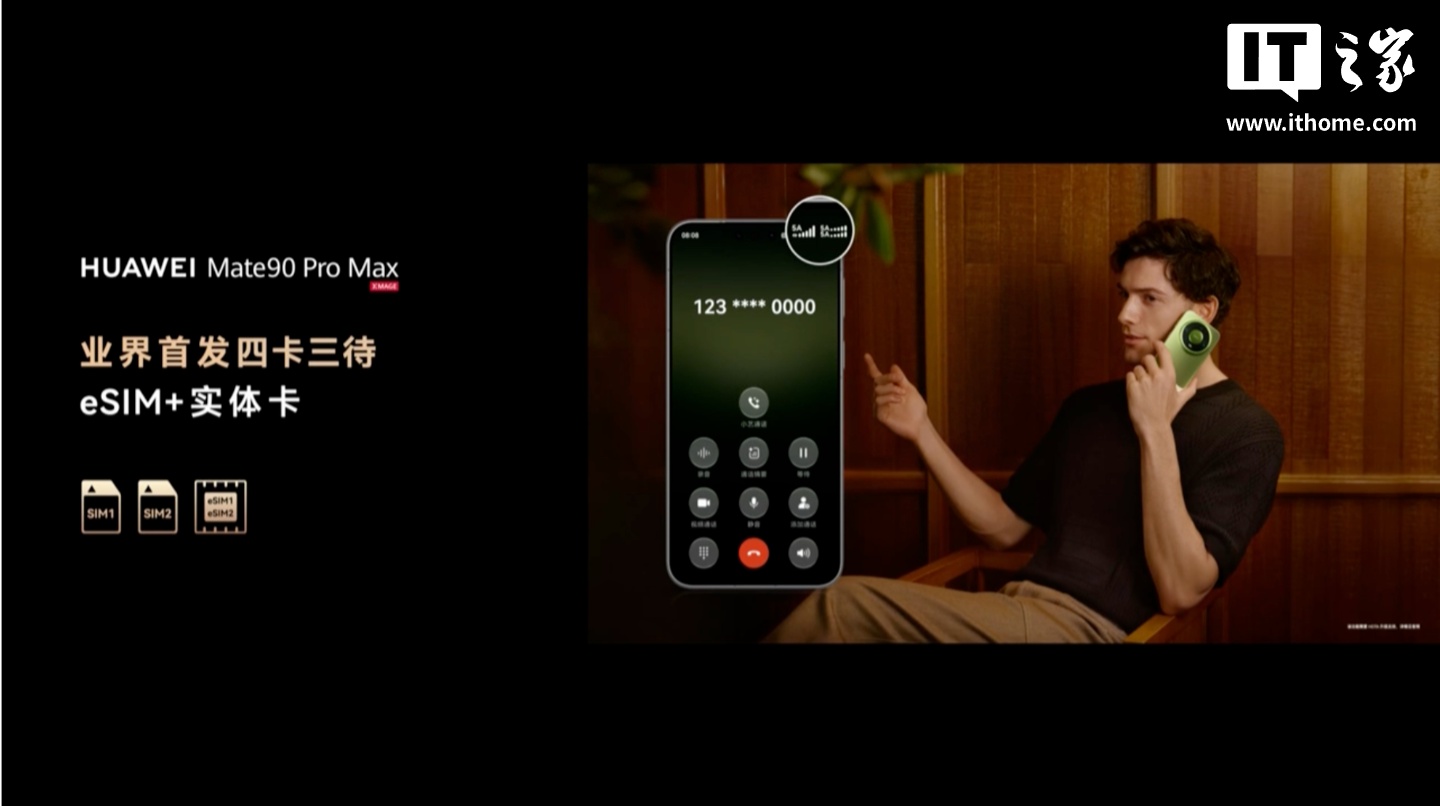
At the recent Huawei Mate 90 series and all-scenario new product launch event, Huawei executives unveiled a groundbreaking feature for their latest flagship, the Mate 90 Pro Max. Richard Yu, Huawei’s Executive Director and Chairman of the Terminal BG, announced that the new device achieves the industry’s first quad-SIM tri-standby functionality by integrating eSIM technology with physical SIM cards.
Quad SIMs, Triple Standby
This innovative approach allows the Huawei Mate 90 Pro Max to display signal status for three active SIM cards simultaneously in its status bar. The main card will be fully displayed, while the secondary cards will be shown in a stacked format, all supporting simultaneous 5G communication.
The integration of eSIM technology marks a significant step in mobile connectivity. eSIM, or Embedded SIM, is an evolution from traditional physical SIM cards. It allows users to activate mobile network operator services without the need for a physical card, offering the same functionalities as a traditional SIM, including voice calls, text messages, data services, and international roaming, all manageable digitally.
A History of Innovation
Huawei has been at the forefront of SIM technology advancements. As early as December of last year, the company introduced eSIM capabilities in its Mate 80 RS | ULTIMATE DESIGN model. That device supported up to four numbers, combining two physical SIM cards with dual eSIMs.
The introduction of quad-SIM tri-standby on the Mate 90 Pro Max highlights Huawei’s commitment to pushing the boundaries of mobile technology and providing users with unparalleled flexibility and connectivity options. This feature is expected to be particularly beneficial for users who manage multiple phone numbers for work and personal use, or frequent international travelers.
The full specifications and availability details for the Huawei Mate 90 series are expected to be released soon, following this major announcement regarding the Mate 90 Pro Max’s unique SIM capabilities.