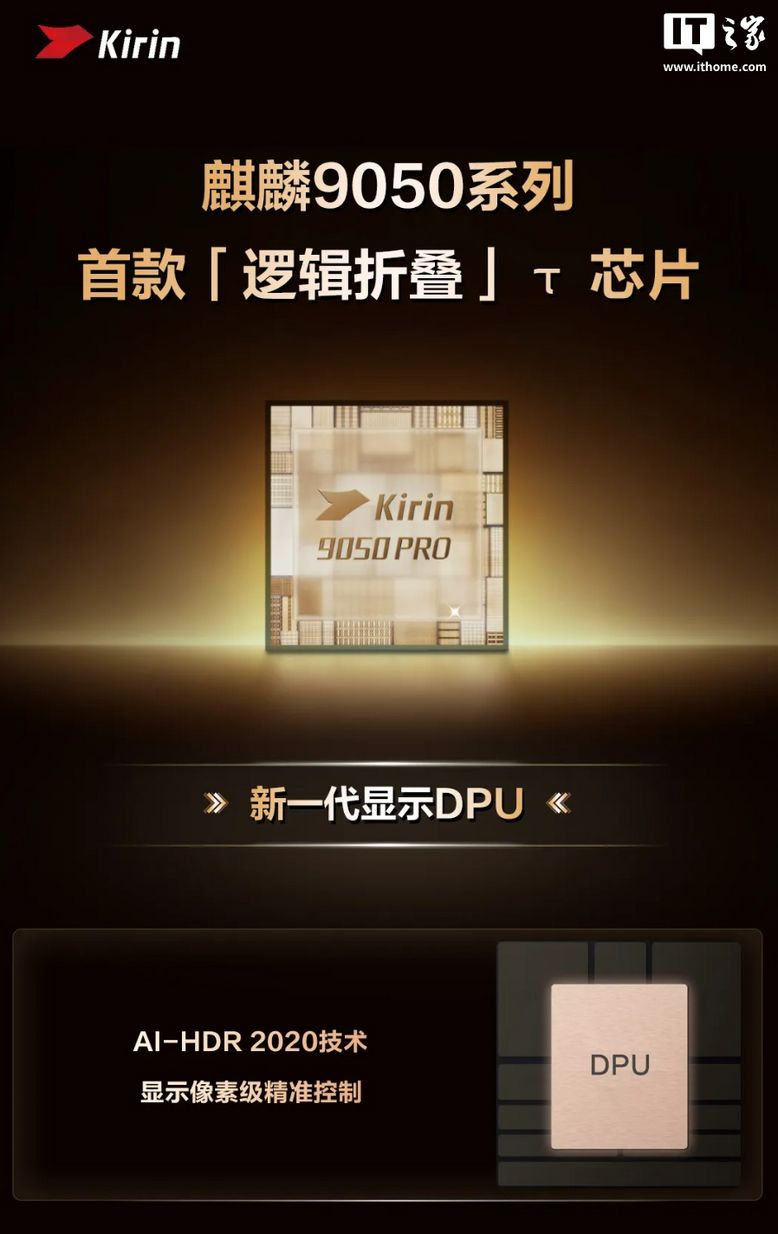
Huawei has unveiled more details about its upcoming Kirin 9050 series chipset, highlighting its advanced display capabilities. The chip features a next-generation display DPU (Data Processing Unit) that supports full-color AI-HDR2020 technology, aiming to enhance the visual experience by bringing richer details and color depth to standard SDR content.
Advanced Display Processing
The new display DPU enables the Kirin 9050 series to achieve high-precision, pixel-level control over display output. In conjunction with terminal display technologies, this advanced processing allows for rapid switching between privacy modes and overall picture quality optimization.
Industry Collaboration and Production
Earlier in October, Xu Songyu, head of Huawei’s Semiconductor Business Wireless Terminal Chip Product Management Department, announced that the Kirin 9050 series had successfully entered mass production, thanks to the support of the Chinese semiconductor industry. He emphasized the importance of collaboration and support from the broader semiconductor industry and academic communities, stating that the future hinges on open cooperation and that no single company can solve all challenges alone.
Key Technological Innovations
The Kirin 9050 series is packed with several notable technological advancements:
- Intelligent Audio-Video Processing: Features low-latency AI heterogeneous computing and is the first to support H.266 decoding.
- Advanced AI Modem: Introduces a novel fusion communication architecture and is the industry’s first to offer quad-SIM tri-standby capability.
- Next-Generation Graphics and Imaging: The new Maliang GPU incorporates second-generation hardware ray tracing. The AI ISP realizes the first-ever 200-megapixel fused photography.
- Core Processing Unit: The new Lingxi CPU boasts a 9-core, 16-thread parallel scheduling system and includes memory compression acceleration.
These revelations underscore Huawei’s continued commitment to pushing the boundaries of mobile chipset technology, focusing on enhanced visual fidelity, communication efficiency, and processing power. The emphasis on industry-wide collaboration suggests a strategic approach to navigating the complex landscape of semiconductor development and manufacturing.