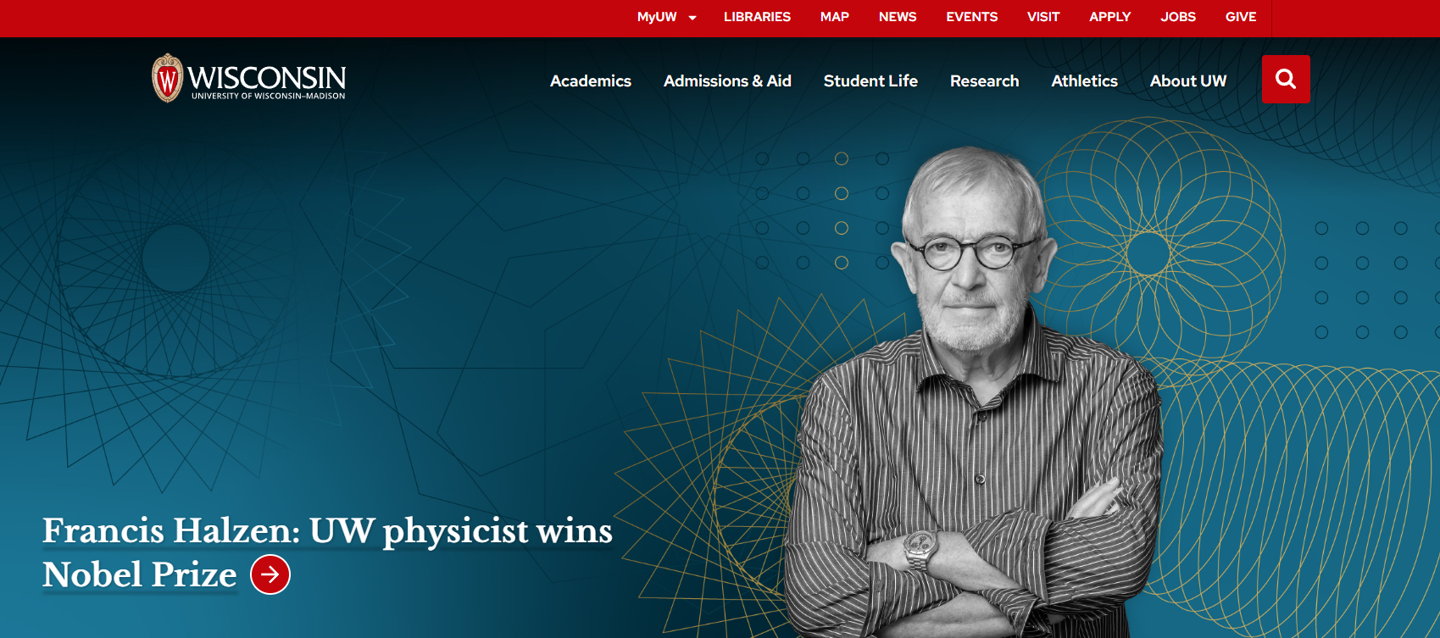
The 2026 Nobel Prize in Physics has been awarded to Francis Halzen for his pivotal role in the IceCube Neutrino Observatory and the discovery of high-energy neutrinos with astrophysical origins. The announcement, made on October 6th, recognizes Halzen’s groundbreaking work that has opened new windows into the universe.
Speaking at a press conference held at the University of Wisconsin-Madison on October 6th, Halzen described the Nobel Prize as a “weight off my shoulders.” He revealed that while winning the award wasn’t a deliberate pursuit, the annual anticipation each October, and the feeling of letting down his collaborators by not winning, had become a source of discomfort.
A Celebration of an Unconventional Project
Halzen emphasized that this award is a celebration of a highly unusual project. “It is hard to imagine where else we could have achieved this goal, apart from at the University of Wisconsin-Madison, which has a unique research infrastructure,” he stated. The success of the IceCube Neutrino Observatory, he noted, required a degree of luck and a supportive environment that allowed unconventional ideas to flourish.
“I was fortunate to be at Wisconsin, where unconventional ideas can flourish, and I have had the support of a remarkable community, from the talented engineers at the Physical Sciences Laboratory to my long-time colleagues among the faculty and supporting staff,” Halzen added. “It is hard to imagine this project happening anywhere else.”
The IceCube Neutrino Observatory is a unique facility located at the Amundsen-Scott South Pole Station in Antarctica. It uses a cubic kilometer of deep ice, embedded with more than 5,000 optical sensors, to detect neutrinos—elusive subatomic particles that travel billions of light-years to reach Earth. By studying these high-energy neutrinos, scientists can investigate some of the most extreme environments in the universe, such as black holes and supernovae.
A Rare Solo Award
This year’s Nobel Prize in Physics marks a rare occasion, being awarded to a single scientist for the first time in 34 years. The last time the prize was given to an individual was in 1992, when Georges Charpak, a Polish-French physicist, received the award for his invention of the multi-wire proportional chamber and other particle detectors. Typically, the Nobel Prize in Physics is shared among multiple researchers who have made significant contributions to a discovery.
About Francis Halzen
Francis Halzen was born on March 23, 1944, in Tienen, Belgium. At 82 years old, he is currently affiliated with the University of Wisconsin-Madison. His extensive career has been dedicated to astroparticle physics, with a particular focus on using neutrino detectors to probe cosmic phenomena. His leadership in the development and operation of the IceCube Neutrino Observatory has been instrumental in advancing the field of neutrino astronomy.
The IceCube Neutrino Observatory continues to be a vital instrument for astrophysical research, pushing the boundaries of our understanding of the cosmos. Halzen’s Nobel Prize is a testament to his vision, perseverance, and the collaborative spirit that brought this extraordinary scientific endeavor to fruition.