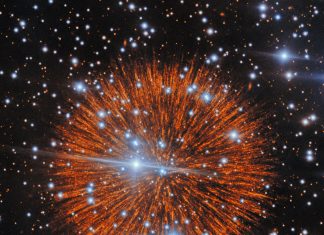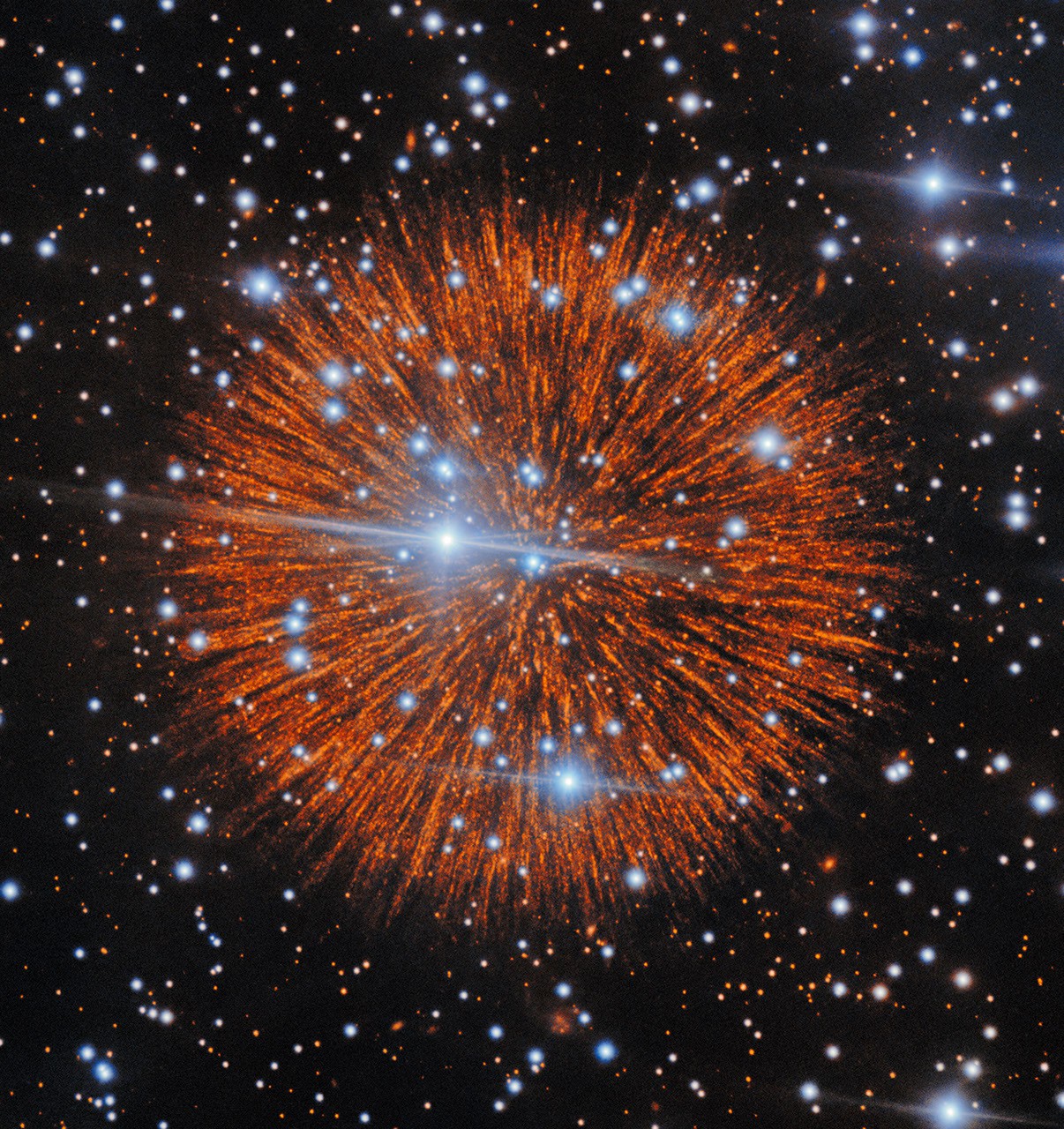
Astronomers are peering into the explosive aftermath of a stellar demise, with the Gemini North Telescope capturing a breathtaking image of Supernova Remnant Pa 30. This celestial nebula is believed to be the lingering remains of a ‘guest star’ that blazed brightly in the sky for 185 days in the year 1181, a phenomenon documented by ancient Chinese, Japanese, and Arabic astronomers. The powerful explosion, classified as a Type Iax supernova, is thought to have originated from the rare merger of two white dwarf stars, leaving behind a mesmerizing cosmic cloud.
A 845-Year-Old Mystery Unfolds
The image of Pa 30, observed from Hawai’i, showcases a radiant central star that is incredibly hot and emits a powerful stellar wind. This wind is responsible for shaping the nebula’s intricate, radial filaments. Close examination reveals ‘pearl-like knots’ strung along these filaments, each an astonishing 4 light-days in diameter. Unraveling the precise sequence of events that led to this unusual supernova and the formation of this spectacular nebula continues to be an ongoing scientific investigation, building upon a mystery that has persisted for over eight centuries.
Understanding Stellar Explosions
Supernovae, the violent explosions of stars, are crucial events in the universe, scattering heavy elements that are essential for the formation of planets and life. Type Iax supernovae, like the one that created Pa 30, are particularly enigmatic. Their unusual characteristics are believed to stem from the complex interaction between two white dwarf stars. Studying remnants like Pa 30 provides invaluable insights into the physics of these explosions, the evolution of stars, and the chemical enrichment of the cosmos.
Source: NASA