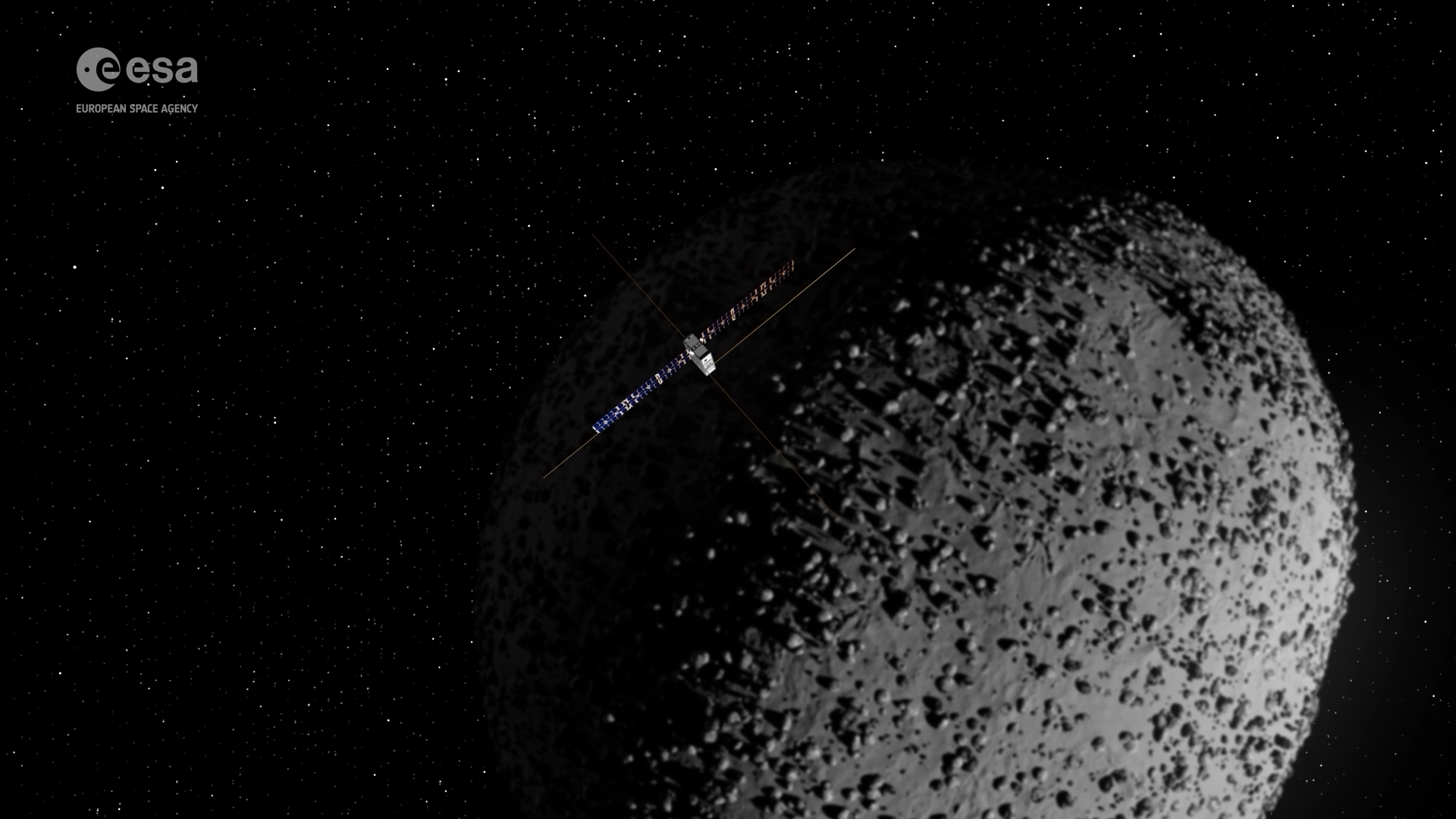
The European Space Agency’s (ESA) Hera mission is set to embark on a groundbreaking journey to the Dimorphos asteroid in November, aiming to gather crucial data on asteroid deflection techniques and unlock lingering scientific enigmas. This pioneering planetary defense mission will conduct a close-up survey of the site where NASA’s DART spacecraft intentionally altered Dimorphos’ orbit, marking the first time humanity has successfully changed the trajectory of a celestial body. Hera’s observations will be vital for refining asteroid deflection strategies and will also shed light on the complex nature of asteroids.
Hera: A Deep Dive into Asteroid Dynamics
Hera, roughly the size of a small car, is on its way to Dimorphos, a 151-meter-wide asteroid that orbits its larger parent, Didymos (780 meters in diameter). The DART mission’s impact in September 2022 provided a spectacular visual cue of an altered orbit, but the precise physical effects on Dimorphos remain largely unknown. Hera’s mission is to meticulously examine the aftermath of this kinetic impact, transforming the experiment into a well-understood planetary defense tactic. Beyond its primary objective, scientists anticipate valuable bonus science from Hera’s close encounter, as past missions have shown asteroids to be surprisingly dynamic and rich in history, presenting numerous unanswered questions.
Key Asteroid Mysteries Hera Aims to Solve
Hera’s scientific payload is designed to tackle a range of fundamental questions about asteroids, offering unprecedented insights into these celestial bodies. Among the 10 key mysteries the mission seeks to explore are:
- The precise geological composition and internal structure of Dimorphos following the DART impact.
- The exact nature and distribution of ejecta – the material thrown out by the impact.
- How the impact affected the asteroid’s spin and rotation.
- The surface properties and morphology of Dimorphos before and after the impact.
- Whether the impact created any significant subsurface fractures.
- The presence and behavior of any boulders or smaller fragments generated by the collision.
- The gravitational field of the binary asteroid system and its influence on smaller bodies.
- Insights into the formation and evolution of binary asteroid systems.
- The potential for volatiles (like water) within the asteroid and their interaction with the space environment.
- The overall dynamics of rubble-pile asteroids and how they respond to external forces.