The James Webb Space Telescope (JWST) has delivered breathtaking new insights into the explosive deaths of stars, revealing intricate details within the iconic Cassiopeia A (Cas A) supernova remnant. By analyzing the composition of the dust forged in this cosmic blast, astronomers are gaining a clearer understanding of the life and evolution of the star that met its fiery end, suggesting a dramatic internal shift just before its demise.
Echoes of Stellar Lives in Cosmic Debris
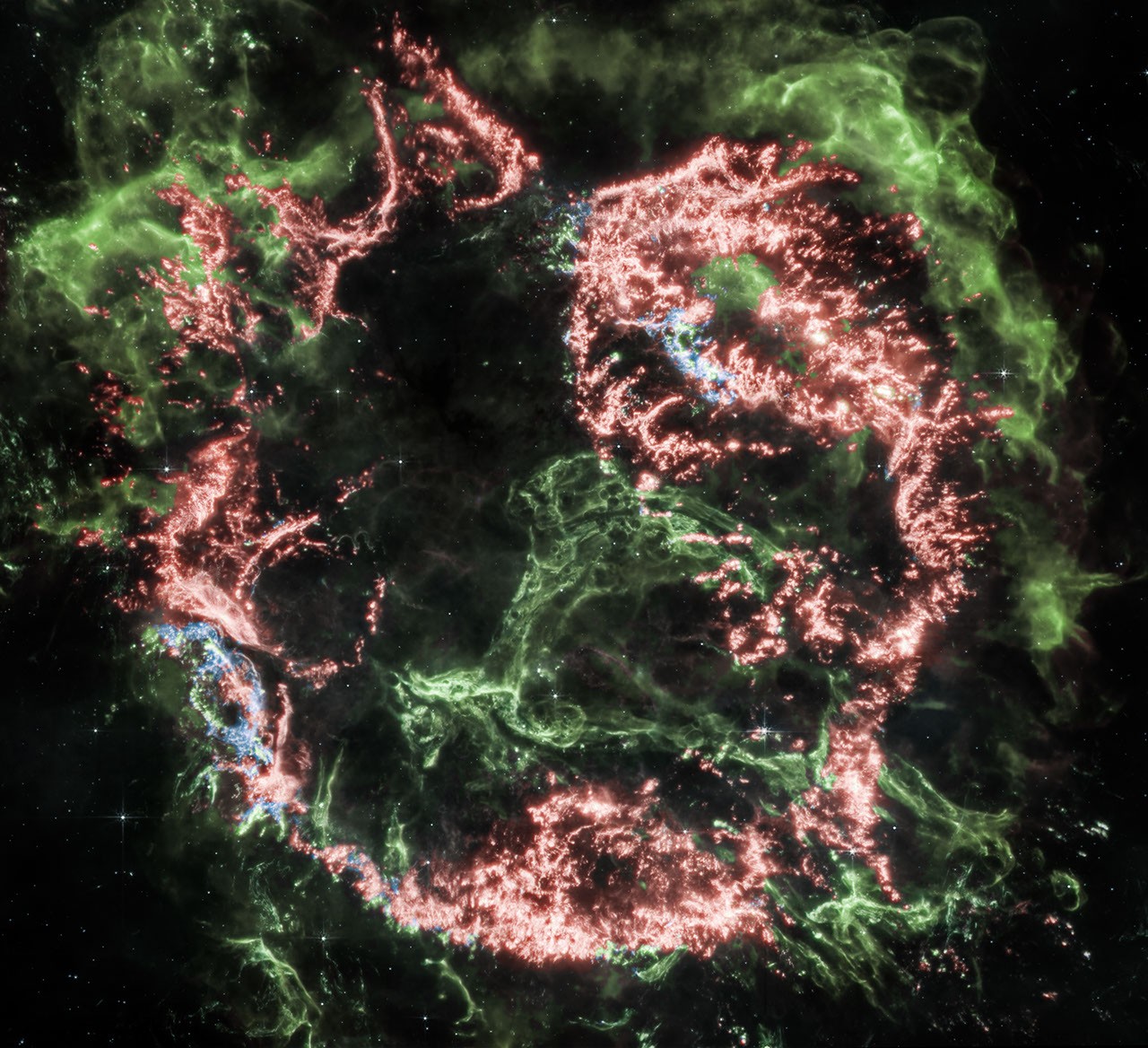
Supernova remnants, the scattered remnants of stellar explosions, are cosmic crucibles that not only mark the end of a star’s life but also provide the building blocks for future celestial generations. Webb’s unparalleled mid-infrared vision has captured Cassiopeia A in unprecedented detail, showcasing the complex tapestry of gas and dust. This intricate structure is offering astronomers a unique ‘fingerprint’ of the original star’s internal architecture and its evolutionary journey.
Stars are born from vast clouds of gas and dust. As gravity compresses these clouds, infant stars, or protostars, ignite. When a star like the one that formed Cas A exhausts its core hydrogen, it begins fusing heavier elements, creating distinct shells of different chemical compositions. When such a massive star finally explodes as a supernova, these elements are ejected into space. Some of this material then cools and condenses into dust grains, creating a chronicle of the star’s final moments.
Webb Detects Evidence of Internal Stellar Chaos
By meticulously mapping and analyzing the composition of individual dust clumps within Cas A, Webb has uncovered compelling evidence for a phenomenon known as a ‘shell merger.’ This occurs when the internal layers of a star mix and merge shortly before its supernova explosion. Such a dramatic internal churning, like the merging of oxygen and carbon-burning shells, would significantly alter the star’s structure and the chemical abundances observed in the supernova’s aftermath.
To pinpoint specific areas for Webb’s detailed examination, scientists utilized archival data from NASA’s Spitzer Space Telescope. Spitzer had identified three promising regions within Cas A. Webb’s observations revealed that one region within the ‘reverse-shocked’ area, where an inward shock wave meets the outward blast, was rich in silica dust, while another was dominated by carbon dust. A third striking feature, dubbed the ‘Green Monster’ and first identified by Webb, was found to be laden with complex magnesium silicates. Intriguingly, this feature originated from material shed by the star *before* its explosion, rather than from the supernova’s ejecta itself.
Source: NASA