The Chengdu High-Tech Disaster Reduction Institute has issued an apology following a significant deviation in its earthquake early warning for a 4.7 magnitude earthquake that struck Changning, Yibin, Sichuan province on August 24th.
Apology for Early Warning Discrepancy
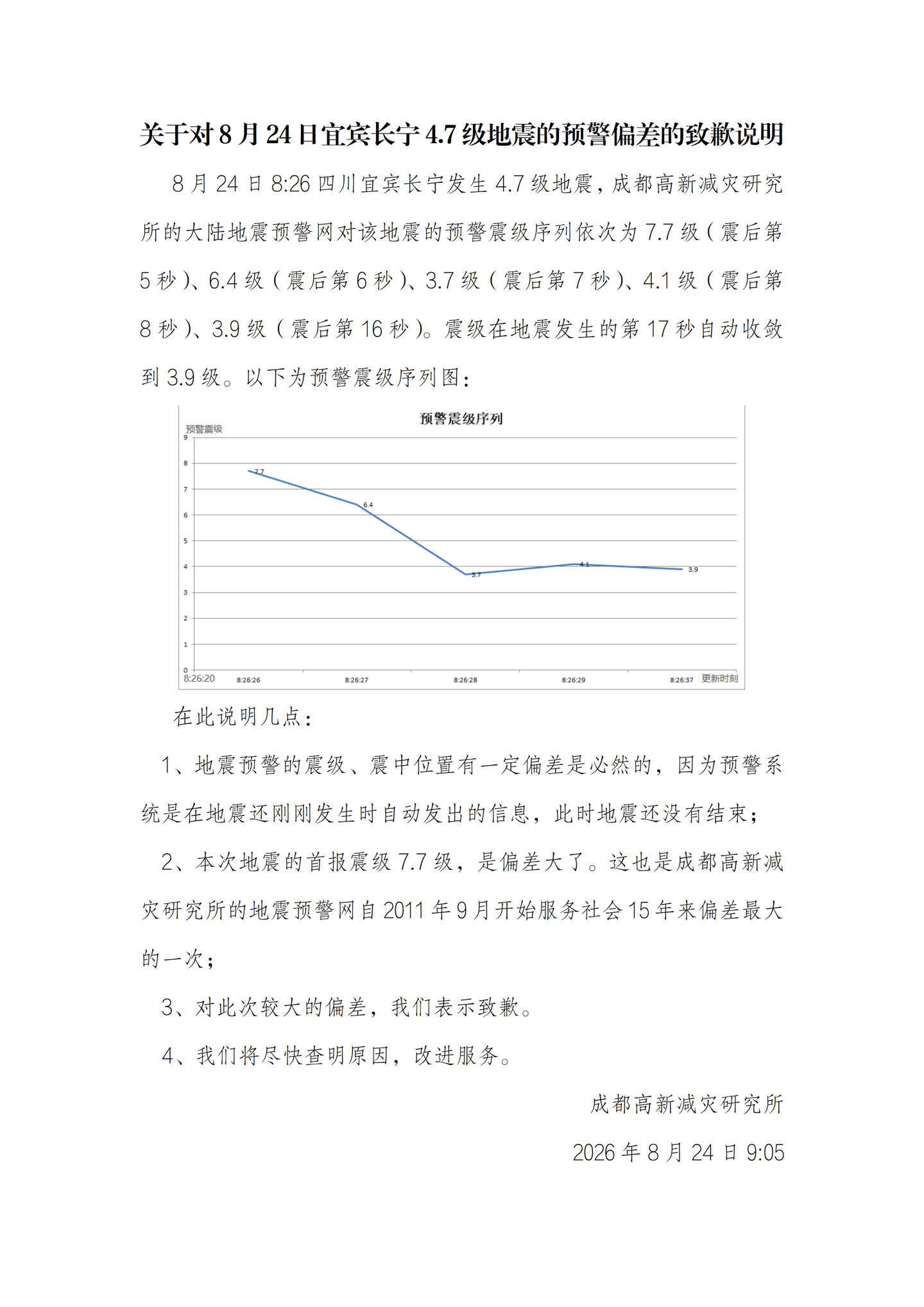
On August 24th at 8:26 AM, a 4.7 magnitude earthquake occurred in Changning, Yibin. The Chengdu High-Tech Disaster Reduction Institute’s China Earthquake Early Warning Network initially reported the quake with a magnitude of 7.7 just five seconds after it began. Subsequent reports showed significant fluctuations: 6.4 magnitude at 6 seconds, 3.7 magnitude at 7 seconds, 4.1 magnitude at 8 seconds, and 3.9 magnitude at 16 seconds. The system stabilized at 3.9 magnitude by the 17th second.
The institute acknowledged that some deviation in initial magnitude and epicenter location is inherent in earthquake early warning systems, as warnings are issued while the seismic event is still in progress.
However, the initial report of a 7.7 magnitude was deemed a substantial error. The institute stated that this was the largest deviation recorded since its earthquake early warning network began providing services to the public in September 2011, a period of 15 years.
Expressing regret for the significant inaccuracy, the institute has pledged to thoroughly investigate the cause of the large discrepancy and implement improvements to its services to prevent similar issues in the future.
Understanding Earthquake Early Warning Systems
Earthquake early warning (EEW) systems aim to provide seconds to tens of seconds of advance notice before strong shaking arrives. These systems detect seismic waves generated by an earthquake and transmit alert signals to protected areas. The effectiveness and accuracy of these warnings depend on several factors, including the speed of seismic wave propagation, the density of the monitoring network, and the algorithms used to estimate earthquake parameters.
The initial seconds after an earthquake strike are crucial for data collection. During this phase, the system rapidly processes information from seismometers to estimate the earthquake’s magnitude, location, and potential impact. This rapid estimation process can lead to initial inaccuracies, which are then refined as more data becomes available.
In this specific case, the discrepancy between the initial 7.7 magnitude report and the final 4.7 magnitude highlights the challenges inherent in real-time seismic event characterization. While EEW systems are invaluable tools for mitigating earthquake damage, their initial reports may require user interpretation and caution, especially in the moments immediately following an event.
The Chengdu High-Tech Disaster Reduction Institute’s commitment to transparency and continuous improvement is crucial for maintaining public trust in its vital early warning services. By identifying and rectifying the root causes of this significant deviation, the institute aims to enhance the reliability and accuracy of its future alerts, ensuring better preparedness and safety for communities in seismically active regions.