NASA’s Mars rover Curiosity has successfully completed a significant research phase in a new area of Gale Crater, collecting its 48th rock sample. Discoveries made in a locale dubbed ‘Cache Creek’ promise to shed light on the Red Planet’s ancient geological history, with scientists eagerly awaiting analysis results in hopes of finding mineral ‘gold’ that could reveal insights into Mars’s past lakes.
From Gold Rush to Cosmic Discoveries
The ‘Cache Creek’ region on Mars draws its name from a geologically diverse area in British Columbia, Canada. This Canadian locale is renowned for its unique rock formations, including oceanic crust, marine sediments, volcanic rocks, and glacial deposits. Of particular interest are lakes with unusual chemistry, which could serve as an analog for understanding the bodies of water that once existed on Mars. Furthermore, the Canadian ‘Cache Creek’ is situated at the southern end of an 1860s gold rush trail, where prospectors feverishly sought riches.
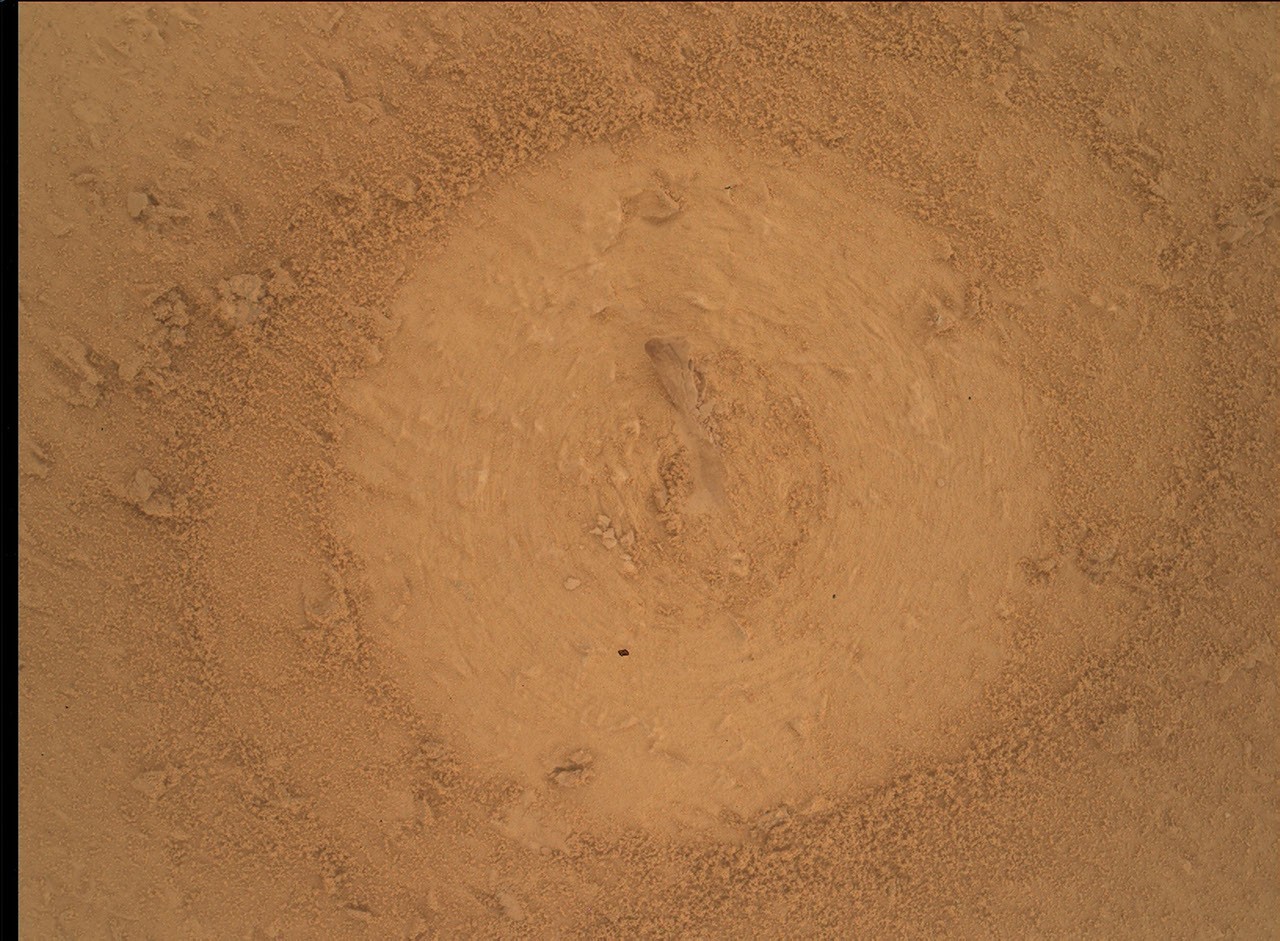
The Curiosity rover, having already traversed over 38 kilometers and ascended more than a kilometer in altitude, has reached a new research quadrangle. This area had been pre-designated with specific names for investigation even before the rover’s landing. Now, the rover has gained access to potential geological treasures that could be as scientifically valuable as gold. The successful drilling of the 48th rock sample, named ‘Basque Lakes’ within ‘Cache Creek,’ marked the culmination of a week’s worth of team planning. Scientists are meticulously examining this site, employing the rover’s instruments for detailed analysis of the rock’s texture, chemical composition, and other characteristics.
A ‘Gold Vein’ of Information
To study ‘Basque Lakes,’ the Curiosity team deployed a suite of key instruments. The Mars Hand Lens Imager (MAHLI) captured close-up images of the rock from distances as little as one centimeter, scrutinizing its texture. The Alpha Particle X-ray Spectrometer (APXS) was placed in contact with the rock to measure its elemental composition, and the ChemCam laser analyzed its surface, providing additional compositional data. These contact investigations helped assess the rock’s stability and informed the decision to drill.
Despite energy constraints, particularly during drilling and subsequent analysis, and considering the rover’s considerable age, engineers managed to plan additional scientific operations. The Mastcam camera captured panoramic images of the surrounding landscape to provide context for the new sample. ChemCam also investigated another nearby rock, ‘Peace River,’ utilizing its spectral capabilities to study the new drill hole and surrounding material. The Navcam and Mastcam cameras continue to monitor the environment and atmospheric conditions within Gale Crater.
Analysis of the ‘Basque Lakes’ sample will continue next week with the delivery of material to the Sample Analysis at Mars (SAM) instrument, which will help uncover more ‘nuggets’ of information about the history of this rock. The rover is expected to remain at this location for another week before continuing its journey toward Mount Sharp, unraveling more of Mars’s mysteries.