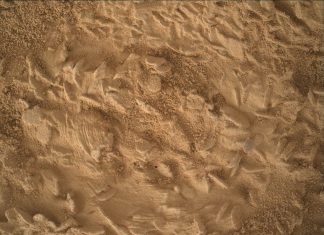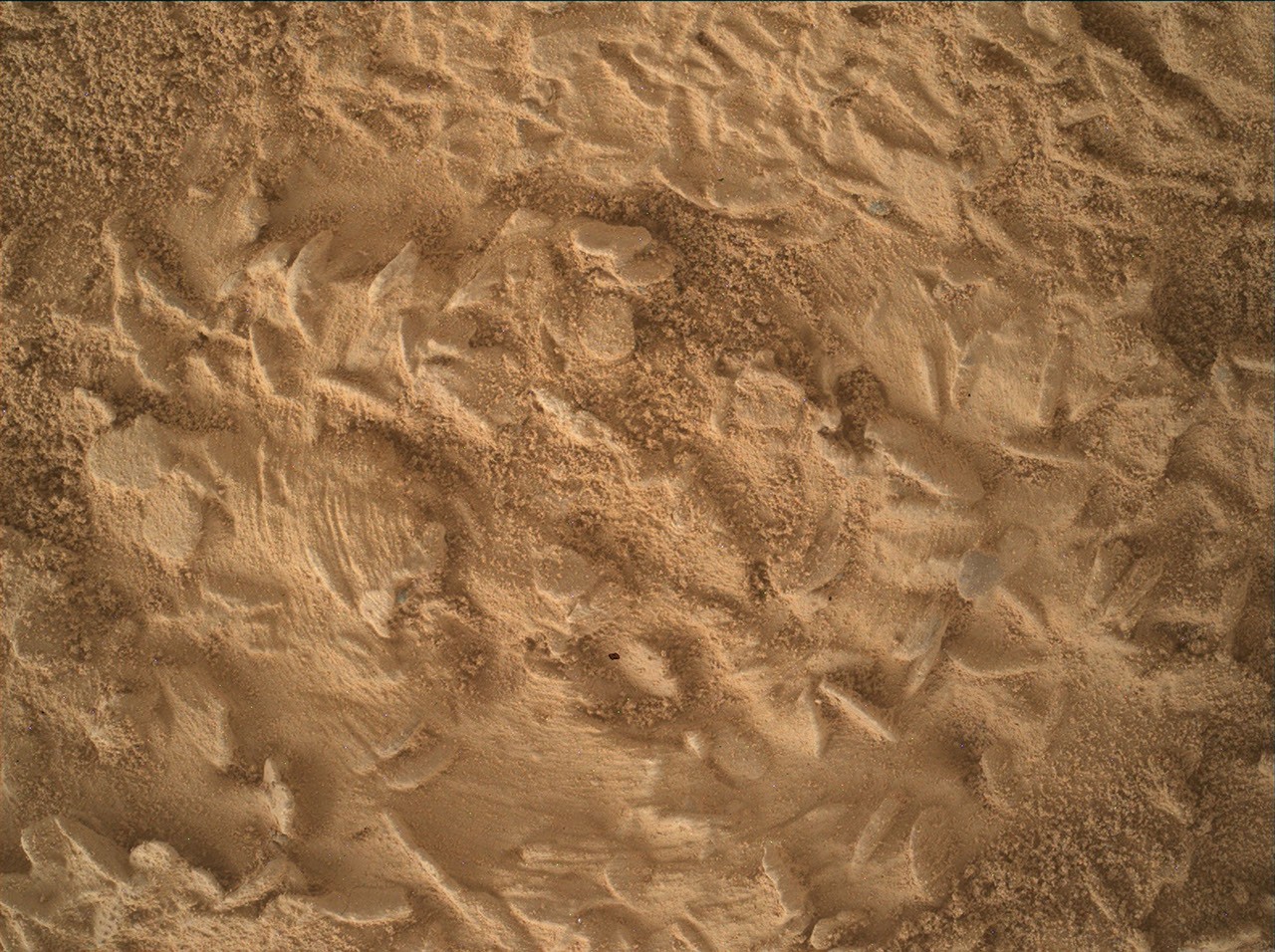
NASA’s Curiosity rover is gearing up for a significant new phase of its Mars mission, focusing on a region unofficially dubbed “Nazca” for its remarkable crystalline formations. Over Martian days (sols) 5043 to 5049, the rover team has been preparing to drill into this area, which holds the potential to unlock secrets about Mars’ geological history and ancient environmental conditions.
Intriguing Crystal Structures Offer Glimpse into Mars’ Past
Following its drilling campaign at “Basque Lakes,” Curiosity repositioned itself to a nearby rock outcrop, adjacent to a previously investigated site known as “Chiu-Chiu.” While Chiu-Chiu proved unsuitable for drilling, the neighboring outcrop has revealed itself as exceptionally promising. Image analysis conducted after the rover’s move confirmed the presence of numerous “disk-shaped and needle-like” formations, similar to those observed at Chiu-Chiu. This discovery prompted the mission team to swiftly authorize preparations for drilling at the new, aptly named “Nazca” site.
The prevailing hypothesis for the formation of these distinctive textures points to crystal growth processes. Minerals tend to form specific shapes dictated by their microscopic crystalline structure, much like salt crystals growing in a home environment. The substantial size of the crystal features at both Nazca and Chiu-Chiu provides valuable data regarding the ambient temperature at the time of their formation, as well as the availability of salts and liquids.
In-Depth Investigation and Analysis Underway
Before commencing drilling, specialized observations were planned as part of the lead-up to a preliminary load test, aimed at characterizing the crystal formations in detail. The Mars Hand Lens Imager (MAHLI) camera, mounted on the rover’s robotic arm, will conduct observations using a “Quantitative Relief Model” (QRM) technique to generate a detailed three-dimensional model. Additionally, MAHLI will capture a series of high-resolution images, doubling the number of focus mechanism steps to significantly enhance the clarity of the 3D models.
Concurrently, the ChemCam instrument, specifically its Laser-Induced Breakdown Spectroscopy (LIBS) component, will perform a “depth profiling” experiment on a nearby crystalline-rich area called “Tucan.” Instead of the usual distribution of 150 laser shots across five points, all shots will be concentrated on a single spot. Each laser pulse ablates a small amount of rock, creating plasma. This focused approach means the 150 shots will penetrate approximately five times deeper than a standard observation, allowing for an examination of the composition of deeper layers within a crystal formation and a comparison with its surface composition. This will help identify potential differences related to the influence of the modern Martian environment or specific formation conditions of the crystalline structures.
Prior to drilling at “Nazca,” the LIBS, Dust Removal Tool (DRT), and Alpha Particle X-ray Spectrometer (APXS) instruments will also be employed for a comprehensive analysis of the surface composition. A third LIBS analysis will be conducted on an adjacent block, “Condor,” which exhibits a fine-layered texture. Furthermore, the Curiosity team continues to monitor the current Martian atmosphere, particularly the onset of the cloud season. Nighttime imaging of Phobos, one of Mars’ two moons, has been scheduled. This observation will help assess the particle size in Martian clouds by analyzing the sunlight reflected off Phobos and its scattering in the atmosphere.