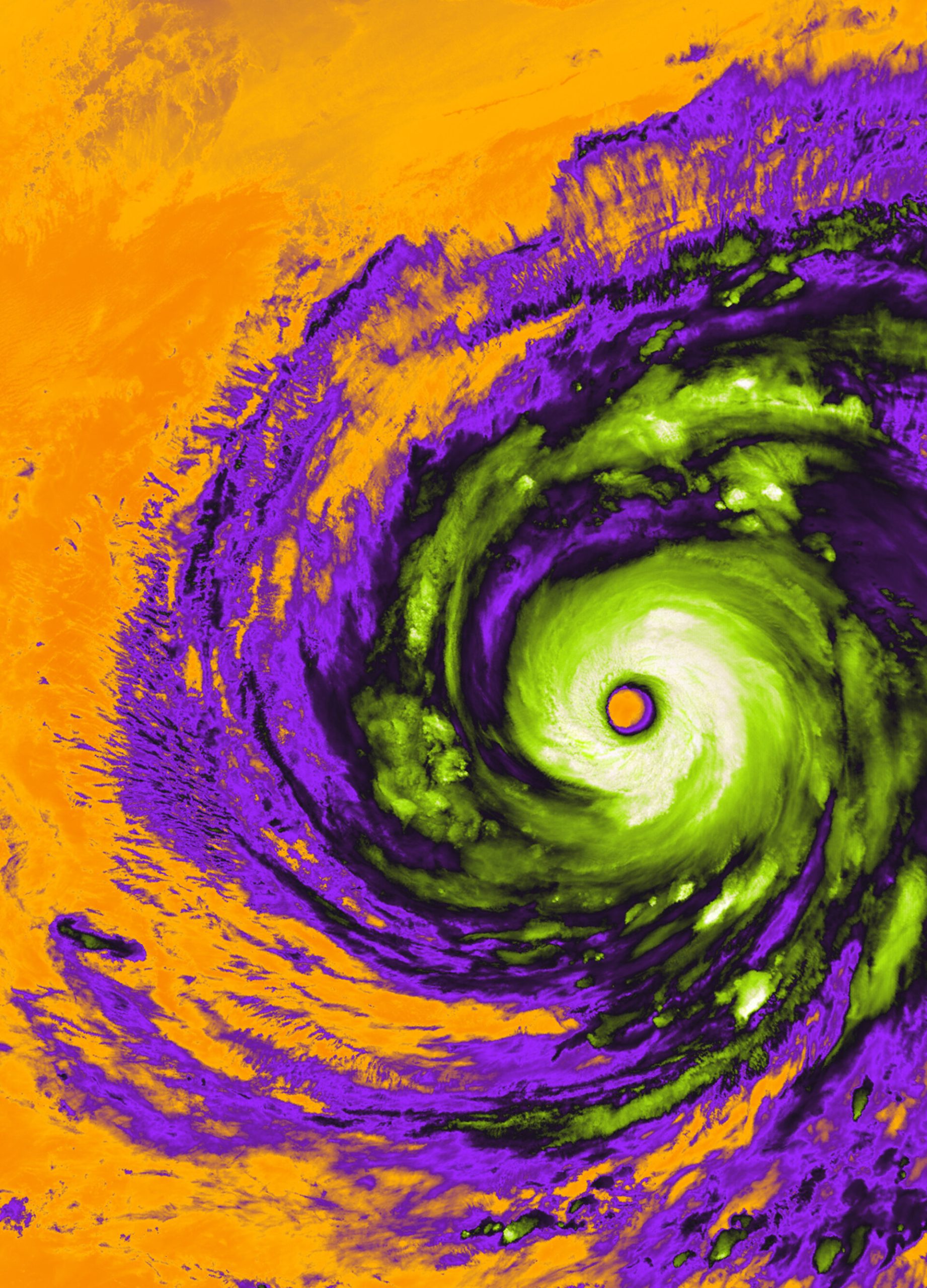
The immense power of nature has been vividly showcased from space with a stunning false-color image of Super Typhoon Champi, captured by the Copernicus Sentinel-3 satellite. This colossal storm, observed off the coasts of Taiwan and the Philippines on October 21, 2026, features an ‘eye’ approximately 50 kilometers wide, a chilling spectacle that evoked Halloween themes with its spectral hues. As the strongest tropical cyclone recorded for the year, with sustained winds reaching a staggering 296 km per hour, Champi delivered a stark reminder of Earth’s dynamic and sometimes destructive weather systems.
Unveiling the Storm’s Structure
The Sea and Land Surface Temperature Radiometer aboard Sentinel-3 provided an unprecedented look at the storm’s dynamics. This advanced instrument measures radiance in thermal infrared wavelengths, allowing scientists to infer brightness temperatures and visualize the different atmospheric layers. The resulting false-color image uses distinct colors to highlight these temperature variations, painting a dramatic picture of the typhoon’s core and surrounding cloud structures.
- Cold Cloud Tops: The striking green, white, and light grey areas represent the extremely cold cloud tops at the storm’s center, plunging to temperatures as low as -70°C.
- Mid-Level Clouds: Purple hues indicate clouds with temperatures ranging from -30°C to -15°C.
- Warmer Surfaces: Orange areas signify warmer temperatures over both the ocean and land, averaging around 25°C.
This imagery effectively illustrates the fundamental process driving the typhoon: the interaction of frigid cloud systems moving over the warm ocean surface.
Impact and Scientific Significance
Beyond its visual awe, Super Typhoon Champi’s immense strength resulted in significant consequences on the ground. The powerful storm triggered severe flooding and widespread damage across eastern Taiwan, while generating colossal waves up to 10 meters high near its epicenter. The data collected by Copernicus Sentinel-3 not only offers a breathtaking glimpse of Earth’s atmospheric phenomena but also provides crucial scientific insights for improving weather forecasting and understanding the behavior of these powerful cyclones, ultimately aiding in disaster preparedness and mitigation efforts globally.