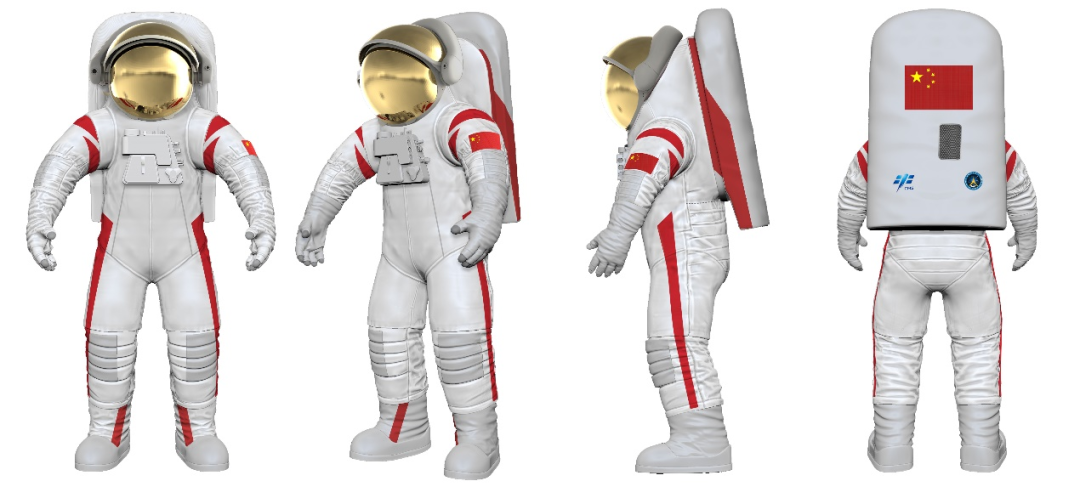
China’s advancements in extravehicular spacesuits have reached an internationally advanced level, with significant progress reported on the ‘Wangyu’ lunar spacesuit. This was announced today at the first Aerospace Medicine Engineering Conference in Tianjin, according to Xinhua News Agency.
Cutting-Edge Spacesuit Technology
Extravehicular spacesuits are critical for astronauts during spacewalks, ensuring their survival and enabling efficient work outside the spacecraft. The complexity and broad range of disciplines involved mean that only a handful of nations possess the capability for independent development of these suits.
Space Station Successes
Since the commencement of space station missions, China’s extravehicular spacesuit technology has seen substantial improvements. The nation has established a comprehensive research and development system for these suits, integrating ground-based and in-orbit verification. Key breakthroughs include ‘high-efficiency human-suit protection, long-life high-reliability suit defense and life support, high-reliability real-time information architecture for complex space environment information transmission, and integrated ground-space suit health assessment.’
These advancements have directly supported astronauts in setting a world record for a single spacewalk lasting 9 hours and have enabled a single suit to be used for 20 spacewalks over a 4-year period in orbit.
The ‘Wangyu’ Lunar Spacesuit
The ‘Wangyu’ lunar spacesuit, under development since 2020, is specifically designed to meet the demands of complex lunar surface activities and extreme environmental challenges. With a focus on lightweight, compact, high-efficiency, and highly reliable design, the project has overcome dozens of critical technical hurdles and is progressing smoothly.
Second-Generation ‘Feitian’ Suits in Action
China’s second-generation ‘Feitian’ extravehicular spacesuits made their debut on July 4, 2021, during the Shenzhou-12 mission. To date, these suits have successfully supported 27 spacewalks for the space station. As stated by Zhang Wanxin from the China Astronaut Research and Training Center, the overall technology of these suits is now considered internationally advanced.
Through lifespan assessments and in-orbit health monitoring, the operational lifespan of China’s extravehicular spacesuits in orbit has been extended to ‘4 years and 20 uses,’ meaning they can be stored for four years and used for at least 20 spacewalks within that timeframe.
Astronaut’s Perspective
Astronaut Chen Dong shared his experience, stating, ‘During the Shenzhou-14 and Shenzhou-15 missions, I performed 6 spacewalks, all wearing extravehicular spacesuit B. Not only the extravehicular spacesuits, but also the upcoming lunar suits, I look forward to wearing them and venturing into space again.’
China’s Lunar Ambitions
The lunar exploration phase of China’s manned lunar program has been fully initiated, with the goal of landing Chinese astronauts on the Moon before 2030. The lunar suit is a vital piece of equipment for these future missions, designed to provide life support and operational assistance for astronauts conducting extravehicular activities on the Moon’s surface. It will offer comprehensive protection against the Moon’s vacuum, extreme temperatures, lunar dust, and radiation, enabling astronauts to perform tasks such as walking, climbing, driving lunar rovers, and conducting scientific research.