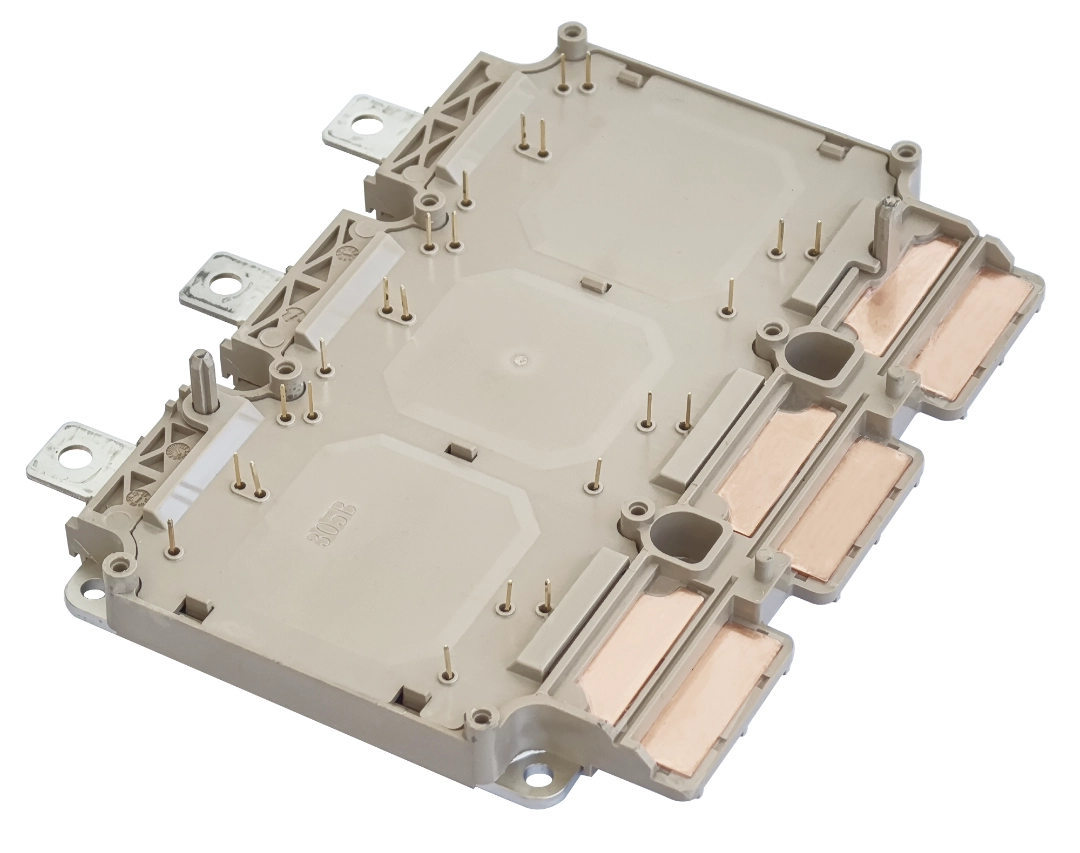
BYD Semiconductor has unveiled its latest generation of automotive-grade 1000V Silicon Carbide (SiC) power modules, the V-305B. This new module is engineered to overcome the limitations of traditional SiC solutions, particularly concerning stray inductance, which has been a bottleneck for high-voltage platforms.
Addressing the 1000V Platform Challenge
As 1000V high-voltage systems gain traction in mass production, issues like high stray inductance and limited power density in conventional SiC designs become more apparent. BYD’s V-305B module directly tackles these pain points. It boasts a blocking voltage exceeding 1500V, providing ample voltage margin for 1000V applications. Crucially, the module itself features a remarkably low parasitic inductance of just 5.5nH. When integrated with peripheral components, the overall system stray inductance can be maintained below 10nH.
This significant reduction in stray inductance, compared to the typical 20nH or higher found in older modules, offers substantial benefits. It leads to a 30% decrease in switching peak voltage and a 30% reduction in switching losses. Under 1000V operating conditions, the V-305B module can deliver an output current exceeding 650Arms, making it suitable for high-power electric drives and fast-charging systems.
Innovative Design and Advanced Manufacturing
The V-305B module’s design incorporates advanced manufacturing techniques to achieve its performance targets. It features a DC busbar stacked terminal design with laser welding, minimizing the power loop area. Replacing traditional wire bonding with laser welding for chip-to-terminal connections results in lower contact resistance and a shorter current path. This innovative approach is key to achieving the ultra-low inductance figures.
Enhanced Reliability and Thermal Management
Reliability is paramount in automotive applications, and BYD has implemented several features to ensure the V-305B’s durability. The SiC chips utilize a double-sided silver sintering process, which lowers thermal resistance. The module’s substrate is made of Silicon Nitride AMB (Active Metal Brazing) material, known for its high thermal conductivity and strong resistance to thermal shock. The baseplate employs an elliptical segmented structure to optimize both heat dissipation area and fluid resistance. For enhanced vibration resistance, ultrasonic welding is used for the connection between the frame and the substrate. Additionally, the encapsulating silicone gel has a glass transition temperature (Tg) of 200℃, and the internal driver circuit features a symmetrical layout to ensure balanced current distribution among parallel chips.
Available Configurations and Specifications
BYD Semiconductor has already released several variants of the V-305B module, including 1200V/1040A, 1500V/1400A, 1500V/1040A, and 1500V/840A. All models share a uniform physical dimension of 154.5×128.5×32mm³ and weigh 780g.
Note: Stray inductance refers to the non-ideal inductance generated by parasitic parameters within a power module. Excessive stray inductance can cause voltage spikes during switching, increase switching losses, and hinder the effective utilization of SiC devices’ high-frequency and high-voltage capabilities. BYD’s V-305B module directly addresses this critical limitation.