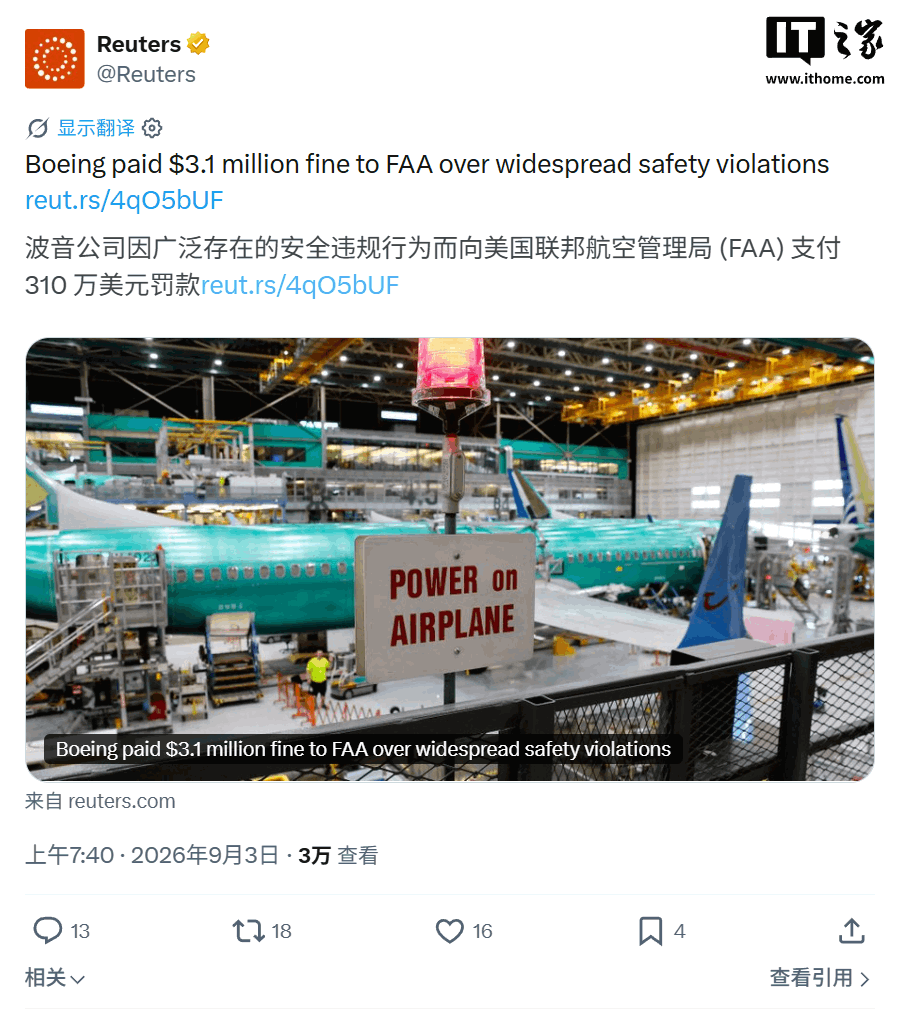
The Federal Aviation Administration (FAA) has disclosed that Boeing paid a $3.1 million fine earlier this year. This penalty, initially proposed in 2025, addresses a series of safety and compliance issues, including those connected to the 2024 Alaska Airlines 737 MAX 9 incident.
A History of Compliance Issues
The FAA’s penalty, which was not previously disclosed, stems from multiple violations. Among them, Boeing was cited for interfering with the independence of safety inspectors and submitting two aircraft for approval that did not meet airworthiness standards. These findings highlight ongoing challenges in Boeing’s quality control and adherence to regulatory requirements.
Factory Inspections Uncover Hundreds of Violations
Further scrutiny of Boeing’s manufacturing processes came to light following inspections of the company’s 737 factory in Renton, Washington, and its fuselage supplier, Spirit AeroSystems, in Wichita, Kansas. These inspections, conducted in 2024, revealed hundreds of quality system violations that occurred between September 2023 and February 2024. The depth and breadth of these issues underscore systemic problems within Boeing’s production environment.
Pressure on Inspectors and Non-Compliant Aircraft
One particularly concerning incident involved a Boeing employee pressuring a colleague, who was acting on behalf of the FAA, to sign off on a release document for a 737 MAX. The colleague had determined the aircraft was not airworthy, but the pressure was applied to meet delivery deadlines. This behavior raises serious questions about the company’s commitment to safety over production targets.
Criticism of FAA’s Penalties
The fines imposed by the FAA have faced criticism for being insufficient. U.S. Senator Richard Blumenthal has previously stated that such penalties are easily absorbed by Boeing as a cost of doing business rather than serving as a genuine deterrent against unsafe practices. This sentiment reflects a broader concern that regulatory enforcement may not be robust enough to compel fundamental change.
The Alaska Airlines Incident and Its Aftermath
The catalyst for much of this increased regulatory attention was the mid-flight incident on January 5, 2024, when a door plug detached from an Alaska Airlines 737 MAX 9. The subsequent investigation by the National Transportation Safety Board (NTSB) found that the aircraft was missing four critical bolts that secure the door plug. This event severely damaged Boeing’s reputation, leading to the temporary grounding of the MAX 9 variant and the imposition of a production cap of 38 737 MAX aircraft per month by the FAA. This production limit was eventually lifted in October 2025.
Regaining Trust and Certification Authority
In July 2026, the FAA announced that Boeing was permitted to resume issuing its own airworthiness certificates for all 737 MAX and 787 aircraft. This decision followed months of detailed data and safety reviews, confirming sustained and stable production quality. The authority to self-certify is a critical function for aircraft manufacturers, signifying a level of trust restored after periods of intense oversight. An airworthiness certificate is the official document confirming an aircraft meets design standards and is safe for commercial operation.
Boeing’s struggle to maintain consistent quality and compliance has been a significant challenge, impacting its operations and its relationship with regulators and the flying public. The recent fine and past scrutiny serve as a stark reminder of the critical importance of safety in the aerospace industry.