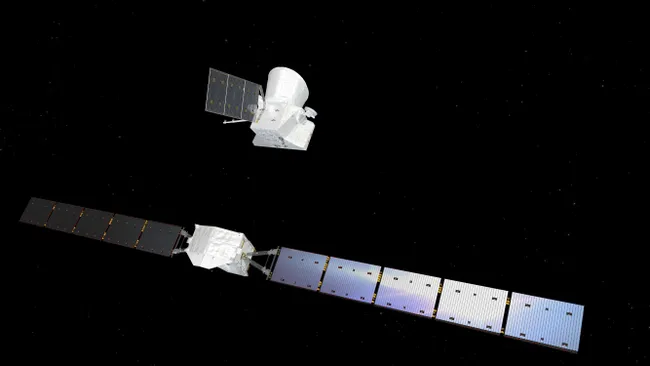
After a journey spanning nearly eight years and covering approximately 10 billion kilometers, the BepiColombo spacecraft has successfully completed a crucial maneuver: the separation of its transfer module. This milestone marks the beginning of the final leg of its mission to explore Mercury, with orbital insertion now anticipated for November 21, 2026.
A Joint Endeavor Nearing Its Goal
BepiColombo, a collaborative mission between the European Space Agency (ESA) and the Japan Aerospace Exploration Agency (JAXA), embarked on its voyage on October 19, 2018, launching atop an Ariane 5 rocket from Kourou, French Guiana. The spacecraft comprises two main components: the Mercury Planetary Orbiter (MPO) developed by ESA and the Mercury Magnetospheric Orbiter (Mio) from JAXA.
On September 3rd, the transfer module, which was instrumental in providing propulsion and power for the interplanetary cruise, was detached. This separation allows the MPO and Mio to proceed independently towards Mercury. The two orbiters will now navigate the final approximately six months of their journey together.
The Final Approach and Scientific Objectives
The mission’s orbital insertion phase is scheduled to commence on November 21, 2026. This will involve a series of 16 orbital maneuvers to precisely align the spacecraft with Mercury. Following this, the Mio is expected to separate on December 9, 2026, while the MPO is slated to enter its polar orbit on March 10, 2027.
The scientific operations are planned to begin synchronously on April 6, 2027. Both orbiters will then commence their distinct investigations of Mercury. The mission aims to conduct comprehensive studies of the planet’s surface, interior, and magnetic field. A key focus will also be on understanding the complex interactions between Mercury’s magnetosphere and the solar wind.
Unlocking Mercury’s Secrets
Mercury, the smallest planet in our solar system and the closest to the Sun, remains a planet of significant scientific interest due to its extreme conditions and enigmatic properties. Its proximity to the Sun results in dramatic temperature fluctuations and intense solar radiation, posing unique challenges for spacecraft operations.
The BepiColombo mission is designed to shed light on several key questions about Mercury. By studying its surface, scientists hope to learn more about its formation and geological history. Analyzing its internal structure will provide insights into its surprisingly large iron core. Furthermore, the investigation of its weak but complex magnetic field and its interaction with the solar wind promises to reveal crucial details about planetary magnetospheres and space weather.
The successful separation of the transfer module and the upcoming orbital insertion represent major achievements for the ESA and JAXA teams. The long journey is a testament to the engineering prowess involved in deep space exploration. As BepiColombo draws closer to its destination, the scientific community eagerly anticipates the data that will undoubtedly deepen our understanding of this fascinating, yet elusive, innermost planet.