In a significant milestone for the International Space Station (ISS), two astronauts have successfully installed and deployed the penultimate upgraded solar array, marking a major step in the station’s power system enhancement. The spacewalk, which took place on Thursday, October 29th, was the 100th spacewalk conducted by NASA astronauts outside the station since the retirement of the Space Shuttle program.
A Seven-Hour Spacewalk for Power Upgrade
NASA astronaut Anil Menon and Canadian Space Agency astronaut Joshua Kutryk, both members of the ISS’s 75th Expedition, completed their 7-hour and 11-minute extravehicular activity (EVA). The mission, which commenced at 3:08 PM Eastern Time, utilized the station’s ‘Quest’ airlock for both their departure and return. Both astronauts were equipped with NASA’s Extravehicular Mobility Units (EMUs) for the demanding task.
This spacewalk also holds historical significance as it marks the first time a Canadian astronaut has performed a spacewalk since David Saint-Jacques accompanied NASA’s Anne McClain in April 2019.
Installation of the iROSA Array
Upon exiting the station, Menon and Kutryk began by unfastening the securing bolts of the International Space Station Roll-Out Solar Array (iROSA) from its temporary storage platform. This particular solar array, measuring 3 meters by 0.6 meters by 1.2 meters in its stowed configuration, was delivered to the ISS earlier in the month via the unpressurized cargo bay of a SpaceX Dragon cargo spacecraft. This delivery was part of the 35th resupply mission executed by SpaceX for NASA.
With Menon positioned at the end of the Canadarm2, he transported the 340-kilogram solar array to its designated location on the port side of the station. Kutryk, meanwhile, traversed the station’s main truss to reach the worksite. The duo collaborated to install the array onto the 2A power channel.
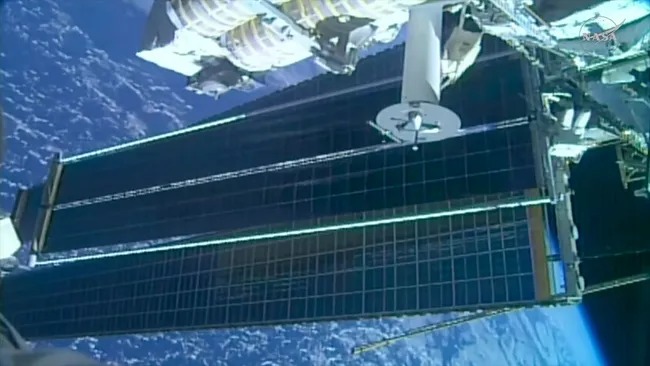
For safety reasons, the astronauts secured the solar array and connected its cables to the station’s power system while the ISS was passing through Earth’s shadow. Once connected, the array is designed to deploy without the need for motorized assistance. The stored potential energy within the retractable carbon fiber composite arms is sufficient to fully unfurl the array to its entire 19-meter length.
Power Boost for Future Missions
Approximately 4 hours and 23 minutes into the spacewalk, the ground mission control confirmed, “We are seeing the roll-out solar array deploying.” About 12 minutes later, the array was fully extended, covering roughly half the area of an older, degraded solar panel on the P4 truss. The original eight solar arrays on the ISS had surpassed their 15-year design life, leading to a continuous decline in power generation capacity.
The integration of the new iROSA with the existing arrays is expected to boost the station’s overall power generation by 20% to 30%. This additional power is crucial for supporting the ISS’s current operations and its future planned missions, including the controlled de-orbit planned for 2030.
Efficient Progress and Future Plans
Due to the rapid progress of the spacewalk, Menon and Kutryk were able to remove brackets from the temporary platform that were intended for the final iROSA. They also rotated two launch locks that were used during the Dragon spacecraft’s transport.
This EVA on Thursday marked the 100th spacewalk for NASA outside the ISS since the end of the Shuttle era. Across all missions, it was the 285th EVA conducted for the assembly, maintenance, and upgrading of the ISS, with 66 originating from the Russian segment and 119 performed by visiting Space Shuttle crews.
The first EVA conducted by NASA from the Quest airlock was on February 20, 2002, by Carl Walz and Daniel Bursch of the Expedition 4 crew. That spacewalk lasted 5 hours and 47 minutes and was primarily focused on testing the Quest airlock systems and performing basic maintenance.
A Milestone Achieved
Reflecting on the experience, Menon stated, “Being outside, I can tell you it’s always sunny in space. It is incredibly breathtaking to be able to put a brand new solar array on the space station.” He added, “It’s an incredible milestone, 100 EVAs for the U.S. on orbit, and it really speaks to what we’ve been able to accomplish.”
This was Menon’s fourth spacewalk, and Kutryk’s first. Menon’s cumulative time spent on spacewalks during his current ISS mission now stands at 26 hours and 31 minutes. Kutryk becomes the fifth Canadian astronaut to perform an EVA.
Menon and Kutryk are scheduled to conduct another spacewalk on November 5th, during which they will install the eighth and final iROSA. This upcoming EVA will officially conclude a five-year project to upgrade the ISS’s power system.