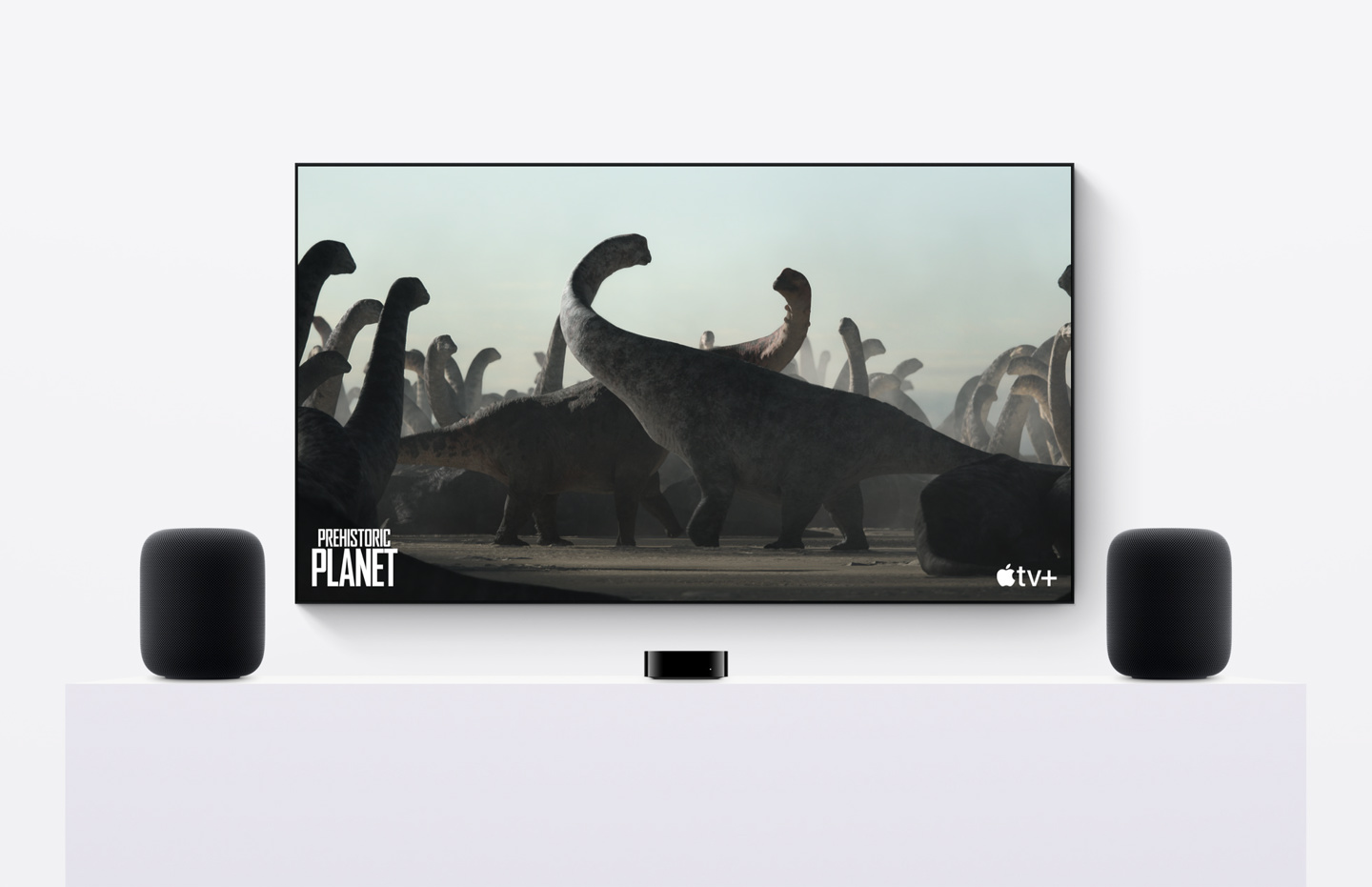
A recent discovery within Apple’s audioOS 27 system files suggests the tech giant is exploring a powerful new home theater setup. A user on the MacRumors forum spotted tuning files in the latest beta that outline a configuration utilizing four HomePod speakers to create a low-latency, surround sound experience.
Four HomePods, Four Roles
The tuning files, identified within audioOS 27 Beta 8 (version 24J5360a), indicate that Apple is testing the ability to assign distinct roles to four HomePod speakers: front left, front right, rear left, and rear right. Each speaker would receive independent sound processing tailored to its designated position.
Front speakers are expected to handle dedicated left and right channel processing, with specific compensation for placement near walls or in corners to optimize audio performance. The rear speakers, on the other hand, are designed for omnidirectional sound field processing, aiming to envelop the listener from behind and around.
Advanced Audio Calibration
Beyond role assignment, the system appears to manage individual speaker components, including bass and treble units, along with controlling bass, equalization, synchronization, and calibration data. While HomePods already possess the capability to analyze room acoustics and calibrate for single or stereo setups using built-in microphones, this new code extends that intelligence to a four-speaker array.
This includes dedicated measurement paths for surround sound, estimation of time-of-flight for each speaker, and a 4×4 mapping of speaker positions. This sophisticated calibration system would allow Apple to dynamically adjust the audio experience for various content types. This includes distinct profiles for dialogue enhancement, bass management, dynamic range control, equalization, and immersive spatial audio mixing.
Furthermore, the system appears to feature separate settings for music playback, including different bass, dynamic range, and EQ profiles compared to cinematic content.
Spatial Audio and Stereo Handling
For standard stereo sources, the system offers two modes. When spatialization is enabled, all four speakers will receive a processed, spatially-aware mix. When spatialization is turned off, regular stereo content will only play through the front speakers, with the rear speakers remaining silent or receiving a blank mix.
New Hardware Clues
The tuning files also hint at potential new hardware. A configuration codenamed “Forklift” is described as consisting of two AID12001 speakers and two AID12007 speakers. The AID12001 is believed to correspond to the second-generation HomePod (internal codename B620), which would serve as the front speakers in this setup.
The identity of the AID12007 speakers remains speculative. Some sources suggest they could be a new, smaller HomePod mini model, while others speculate they might represent a third-generation full-sized HomePod.
Party Mode for Stereo Pairs
Interestingly, the audioOS 27 files also contain references to a “Party Mode” for stereo pairs of second-generation HomePods. This mode utilizes an audio rendering method called “diffuse,” which aims to create a wider, more ambient mix, spreading music more evenly throughout a room for a more immersive listening experience when not using a full surround setup.