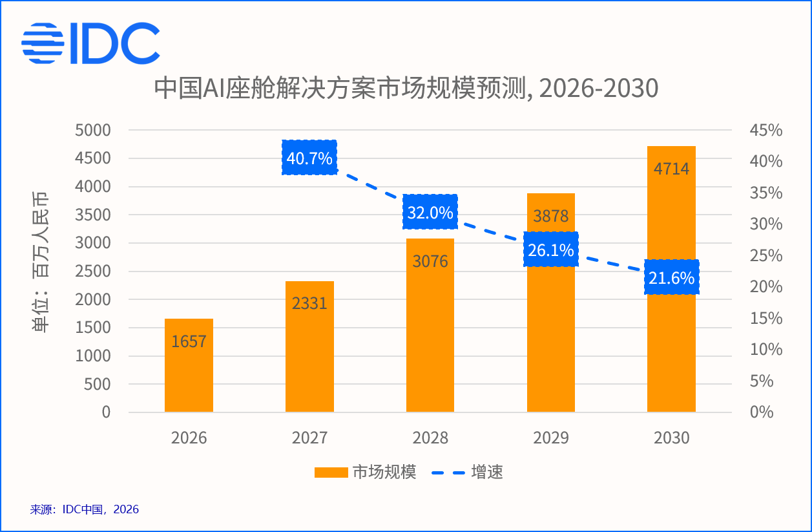
The automotive industry is witnessing a significant shift with the rapid integration of Artificial Intelligence into vehicle cockpits. International Data Corporation (IDC) has released its inaugural report tracking the AI Cockpit Solutions market in China, highlighting a burgeoning market driven by advancements in large language models, multimodal interactions, and cloud-edge collaboration architectures. These technologies are accelerating the adoption of AI-native applications such as intelligent voice assistants, navigation queries, content generation, and personalized recommendations within vehicles.
IDC Defines the AI Cockpit Landscape
IDC’s systematic tracking of the AI Cockpit Solutions market, presented within its ‘China Automotive Cloud Market Tracking’ report, categorizes the market into four key layers:
- AI Development Platforms/Software: Encompassing model development, agent orchestration, and deployment management.
- Model-as-a-Service (MaaS): Covering cloud, in-vehicle, and edge-cloud collaborative calls for large language models, multimodal models, and voice models.
- AI Applications: Including intelligent voice, AI assistants, navigation Q&A, and content generation.
- AI Operations Services: Focused on model updates, knowledge base management, operational monitoring, and continuous optimization.
Market Growth and Projections
The report projects substantial growth for the Chinese AI Cockpit Solutions market. By the first half of 2026, the market is expected to reach 710 million RMB, signaling a move from early exploration to large-scale production and ongoing operations. IDC forecasts the market size to reach 1.66 billion RMB for the full year 2026, with ambitious projections of 4.71 billion RMB by 2030. This indicates a compound annual growth rate of nearly 30%, underscoring the rapid scaling and commercialization within the sector.
Competitive Landscape and Key Players
The competitive landscape is marked by a strong concentration of leading players. For the first half of 2026, IDC data indicates that Volcengine holds the dominant position with a 45% market share, followed by Alibaba in second place. The report notes that the current leadership is primarily built upon extensive mass-production vehicle coverage and significant project experience with key clients, suggesting that the market structure is still fluid and far from solidified.
In the second tier, notable participants include:
- Baidu: Leveraging its existing cockpit business and capabilities in areas like mapping to maintain market presence.
- iFLYTEK: Steadily advancing its AI capabilities through cockpit domain software and hardware solutions, supported by an established customer base.
- Model Startups like Horizon Robotics: Deeply integrating with automakers and industry chain partners to enter the market, with some technologies already deployed in vehicles.
Overall, the market is in a dynamic evolutionary phase, with mass-production project experience, ecosystem collaboration capabilities, and consumer brand recognition emerging as critical competitive factors.
Evolving Business Models
The current billing methods in the AI Cockpit market are diverse. License authorization for functional suites remains the primary model, with pricing varying significantly based on the selected feature sets. For clients with strong in-house development capabilities requiring only foundational model services, public cloud models based on token or call volume serve as a crucial supplement. In-vehicle, edge-based deployments typically involve a one-time activation fee coupled with annual technical support and model iteration maintenance fees.
Automakers are increasingly focused on the return on investment (ROI) for AI integration. Pricing negotiations are increasingly centered on actual usage effectiveness and value density, widening the gap in value between deep-dive empowering projects and basic functional authorization. Furthermore, some vendors are exploring a transition from automaker-funded models to direct C-end user subscription payments, starting with benchmark projects, which opens up new revenue streams and market potential.
Technological Advancements: Edge-Cloud Synergy and Interaction Paradigms
The synergy between edge and cloud computing has become an industry consensus. Edge-side models are responsible for rapid responses to high-frequency, simple commands, while cloud-based large models handle complex reasoning and multimodal interactions, achieving a balance between user experience, latency, and cost.
In terms of interaction paradigms, AI cockpits are transitioning from a ‘passive response’ model to ‘proactive service.’ Previous generations of in-car voice assistants predominantly used a turn-based architecture involving ‘intent domain partitioning + multi-agent collaboration,’ which often resulted in fragmented interactions and limited usage frequency. Since 2026, several leading manufacturers have introduced next-generation cockpit solutions based on Agentic AI architectures. A common thread in these technological routes is the use of a unified AI hub to link functional domains such as vehicle control, navigation, and intelligent driving, thereby evolving cockpit interactions from turn-based Q&A to task-driven autonomous execution.
Publicly disclosed information reveals that leading manufacturers have deployed large-model-equipped vehicles in the millions, with daily cockpit interactions reaching tens of millions. Despite variations in statistical methodologies, AI in the cockpit is demonstrably shifting from a low-frequency ‘novelty feature’ to a high-frequency daily service for users, indicating a clear industry trend.