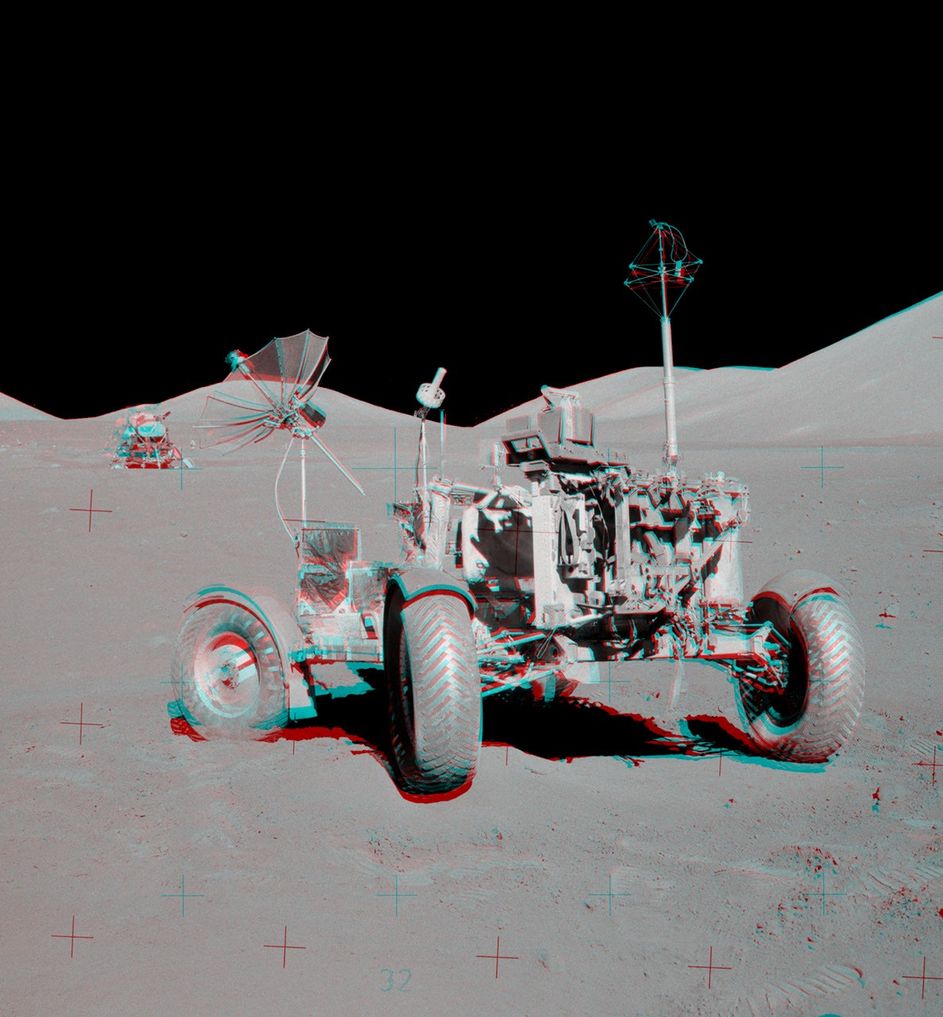
A newly rendered 3D image of the Apollo 17 landing site in the Taurus-Littrow valley offers a compelling perspective on humanity’s last journey to the Moon. The visualization showcases the lunar rover, the descent module, and the surrounding mountainous terrain, highlighting a pivotal moment in space exploration history.
Anaglyph Image Offers Unique Stereo View
The image is presented as a color anaglyph, a stereoscopic 3D effect achievable with red-and-cyan glasses. In the foreground, the Apollo 17 lunar rover is clearly visible, with the lunar module and the distinctive lunar hills behind it. This location is famously known as the VIP Site, chosen for its strategic placement to broadcast the lunar module’s liftoff in real-time using the rover’s onboard television camera.
Historic Significance of Apollo 17 Mission
Just over 50 years ago, astronauts Eugene Cernan and Harrison Schmitt spent more than three days – over 75 hours – on the lunar surface at this very spot. They collected a record 110 kg (242 lbs) of lunar soil and rock samples, the largest quantity ever gathered by any NASA lunar expedition. During their time on the surface, astronaut Ronald Evans remained in orbit around the Moon. Apollo 17, which concluded in December 1972, remains the final piloted mission to land humans on the Moon, making Cernan and Schmitt the last individuals to have walked and driven on Earth’s natural satellite.