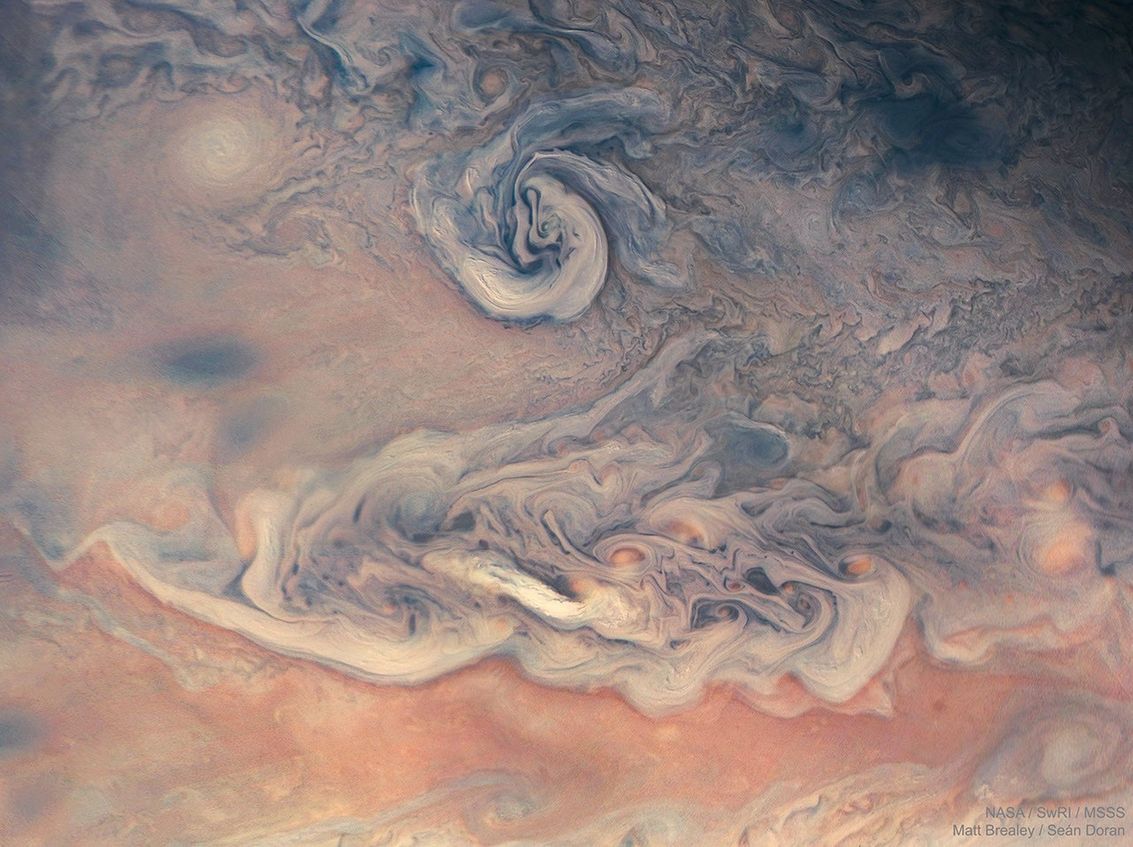
NASA’s Juno spacecraft has delivered a remarkable, colorful image of Jupiter’s cloud tops, offering scientists new insights into the forces that color its atmosphere and the structure of the gas giant’s upper layers.
What Creates Jupiter’s Atmospheric Colors?
Jupiter’s atmosphere is primarily composed of hydrogen and helium, gases that are colorless at the temperatures found in the planet’s upper atmosphere. The exact composition of the trace substances responsible for the vibrant hues of its clouds remains a subject of ongoing scientific investigation. A leading theory suggests that ammonium hydrosulfide (NH4SH) may act as a pigment, contributing to the diverse colors observed in the clouds.
The image, captured during Juno’s 14th close flyby in 2018, reveals that lighter clouds generally appear higher than darker ones. Lighter swirls surround reddish areas in the lower right portion of the frame, while simultaneously covering darker regions in the upper right.
Juno’s Mission
Juno orbits Jupiter elliptically, performing a close pass over the planet every 33 days. This orbital path allows the spacecraft to study different regions of the atmosphere. Analyzing these colorful images helps scientists gain a deeper understanding of the atmospheric processes, climatic conditions, and the structure of the largest planet in our solar system.