According to the latest data from “Loto Technology,” the Chinese market for mobile smart displays, sometimes referred to as “companion screens,” experienced a significant downturn in the third quarter of 2026.
What Are Smart Displays?
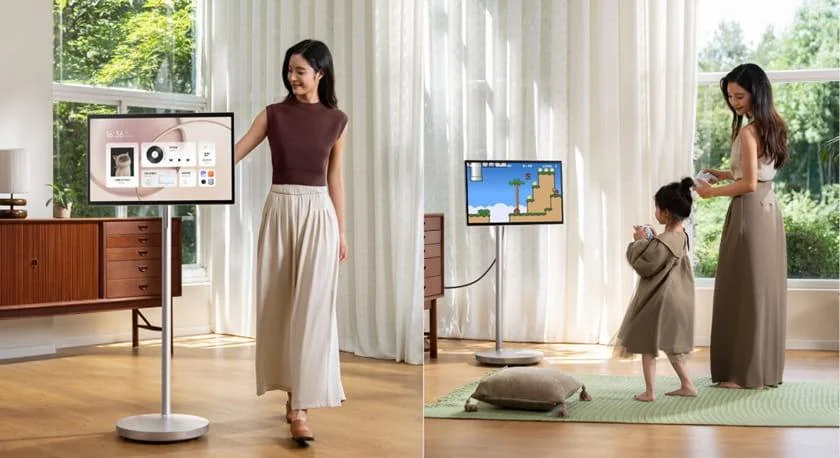
Essentially, these are large, portable touchscreen displays mounted on a high, mobile stand with wheels and a built-in battery. The concept was pioneered by LG with its StanbyME model and gained widespread popularity in China through Baidu’s Xiaodu series, marketed as “gadget girlfriends.” The idea is to have a device that is always nearby, like a best friend, un tethered to a power outlet or a single wall like a traditional television.
How They Work and What They’re For
- Design: These devices typically feature a 27 or 32-inch touchscreen (though 18-24-inch models also exist) mounted on a tall stand. The circular base discreetly houses inconspicuous wheels and a substantial battery, offering 3-5 hours of autonomous operation, with newer flagship models providing even longer endurance.
- Flexibility: The screen can be freely moved around the home, with adjustable height, tilt, and 90-degree rotation capabilities, allowing for portrait mode viewing perfect for scrolling through TikTok or following recipes.
- Internal Components: Inside, they run on an operating system, most commonly Android or proprietary interfaces with integrated AI assistants. They also feature quality speakers, a camera, and microphones.
- Use Cases:
In the kitchen: Place it nearby to watch series or cooking tutorials while preparing meals.
For fitness: Roll it to your yoga mat for full-height fitness or yoga sessions with an AI trainer.
In the bedroom: Position it close to the bed and tilt the screen to watch movies while lying down.
For work and study: Use it as a large secondary monitor, a digital drawing board, or an educational screen for children.

Sales and Revenue Statistics
In the third quarter of 2026, the total market sales volume reached 54,000 units, marking a 22.9% decrease compared to the same period last year. Sales revenue dropped by 14.0%, totaling 230 million yuan.
Concurrently, the average price of these devices increased by 11.5% year-over-year, reaching 4,240 yuan. This figure is also 6.1% higher than in the second quarter of 2026. This trend indicates that the market is not merely shrinking but undergoing significant structural changes.
Reasons for Rising Average Prices
Analysts at Loto Technology attribute the increase in average prices to two primary factors:
- Increased Cost of Goods Sold: Higher production expenses have directly led to an increase in retail prices.
- Shift Towards the Premium Segment: High-end models featuring capabilities like 4K resolution and extended battery life saw a notable rise in their market share during the third quarter. This has substantially driven up the overall average transaction value.
Changes in Sales Channels
The third quarter saw a growth in the share of offline sales channels. Their contribution to total sales volume reached 26.3% (up 3.3% year-over-year and 0.9% quarter-over-quarter). In terms of revenue, offline channels accounted for 27.5% (up 4.3% year-over-year and 3.0% quarter-over-quarter).
The average price in offline channels was 4,449 yuan, approximately 283 yuan higher than in online channels (4,166 yuan). Even within the online segment, products priced above 5,000 yuan emerged as the most popular in terms of sales volume, capturing 34.9% of the market (an increase of 7.9% year-over-year). The revenue share for this price bracket reached 46.6% (up 8.5% year-over-year).
Brand Leadership
In the third quarter of 2026, the combined market share of the top five brands on online platforms increased to 88.3%. For the first three quarters of the year, their cumulative share stood at 85.9%, a 10% increase from the previous year.
Leading Brands and Their Performance:
- Baidu: Holds a leading 44.0% share of the online market, a 11.5% increase year-over-year. The company maintains its dominant position.
- Hisense: Commands an 18.2% market share. The brand distinguished itself through a flexible product line strategy and rapid model updates, ensuring stable performance throughout the year.
- Xiaomi: Saw its share grow to 9.9%, marking the second-largest increase among the top five brands. The Smart Home Screen Max 27 remains a key driver, becoming more accessible due to government subsidies.
- KTC: Holds an 8.4% market share. The company faced considerable pressure, particularly in the segment above 5,000 yuan where its presence was limited. It also contends with competition from Baidu and Xiaomi in the mid-range price bracket.
- Skyworth: Increased its share to 7.8%. The launch of its F3 Ultra model on July 22nd helped solidify the brand’s position in the higher price segment.
Overall, the smart display market is undergoing a transformation, with consumers increasingly valuing quality and functionality. This is reflected in the rising average prices and a growing demand for premium-segment products.
Source: ithome.com