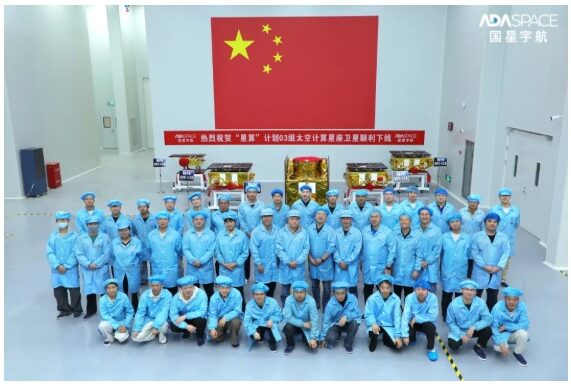
Guo Xing Aerospace has successfully completed the third group of satellites for its ambitious ‘Star Compute’ project. These five satellites, developed in-house by the company, are ready for launch. Once in orbit, they will join the existing satellites from the first and second groups, forming a nascent network for space-based computing.
The Star Compute plan, unveiled at the 2024 Wuzhen World Digital Economy Summit, aims to establish a large-scale, next-generation computing network by integrating 2,800 satellites. This significant endeavor, initiated by Guo Xing Aerospace founder Dr. Lu Chuan, has already seen early successes.
First Steps Towards a Cosmic Computing Network
The first group of Star Compute satellites was successfully launched on May 14, 2025, marking the world’s first space-based computing constellation. This achievement represents a critical milestone in realizing the company’s vision of building a decentralized global computing infrastructure in space.
The creation of such a network involves deploying a substantial number of satellites into orbit, each equipped with significant computing power. These satellites will be capable of processing data directly in space, reducing reliance on ground stations and enabling faster information transfer. This architecture unlocks new possibilities for applications in artificial intelligence, big data analytics, communication, and other advanced technological fields.
Technological Advantages and Future Prospects
Guo Xing Aerospace emphasizes its commitment to in-house development, which allows for stringent quality control and continuous innovation in its satellite designs. The third group of satellites, like its predecessors, is a product of the company’s own manufacturing processes, ensuring high standards of execution.
The deployment of subsequent satellite groups will gradually expand the coverage and capacity of the Star Compute network. Ultimately, the integration of 2,800 satellites is intended to create a powerful space computing resource available to users worldwide. This could fundamentally alter how computing power is accessed, making it more readily available, reliable, and scalable.
Potential Application Areas
- Artificial Intelligence: Processing data for training AI models directly in orbit.
- Data Analysis: Rapid processing of vast amounts of information gathered from satellite sensors, Earth-based sources, or other spacecraft.
- Communications: Enhancing global connectivity, particularly in remote or underserved regions.
- Navigation and Monitoring: Improving the accuracy and speed of data processing for navigation systems and Earth observation.
The realization of the Star Compute plan underscores the rapid advancements in space technology and the drive to establish new digital infrastructure beyond Earth. Guo Xing Aerospace is making a substantial contribution to this evolution by implementing innovative solutions and pushing the boundaries of what is achievable.
Source: ithome.com