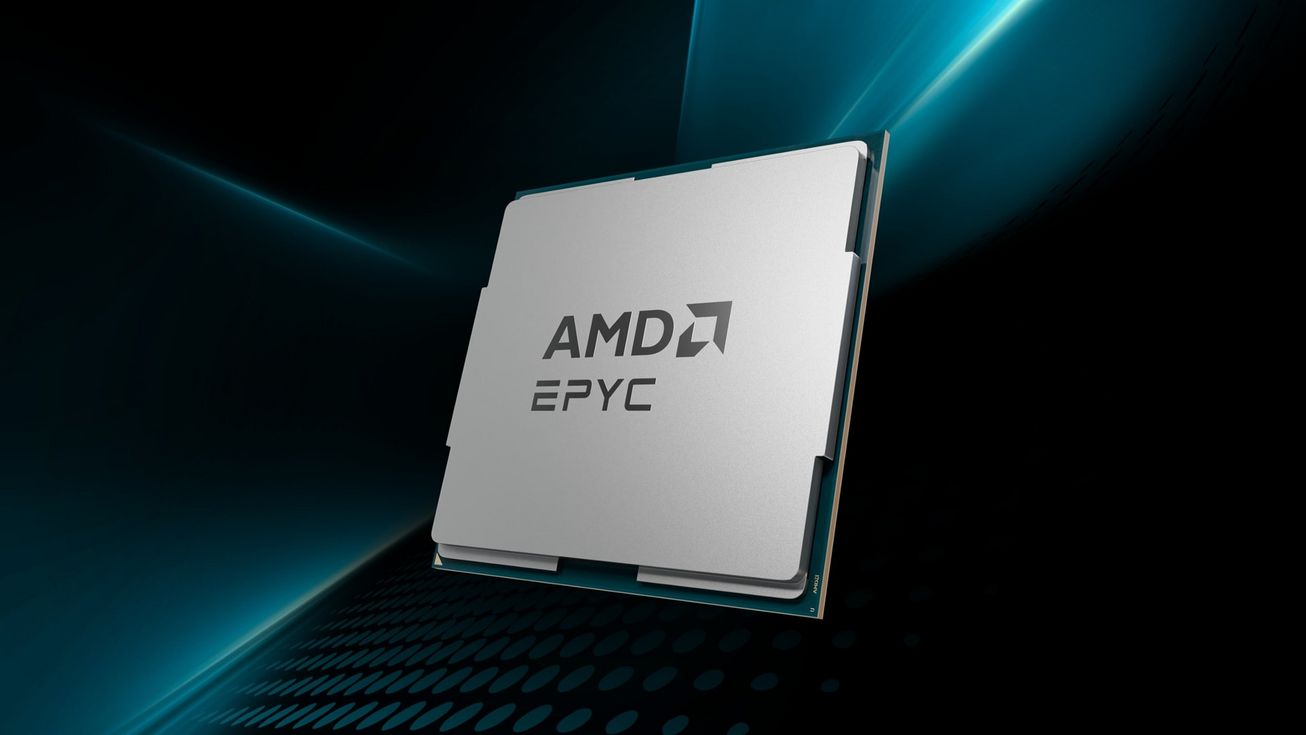
AMD has announced that its 5th Gen AMD EPYC processors are powering Google Cloud’s new TPU 8tx, marking the first cloud-based Tensor Processing Unit (TPU) system to feature hardware-accelerated computation encryption. This enhanced collaboration between AMD and Google Cloud aims to deliver robust AI acceleration, combining the performance of EPYC CPUs with Google’s AI capabilities and AMD’s security features like AMD Infinity Guard. The integration allows enterprises to deploy sensitive AI workloads, including inference, fine-tuning, and reinforcement learning, with a heightened level of security.
Leveraging Google Cloud’s confidential computing architecture on TPU 8tx, supported by 5th Gen AMD EPYC host processors, organizations can now run their most sensitive AI workloads in the cloud without compromising data protection.
This development solidifies the role of AMD EPYC processors as a foundational element for accelerated AI infrastructure. In systems relying on GPUs and specialized accelerators, AMD EPYC CPUs act as the central processing nodes, responsible for data preparation, task orchestration, and managing communication with accelerators. With the TPU 8tx, AMD and Google Cloud are uniting these capabilities with hardware-level security, addressing a critical demand for data protection in production AI solutions.
Confidential AI with AMD EPYC Processors
Within the TPU 8tx systems, 5th Gen AMD EPYC processors manage workload orchestration, data preparation, and high-performance communication with the TPU accelerators. The system utilizes AMD Secure Encrypted Virtualization (SEV) capabilities within the EPYC processors. This, in conjunction with the TPUs, extends confidential computing protection beyond the CPU to attached accelerators, helping to safeguard sensitive data as it moves between components. By verifying the identity and security configuration of accelerators before granting them direct access to protected memory, the system ensures that customer requests, model weights, and intermediate data remain encrypted in CPU memory and during transit between the host and accelerators. This hardware-level isolation during accelerator task execution allows enterprises to confidently utilize confidential information in reasoning and agent-based AI applications.
AMD EPYC processors also underpin Google Cloud’s broader confidential computing portfolio. AMD SEV technologies already protect workloads in Confidential VMs, Confidential GKE, Confidential Space, Confidential Managed Service for Apache Spark, and Confidential Dataflow. The TPU 8tx initiative extends this collaboration to accelerate confidential AI computing.
A Proven Foundation for AI Compute
The choice of CPU remains critical for the performance and deployment of AI systems, whether developed by hyperscalers, leading research labs, or model providers. Accelerators rely on host CPUs for data delivery, task scheduling, and connecting workloads to applications and services. AMD EPYC processors are the chosen host compute solution for over 10 leading hyperscalers and top AI labs, supporting both GPU and specialized ASIC accelerators.
AMD EPYC processors back this role in systems utilizing AMD Instinct GPUs, NVIDIA GPUs, and custom ASICs. This versatility provides customers with a validated CPU platform for a variety of accelerators, supported by the established x86 software ecosystem.
AMD and Google Cloud: A Long-Standing Collaboration
AMD and Google Cloud have a multi-generational partnership spanning numerous EPYC processor generations. This collaboration has supported general-purpose, compute-intensive, storage-intensive, and accelerated workloads, leading to Google Cloud’s current Compute Engine virtual machines like C4D, N4D, H4D, Z4D, and G4. The companies have also collaborated for years on enterprise-grade security technologies, including in-depth security firmware validations by Google security experts on AMD processors.
Through the TPU 8tx, this expanded partnership empowers enterprises to deploy advanced reasoning and agent-based AI workloads in production without compromising data security.