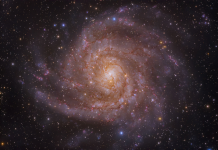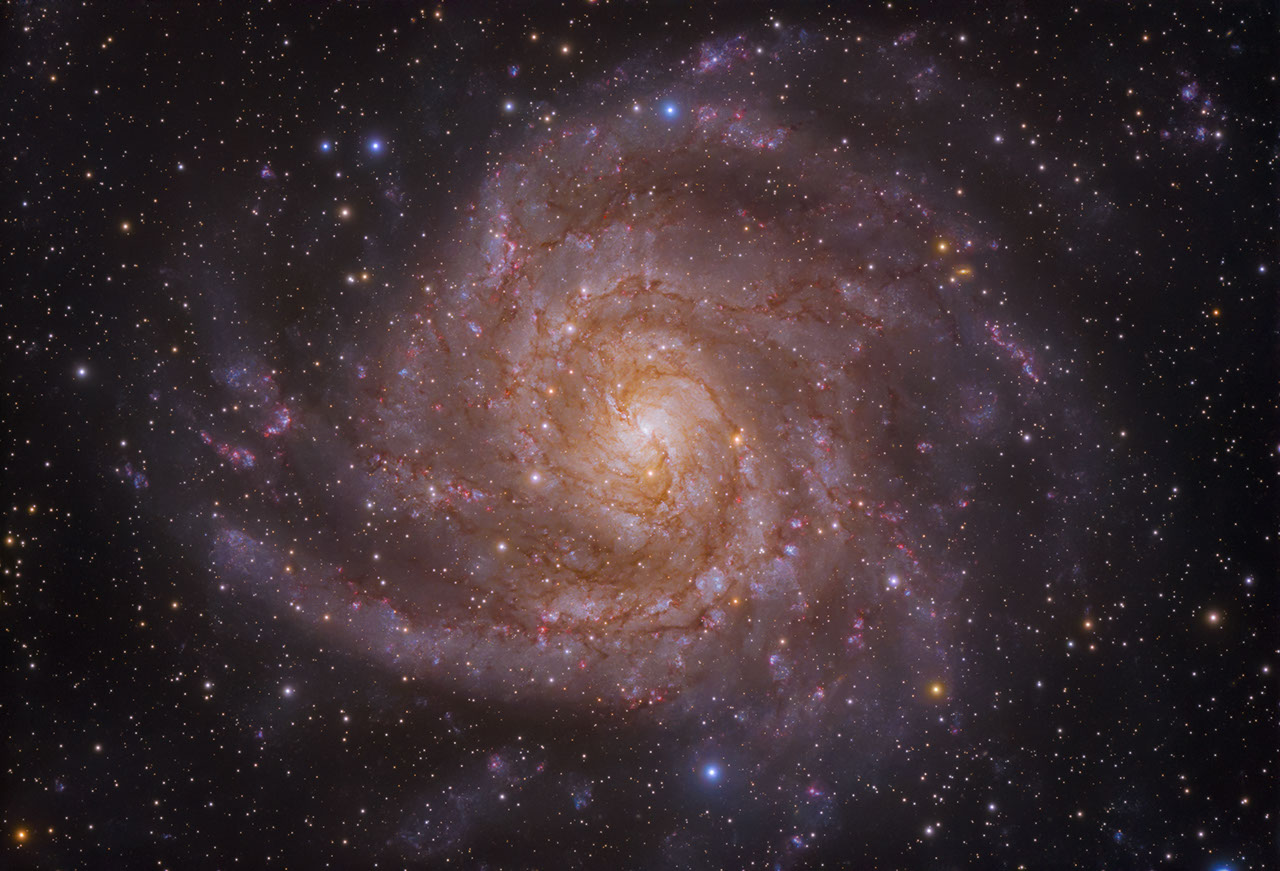
The NASA/ESA Hubble Space Telescope has peered through the obscuring veil of dust and gas in our own Milky Way to reveal new details about the spiral galaxy IC 342. Located a mere 10 million light-years away, IC 342, often dubbed the ‘Hidden Galaxy,’ is one of our closest galactic neighbors. Recent observations with Hubble are offering unprecedented insights into its structure, star formation processes, and the crucial role magnetic fields play in shaping its prominent spiral arms.
IC 342: A Nearby Neighbor Shrouded in Dust
Galaxy IC 342 (also cataloged as Caldwell 5) stands out as a significant member of the IC 342/Maffei group of galaxies. Its relative proximity to our Milky Way makes it a prime target for astronomical study. However, despite its intrinsic brightness, IC 342 has historically been challenging to observe in detail. A dense foreground of gas, dust, and stars within the plane of our own galaxy significantly hinders its visibility. This cosmic curtain has made precise distance measurements and characterization difficult, even leading to erroneous theories in the past, such as its supposed ejection from our Local Group.
New Discoveries: Dust, Stars, and Magnetic Fields
Through detailed observations facilitated by the Hubble Space Telescope, astronomers are making significant strides in understanding IC 342. Researchers have identified that the galaxy possesses its own internal dust clouds, which periodically block the radiation emitted by hydrogen gases. This observation is a strong indicator of active star formation within the galaxy, pointing to the presence of bright, young stars. Furthermore, the study of magnetic fields within IC 342 is poised to address a fundamental question in modern astrophysics: how do the iconic spiral arms of galaxies form? Investigating IC 342’s magnetic field could provide crucial clues to unraveling this cosmic phenomenon.
Source: NASA