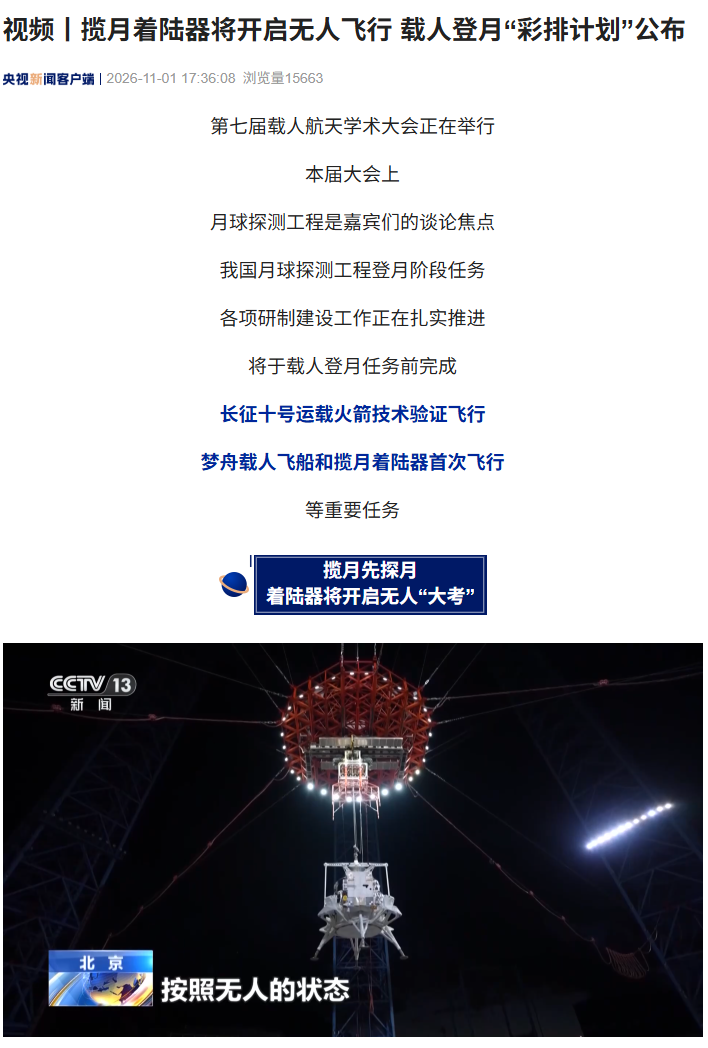
China is making significant strides in its ambitious lunar exploration program, with key development milestones for its crewed moon landing mission moving forward. A crucial unmanned test flight of the Lanyue lander is slated to occur before the first crewed mission, serving as a vital “dress rehearsal” for the historic endeavor. This announcement was made during the ongoing seventh Academic Conference on Manned Spaceflight, where lunar exploration was a central topic.
Phased Approach to Lunar Missions
The overall plan for China’s crewed moon landing involves a series of rigorous tests and validations. The mission will utilize the new Long March 10 rocket, which is designed to carry the payload to lunar orbit. According to the established plan, two Long March 10 rockets will be used sequentially. The first will launch the Lanyue lander, and the second will launch the Mengzhou crewed spacecraft. These two components will then rendezvous and dock in lunar orbit.
The Mengzhou spacecraft is designed to transport up to three astronauts between Earth and lunar orbit. For the surface mission, two astronauts will descend to the moon’s surface using the Lanyue lander, while the third astronaut remains in orbit aboard the Mengzhou spacecraft. This staged approach ensures that critical systems are tested and verified before human lives are on the line.
Emphasis on Unmanned Verification
Wang Xiang, Deputy Chief Designer of China’s Manned Space Engineering and Chief Designer of Lunar Exploration, highlighted the guiding principles behind the mission’s planning. “One principle is to utilize the space station for verification in near-Earth orbit as much as possible for tasks that will eventually be performed in lunar orbit,” he explained. “The second principle is to conduct unmanned flights as much as possible for tasks that will eventually be crewed.”
This strategy involves using a near-Earth version of the Long March 10 rocket to launch a near-Earth version of the Mengzhou spacecraft for space station missions. This allows for the validation of the rocket’s fundamental technologies and the critical re-entry and return aspects of the spacecraft. Subsequently, the lunar-mission variant of the Long March 10 will launch the lunar mission variant of the Mengzhou spacecraft to execute the moon landing.
Lanyue Lander’s Role in Unmanned Flight
The upcoming unmanned flight of the Lanyue lander is designed to gather essential environmental data directly from the lunar surface. This includes real-time measurements of temperature, dust conditions, and the lander’s own performance in the lunar environment. Wang Xiang emphasized the comprehensive nature of this unmanned test:
“Under unmanned conditions, we aim to verify the entire process of the crewed mission, including launch, orbiting the moon, rendezvous and docking with the Mengzhou spacecraft, landing on the surface, staying on the surface, lifting off, and re-docking with the Mengzhou spacecraft. We need to verify all key technologies as thoroughly as possible to ensure the safety and reliability of the crewed flight.”
Seeking Payload Opportunities for Technological Advancement
To maximize the benefits of the unmanned Lanyue lander mission, China’s Manned Space Engineering Office announced on October 22nd a call for proposals for active payloads. This initiative encourages space science exploration, testing of new aerospace technologies, and fostering high-level scientific and technical talent. The goal is to enhance the overall effectiveness of the mission by leveraging the Lanyue lander’s available resources for supplementary experiments and technological demonstrations.
Ambition to Land by 2030
China’s crewed lunar exploration program aims to achieve the country’s first human landing on the moon before 2030. The mission objectives include conducting scientific investigations and relevant technological experiments. Key technologies to be mastered are crewed Earth-moon return, short-term lunar surface stays, and human-machine joint exploration. The program seeks to accomplish multifaceted tasks such as landing, roving, sampling, researching, and returning.
With the unmanned lunar orbit verification mission drawing nearer, China’s next steps in lunar exploration are transitioning from conceptualization to tangible reality, signaling a new era in the nation’s space ambitions.