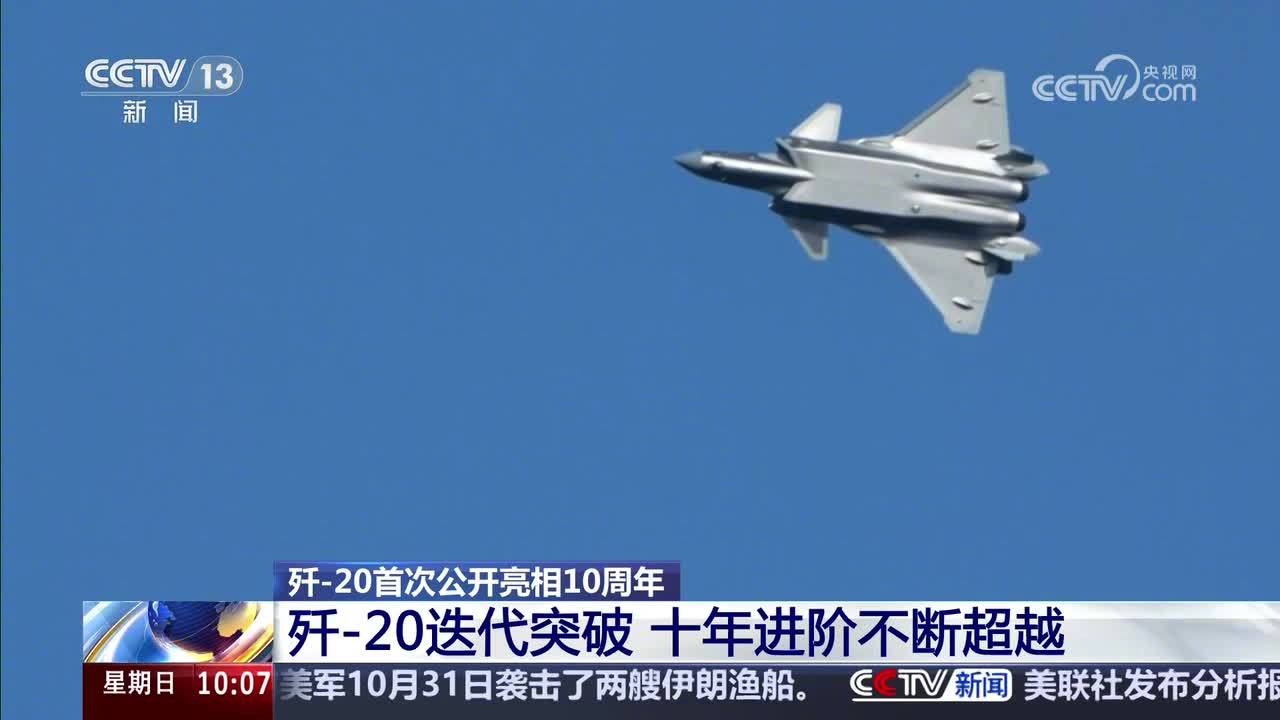
A decade ago, on November 1, 2016, the J-20, China’s new-generation stealth fighter jet, made its public debut at the 11th China Airshow. Today, marking the 10th anniversary of this significant unveiling, CCTV News has provided an in-depth look at the core details behind the J-20’s iterative development, particularly its groundbreaking adoption of domestically produced engines.
The Heart of the Matter: Domestic Engines
Often referred to as the “pearl on the crown of industry,” aviation engines are the most critical component of any fighter jet. The 2021 Zhuhai Airshow marked a pivotal moment with the public appearance of the J-20 equipped with Chinese-made engines, signifying a major breakthrough after a decade of development.
According to military observer Wang Mingliang, the integration of domestic engines has resulted in substantially stronger power. This translates to enhanced capabilities for the aircraft, including higher speeds, the ability to sustain supersonic cruise for extended periods, and greater maneuverability under high G-forces. Crucially, it ensures the autonomy and control of its power systems. Furthermore, this achievement lays a foundational groundwork for the development of even more advanced fighter jets in the future.
J-20A: Refinements for Air Superiority
Building upon the domestic engine upgrade, the single-seat variant has evolved into the J-20A. This version boasts optimizations in its aerodynamic design and avionics sensor systems, with a particular focus on high-speed air combat dominance. Two key enhancements stand out:
- The rear section of the J-20A’s cockpit, which previously had a more pronounced angle where it joined the fuselage, has been redesigned. A raised section now creates a smoother curve where the cockpit meets the aircraft’s body. This aerodynamic refinement is undoubtedly aimed at further improving performance and increasing flight speed.
- The J-20’s nose featured a prominent protrusion underneath. Originally composed of six lens elements, this component has now been upgraded to incorporate eight. This enhancement significantly boosts its detection capabilities, equipping the J-20A with more robust networked, systemic, and anti-stealth combat functionalities.
J-20S: The Two-Seat Variant and Evolving Combat Roles
The emergence of the two-seat J-20S variant represents another significant leap, expanding the operational paradigms for fifth-generation fighters. As the world’s only publicly revealed two-seat stealth fifth-generation fighter, the J-20S breaks away from the mission limitations inherent in single-seat designs.
In the J-20S, the pilot in the front cockpit focuses on engaging the enemy and tactical flight control, while the operator in the rear seat manages tasks such as commanding unmanned drone formations, overall situational awareness, intelligent coordination, and planning for ground and sea missions. This configuration is exceptionally well-suited for future combat scenarios characterized by increased intelligence, unmanned systems, and networked operations.
Wang Mingliang believes this signifies that the J-20 is no longer just a traditional air superiority fighter. It may be undertaking a role of system control. The system operator in the rear seat, in addition to managing the aircraft’s own detection and communication systems, will be responsible for providing intelligence, target designation, allocating combat missions, and coordinating system-wide operations for other aircraft. It can be described as a commander of a new type of aerial combat system.
Integration into a Complete Combat System
Even the most advanced equipment can only achieve its full potential when integrated into a comprehensive combat system and put into practice. Today, the J-20 operates in conjunction with other key domestically produced aircraft, including the KJ series early warning aircraft, the HY-20 tanker, and fighter jets like the J-16 and J-10C. This synergy forms a complete aerial offense and defense combat chain.
With tiered coordination and complementary roles among various aircraft types, network-based early warning systems providing all-domain sensing, and aerial refueling extending operational range, a mature combat system with integrated offense and defense capabilities has been established, capable of bridging both near and far engagements.
A Legacy of Innovation
The J-20, a fifth-generation air superiority fighter developed independently by China, possesses high stealth, situational awareness, and maneuverability. It is the latest generation of twin-engine heavy stealth fighters. Currently, the Chinese Air Force operates a fleet of over 300 J-20s, making it the largest heavy stealth fighter force globally. The first flight of the J-20, China’s inaugural stealth fighter, was revealed for the first time in October last year. The aircraft successfully completed its maiden flight on the afternoon of January 11, 2011, at 1:11 PM, marking the end of an era where China lacked stealth fighter capabilities.