Developer Divyansh Agrawal has introduced Qwenputer, an experimental AI model that directly embeds a 32-bit RISC-V processor into its architecture. This innovative integration allows large language models (LLMs) to perform complex calculations and execute programs without relying on external tools like Python interpreters.
An Innovative Approach to AI Computation
Traditional large language models, built on the principle of predicting the next token, often struggle with precise mathematical operations, especially with large numbers or lengthy calculation chains. To overcome these limitations, developers typically integrate external tools such as calculators or code interpreters. Qwenputer offers a radical new approach: embedding central processing unit (CPU) functionality directly within the model itself.
Based on the Qwen3.5-4B model, Qwenputer utilizes the RISC-V RV32IM instruction set and its extensions, which have been ‘compiled’ and integrated into the neural network’s weights. The internal state of Qwen3.5 serves as the random-access memory (RAM), enabling the model to execute arithmetic operations, conditional branching, and even run programs.

Significant Improvement in Computational Accuracy
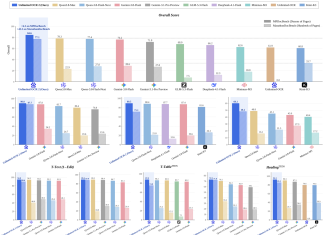
Testing of Qwenputer has yielded impressive results compared to the original Qwen3.5-4B model:
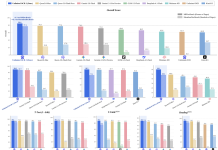
- Multiplication of large numbers: Accuracy increased from 55% to 97.5%.
- Division of large numbers: Accuracy improved from 72.5% to 97.5%.
- Complex operations (multiplication/division): Achieved 100% accuracy.
On the standard NUPA benchmark for long integer arithmetic, Qwenputer demonstrated 100% accuracy, while the standard model achieved only 48.6%. According to the developer, the integrated CPU successfully passed official RISC-V tests, executing approximately 18 million instructions without errors.
Experimental File System and Long-Term Memory
Qwenputer also features an experimental ‘in-model file system.’ This system allows for the storage of up to 512 files, totaling around 53 thousand tokens, within the DeltaNet state. Information stored this way can be loaded in subsequent dialogues, significantly enhancing the model’s contextual memory.
In tests where information from previous dialogues was utilized, Qwenputer’s response accuracy reached 90%. For comparison, a model receiving the same information as direct input showed only 30% accuracy.
Challenges and Trade-offs
Despite its significant advantages, Qwenputer also has its drawbacks:
- Increased model size: The model’s size has grown to approximately 18.8 GB, nearly double the original version.
- Reduced speed: Each CPU instruction requires the generation of multiple tokens, which can increase processing time from milliseconds to several seconds.
- Specialized requirements: The model requires custom drivers to operate, unlike standard LLMs that can be downloaded and used directly.
Availability and Future
The Qwenputer project has been published on Hugging Face and GitHub, making it accessible to the wider developer community. The model can run on a single GPU with 24 GB of video memory.
This development opens new horizons for creating more powerful and self-sufficient artificial intelligence models capable of handling complex tasks without external assistance.