A new study published in the prestigious Proceedings of the National Academy of Sciences (PNAS) is challenging conventional understanding of star and planetary system evolution. A team led by Professor Qian Shengbang from the School of Physics and Astronomy at Yunnan University has identified three exoplanets that have remarkably survived orbital paths where they were predicted to be engulfed by their expanding parent stars.
Giant Stars and Their Victims
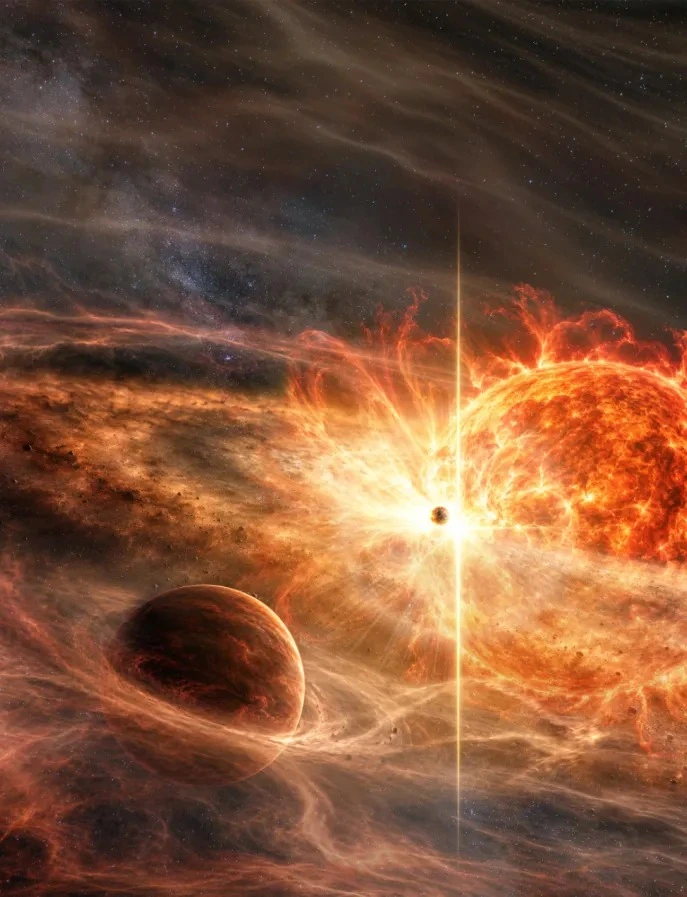
According to prevailing scientific theory, stars similar to our Sun primarily generate energy through the nuclear fusion of hydrogen in their cores. As hydrogen reserves deplete, the star begins to expand significantly, transforming into a red giant. During this phase, its volume can increase hundreds of thousands or even millions of times.
Planets situated too close to a star at this stage typically face two possible fates: being consumed by the star’s inflated atmosphere or gradually spiraling inward due to tidal forces, ultimately falling into the star.
Unlikely Survivors
However, the three objects in Qian Shengbang’s team’s study—planets orbiting the stars 24 Boo, HD 12648, and TYC 4282-605-1—were found to be in a zone where, according to theory, they should have been absorbed. Using satellite data, researchers initially detected subtle changes in the brightness of these stars, indicative of them entering the helium-burning stage in their cores. This suggests the stars had already passed through their red giant phase.
Subsequently, the scientists employed stellar evolution models to reconstruct the past expansion scales of these host stars. By comparing this data with the planets’ current orbits, they discovered that the orbital radii of the three planets fall within the theoretical zone that should have led to their engulfment. Despite this, the planets continue to exist.
Not Coincidence, But a Law?
“If we had found only one such planet, it could have been explained as a fluke. But now that we have found three such ‘lucky survivors,’ it suggests this is not an isolated incident, and there might be a common physical mechanism at play,” stated Qian Shengbang in an interview.
This discovery compels a re-evaluation of established notions that planets too close to a star struggle to survive the red giant expansion phase. The interaction between a star and its planet in the later stages of their existence may be more complex than current models account for.
Implications for Our Solar System
The findings also prompt reflection on the long-term evolution of our own Solar System. Qian Shengbang points out that in several billion years, our Sun is also expected to enter its red giant phase. Under traditional theories, Earth would inevitably be consumed by the expanding Sun. However, the new data suggests that the future fate of Earth and other planets in our Solar System might be less predictable than previously modeled.
Institutions involved in the research include Yunnan University and the Pulkovo Observatory of the Chinese Academy of Sciences.