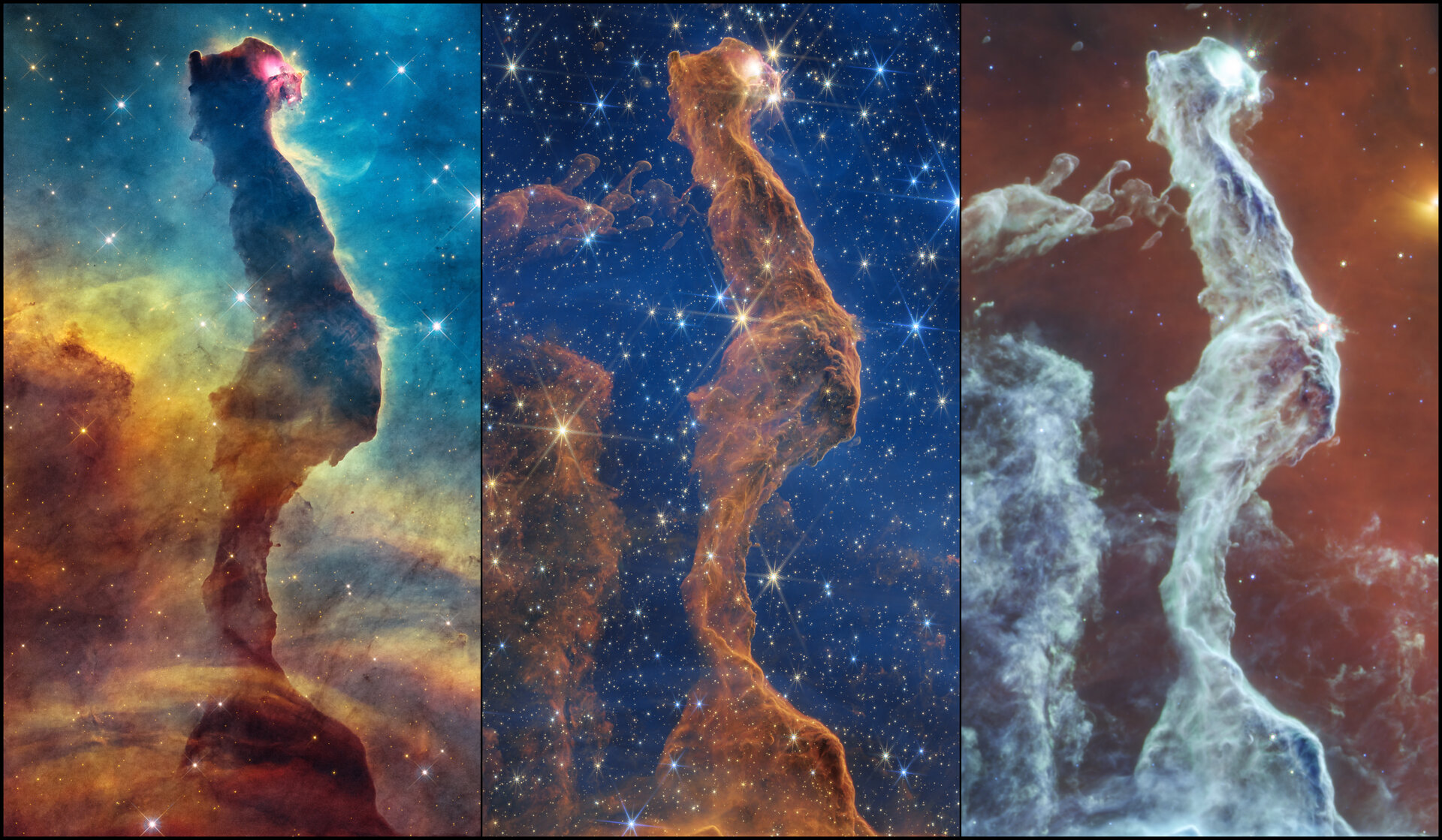
In a celestial spectacle, the iconic Cat’s Head Nebula, a dynamic star-forming region within the vast Carina Nebula, has been captured in breathtaking new imagery by NASA’s Hubble and James Webb Space Telescopes. Located approximately 7,500 light-years away, this eerie, dust-sculpted formation offers a unique glimpse into the ‘magical’ processes that birth stars, with each telescope revealing different layers of its complexity.
A Tale of Two Telescopes: Contrasting Views of a Cosmic Feline
The Cat’s Head Nebula, so nicknamed for its striking resemblance to a feline with its back to the viewer and a glowing ‘eye,’ is a testament to the powerful forces shaping our universe. The Carina Nebula, a colossal cloud of gas and dust, is a fertile ground for stellar nurseries. Intense ultraviolet radiation and stellar winds from massive stars within this nebula relentlessly sculpt and erode the surrounding material. The denser pockets, like those forming the Cat’s Head, resist this erosion, creating these magnificent structures over eons.
Hubble’s keen eye, observing in visible light, portrays the nebula as a dark, elongated pillar of dust. Its signature ‘red eye’ is thought to be a young star still partially enshrouded in cosmic dust. A luminous, yellow-hued ridge along the right edge of the pillar hints at gas being illuminated and ionized by nearby stars, a process known as photoevaporation, where energetic light literally evaporates the gas.
Peering Through Dust: Webb’s Infrared Revelation
James Webb, with its unparalleled infrared capabilities, pierces through the dusty veil that obscures so much of the cosmos. In its near-infrared view, the nebula’s structure becomes more transparent, revealing intricate surface details. Delicate wisps of dust and gas, exquisitely sculpted by stellar radiation, are visible on the nebula’s left. While Hubble’s prominent optical nebulosity fades in Webb’s infrared gaze, the space for a dense population of stars, appearing blue and yellow, emerges. Even in this infrared light, some stars remain partially hidden by dust, while the prominent ‘eye’ clearly marks an embedded star. Intriguingly, a faint jet-like feature near the nebula’s ‘belly’ suggests the presence of an active young star expelling material.
Webb’s mid-infrared observations further unveil the nebula’s chemical composition. Emission from warm dust and carbon-based molecules, including polycyclic aromatic hydrocarbons (PAHs), outlines intricate structures in shades of blue and green. These molecules, energized by starlight, provide clues about the conditions within this star-forming region. The mid-infrared view also highlights delicate globules and strands to the pillar’s left, as well as a bright light source to the right, hinting at further celestial activity.