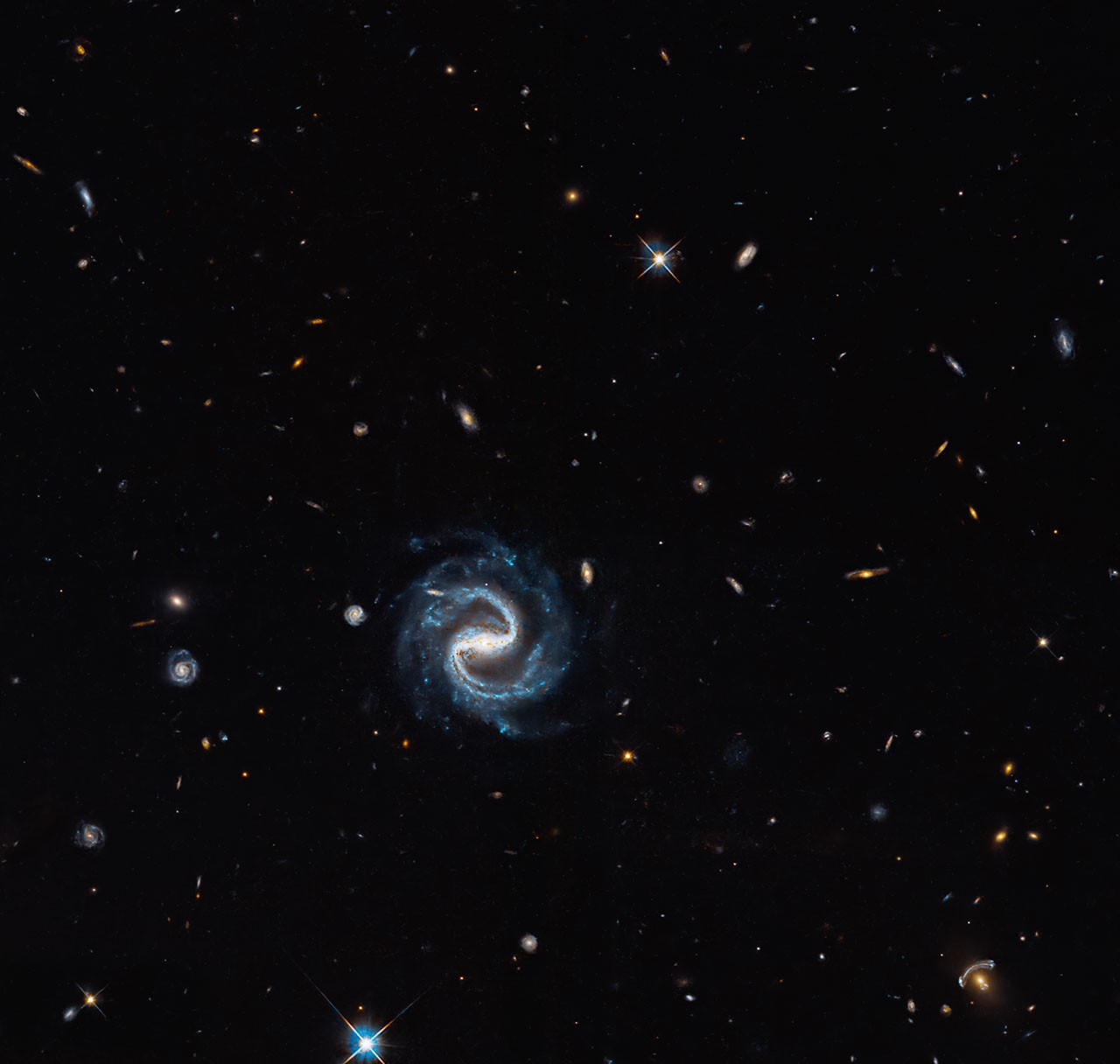
The Hubble Space Telescope is playing a crucial role in preparing for the launch of the future Nancy Grace Roman Space Telescope. Recent Hubble observations, which captured the phenomenon of gravitational lensing, will help scientists better understand the distribution of dark matter in the universe and prepare for analyzing the data that Roman will provide.
Gravitational Lenses: Cosmic Light Distortions
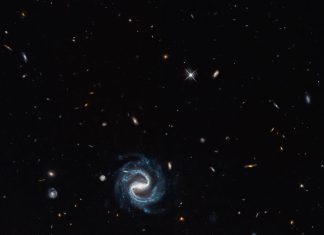
An image captured by Hubble showcases a striking example of gravitational lensing. This phenomenon occurs when a massive object, such as a galaxy, warps the fabric of spacetime around it. Light from a more distant object passing nearby is bent, distorted, and magnified, as if viewed through a giant cosmic lens. The image displays a spiral galaxy, but the real treasure lies in the gravitational lens in the lower right corner. Here, light from a background galaxy approximately 8 billion light-years away is warped and magnified by the gravity of a closer elliptical galaxy (about 4.5 billion light-years away). This effect creates arcs, with one being a large, prominent arc and the other a smaller, inverted version of the same background galaxy. This configuration is known as an arc-counterarc pair.
Unveiling Dark Matter and Telescope Collaboration
Studying the distortions of the background galaxy allows scientists to determine the mass of the lensing object and, crucially, estimate the amount of dark matter it contains. Dark matter is an invisible substance that constitutes the vast majority of the universe’s mass, and its study is a key objective of modern astrophysics. Hubble, which primarily observes in visible and ultraviolet light, can provide high-resolution images of individual objects. In contrast, the future Nancy Grace Roman Space Telescope will operate mainly in the infrared spectrum and boast a significantly wider field of view, enabling it to survey larger areas of the sky. This means Roman will be able to detect many more such gravitational lenses. Images like this demonstrate how Hubble and Roman will work in tandem to create a more complete picture of the cosmos. Scientists are already using Hubble’s sharp images to build computer models that will aid in analyzing the data Roman collects, particularly concerning distortions caused by dark matter.