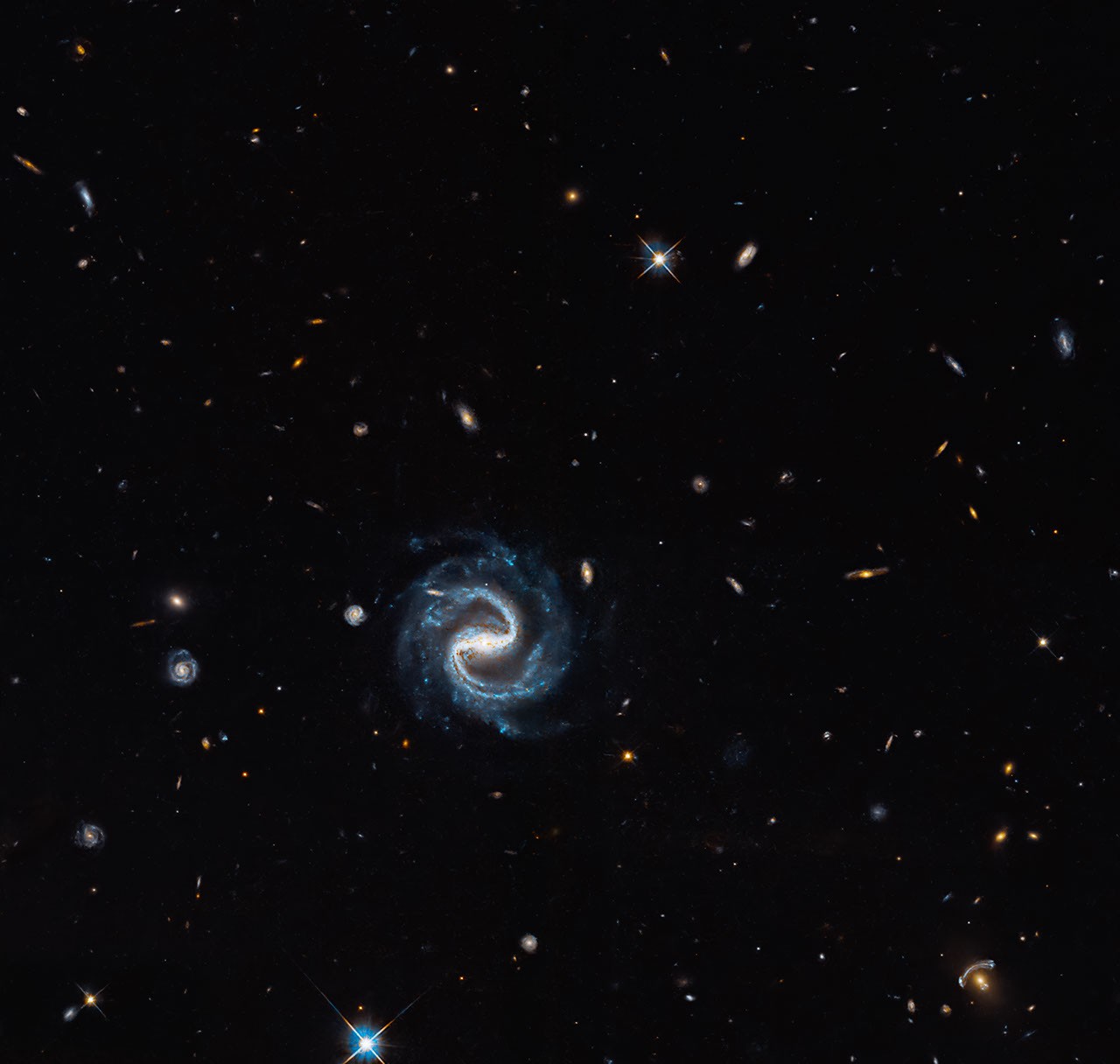
NASA’s Hubble Space Telescope has captured stunning images of gravitational lenses, acting as cosmic signposts that will guide the upcoming Nancy Grace Roman Space Telescope in its quest to understand dark matter and the evolution of the universe. These natural magnifying glasses, created by the immense gravity of galaxies, distort and amplify light from more distant objects, offering a unique peek into the cosmos and providing invaluable data for future observations.
Unveiling the Universe with Gravitational Lenses
Gravitational lensing occurs when a massive object, like a galaxy, warps the fabric of spacetime around it. As light from a more distant galaxy travels past this warped region, it bends and distorts, much like light passing through a glass lens. This phenomenon can magnify and even create multiple images of the background galaxy. NASA’s Hubble Space Telescope has been instrumental in identifying and studying these cosmic lenses. One striking example showcases a foreground elliptical galaxy, approximately 4.5 billion light-years away, acting as a lens for a background galaxy situated about 8 billion light-years distant. The light from the background galaxy is bent into spectacular arcs around the foreground galaxy, appearing as a distinct arc and a smaller, flipped counterpart – a configuration known as an arc-counterarc pair. This observation is crucial because the degree of distortion directly reveals the mass of the foreground galaxy, including its elusive dark matter content.
Hubble’s Role in Preparing for the Roman Telescope
The mass of the foreground galaxy, amplified by gravitational lensing, provides scientists with a critical tool for studying dark matter, the invisible substance that constitutes the majority of mass in the universe. By analyzing the distortion of the background galaxy’s light, researchers can precisely calculate the mass of the foreground galaxy and, consequently, the amount of dark matter it contains. While Hubble can observe these gravitational lenses one at a time, the Nancy Grace Roman Space Telescope, with its significantly wider field of view, will be able to survey a much larger sample of these phenomena. Hubble’s high-resolution images are currently being used to develop sophisticated computer models that will help astronomers analyze the vast amounts of data Roman is expected to collect. Furthermore, Hubble will serve as a follow-up observatory, providing detailed looks at particularly interesting lenses that Roman identifies, ensuring a comprehensive understanding of these cosmic marvels.
Source: NASA