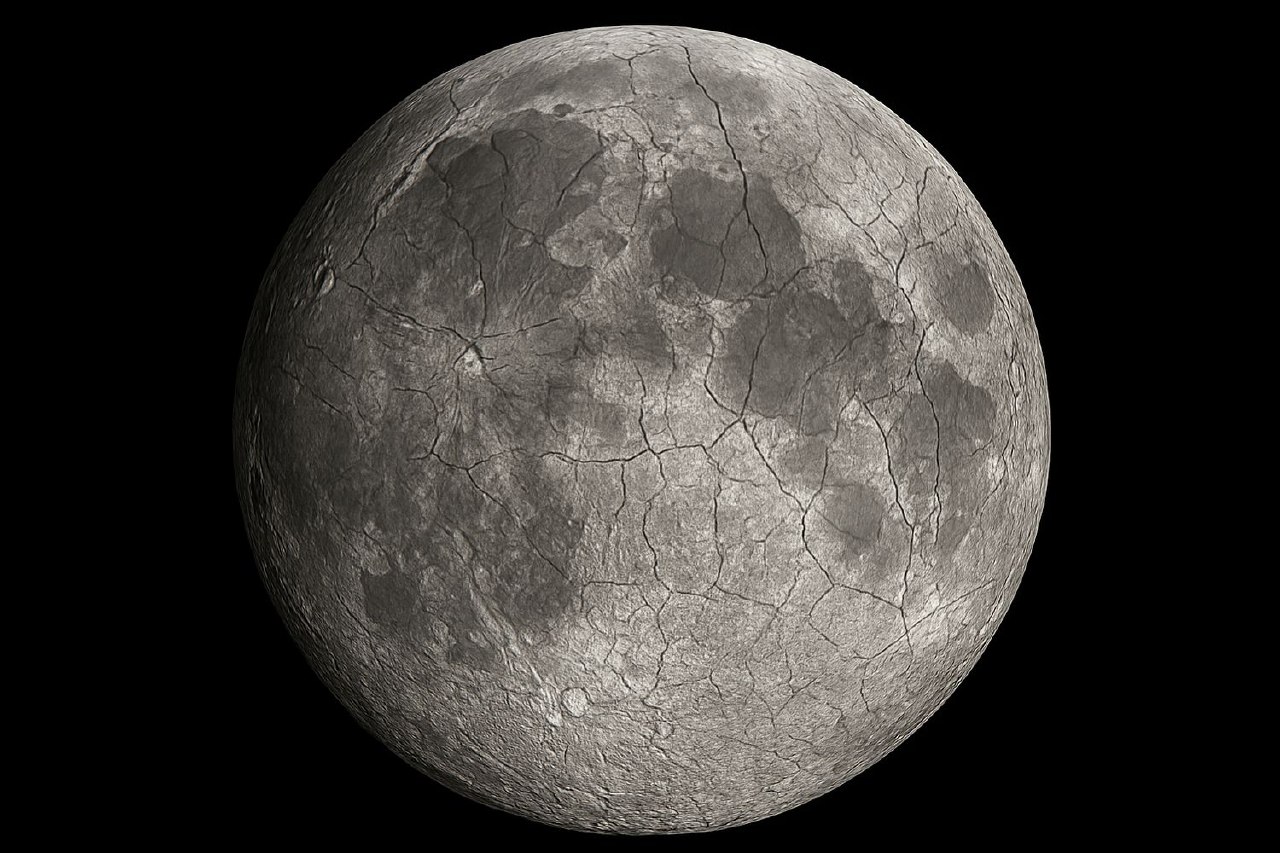
Our natural satellite, the Moon, is gradually decreasing in size. New research, based on images from the Lunar Reconnaissance Orbiter (LRO), has uncovered over 10,000 new cracks and faults on its surface. These geological features indicate that the Moon continues to contract due to the cooling of its internal core, a process that has reduced its radius by approximately 45 meters over the last 400 to 800 million years.

Causes of Lunar Contraction
Scientists believe the Moon formed approximately 4.5 billion years ago following a massive impact between the Earth and another celestial body. Since then, its interior has been gradually cooling, causing its volume to shrink. This contraction leads to the formation of new faults and the widening of existing ones on the Moon’s surface. These features are known as “lobate scarps” – long, curved structures that arise from crustal shortening.

New Data and Geological Features
Analysis of images captured by the Lunar Reconnaissance Orbiter Camera (LROC) has identified not only lobate scarps but also smaller “wrinkles” on lunar plains, known as mare ridges. In total, over 10,000 such young geological formations have been identified, a significantly higher number than scientists had anticipated. Researchers note that, unlike Earth, the Moon does not have tectonic plates; its outer shell is a single, unbroken piece, fractured only by faults.

A map of global lunar faults reveals that they are distributed across the entire surface, rather than being concentrated solely at plate boundaries. Areas with fewer fissures have been found to have thicker crusts, suggesting greater stability and indicating that a significant portion of the deformation occurred later in the Moon’s history.